
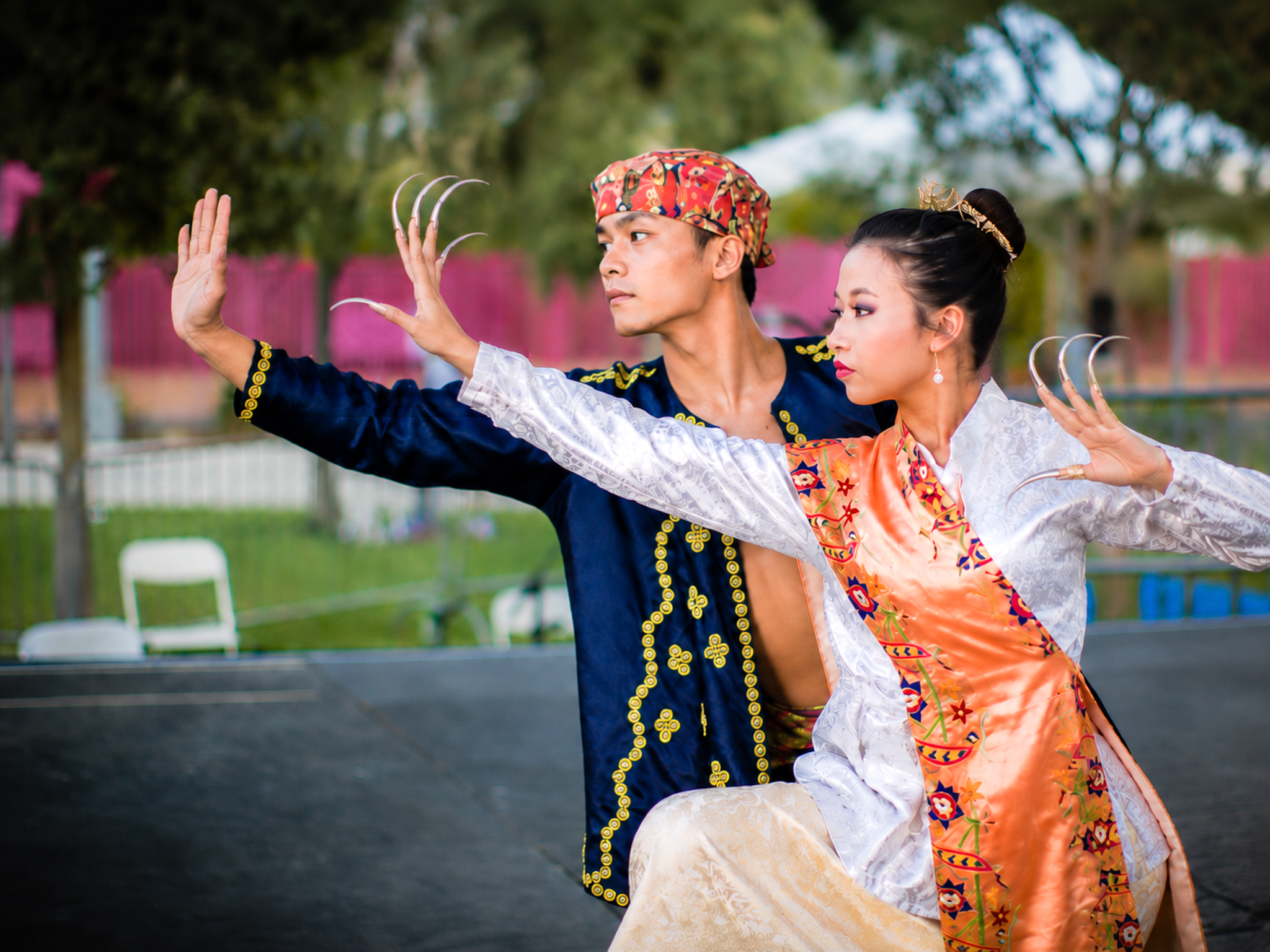
Summary. Pangalay, often called the “fingernail dance,” is a flowing dance traditionally performed by the Tausug people of the southern Philippines.[1][2][4] It is known for flowing, wave-like movement in the hands and arms, with fine control in the hands, fingers, shoulders, elbows, and wrists, often made more visible by long metal fingernails called janggay.[1][3] Pangalay is traditionally performed at weddings and other festive community events, and it is often presented as a link to other Asian dance traditions.[2][4] Those comparisons connect it with Indian, Javanese, Thai, Burmese, and Cambodian classical styles.[3][5]
Quick facts
| Origin/Region | Pangalay is strongly associated with the Sulu Archipelago in the southern Philippines. It is traditionally performed by Tausug communities and is also associated with Samal, Badjao, and Jama Mapun peoples in Sulu and Tawi-Tawi, island groups in the same southern region.[1][2][4] |
| Music/Ensemble | Pangalay may be danced with kulintangan, a gong-chime ensemble or gong-chime musical tradition, as well as Asian or Western music. In Sabah Suluk practice, meaning Suluk practice in Sabah across the sea from Sulu, the song “Tiyula Itum” can serve as an anthemic stand-in when live kulintangan is not used.[3][6] |
| Movement quality | The dance is commonly described as slow, refined, meditative, elegant, and sustained rather than sharp or percussive. It gives an impression of calm control instead of attack.[7][3] |
| Costume | A signature adornment is the janggay, the long metal fingernails worn by dancers. They intensify the visual effect of finger and hand movement. The audience can see the dance language more clearly.[1][3] |
| Typical context | Pangalay is traditionally performed at weddings and other festive community events. It is tied to celebration and shared public occasions.[2][4] |
| Difficulty | The dance demands steady control of posture, balance, and coordination. Dancers keep a slightly bent torso, flexed knees, and a subtle springing lightness. Expression is carried mainly through the arms, hands, fingers, shoulders, elbows, and wrists rather than through extra hip and torso movement.[3] |
| Related traditions | Related dance traditions include Sama and Bajau igal and the regional form pamansak. They share some movements with pangalay while keeping their own community settings and styles.[8][9] |
Origins & history
Pangalay did not begin as a stage number or a page in a folk-dance book. It grew out of social life in the Sulu Archipelago, a chain of islands at the southern edge of the Philippines. Tausug communities traditionally performed it at weddings and festive gatherings, while the wider region also includes related dance traditions practiced by Samal, Badjao, and Jama Mapun communities.[1][2][4]
A 1923 account of Sulu life describes Samal dancers performing at feasts. Martin M. Santamaria quotes the passage in his later study of pangalay. The account describes a slow body sway, hands held with extended fingers, and dancers taking a series of postures while their feet keep time to the music. Those details already point to the poised posture, measured timing, and expressive hands that make pangalay recognizable today.[8]
Pangalay is one of several closely related dance traditions found across Sulu and Tawi-Tawi. Among neighboring Tausug and Sama communities, similar forms are known as igal and pamansak. These dances often share graceful arm movements and detailed gestures of the hands and fingers, although each has its own cultural context and style. In a 1966 instructional book, dance scholar Francisca Reyes Aquino presented pangalay, igal, and pamansak as three distinct dances built from some of the same basic movements.[8][9]
In the 1970s, pangalay also moved into formal performance and teaching. Ligaya Fernando-Amilbangsa formed the Tambuli Cultural Troupe in 1974 and helped establish IPAG in 1978. IPAG is a performance group that used pangalay as an important movement base for training and stage work. These efforts brought the dance to new audiences while drawing on a movement language rooted in the Sulu region.[1]
Another milestone came in 1983, when Fernando-Amilbangsa’s book Pangalay: Traditional Dances and Related Folk Artistic Expressions was published.[10] In 1999, she formed the AlunAlun Dance Circle in Metro Manila. The group has sustained pangalay through study sessions, workshops, performances, and teaching, creating a public path for learning the dance far from Sulu itself.[2][1]
In 2015, the Philippine Senate formally recognized Fernando-Amilbangsa for her research, documentation, choreography, and preservation of pangalay.[11]
A manual for the Amilbangsa Instruction Method followed in 2019, providing a structured approach to teaching the dance in contemporary settings.[12]
Today, pangalay continues in community celebrations as well as classrooms, workshops, and staged performances. Its modern history reflects both the survival of a regional dance tradition and the work of artists and teachers who have introduced it to wider audiences.[2][1][3]
Steps & style hallmarks
The clearest hallmark of pangalay is its flowing arm-and-hand language. Its hand movements are often compared to ocean waves. The dance relies on refined articulation through the arms, hands, fingers, shoulders, elbows, and wrists. In simple terms, tiny changes in shape matter. The hands do not just decorate the dance. They carry much of its visible expression.[1][3]
This look is matched by a distinct movement quality. Pangalay is often described as slow, refined, meditative, elegant, and sustained. It is usually not presented as sharp or percussive. The effect is controlled and unhurried. Even when the dancer is working hard, the movement can seem calm on the surface.[7][3]
Body placement supports that effect. A classic pangalay stance uses a slightly bent torso, flexed knees, and a gentle springing action that creates an illusion of lightness. The shoulders, elbows, wrists, fingers, knees, and torso work together to keep the movement smooth. Unnecessary hip and torso movement is avoided, while the arms and hands carry most of the expression.[3]
Nature imagery is a common way to describe pangalay, with its gestures compared to waves, wind, leaves, flowers, seaweed, birds, and wings. These images help explain how the movement looks. The lines curve, extend, and soften instead of snapping. The image is organic and sustained, even when the dancer is holding a precise shape.[3][1]
The style can seem simple at first because it is not loud. In fact, much of the difficulty is hidden. A dancer has to keep the stance steady while shaping the hands with care. The audience may notice the wave-like surface first. Under that surface is close control of timing, balance, and placement. That blend of ease and precision is a major part of pangalay’s visual identity.[3]
Music & instruments
Pangalay can be danced to more than one musical setting, including traditional accompaniment and Asian or Western music. That flexibility helps explain why the dance can move across community gatherings, workshops, stage settings, and urban teaching spaces. The movement style remains the main marker of the form, even when the music changes.[3]
Traditional sound still matters. Kulintangan refers here to a gong-chime ensemble or gong-chime musical tradition. The term points to a recognizable sound world rather than a single tune. When pangalay uses kulintangan, the dance sits in a familiar regional musical frame. The ensemble remains a key cultural reference point even when the music changes.[3][6]
There is also an important example from transborder Suluk practice in Sabah. Suluk here refers to a community identity linked across the maritime region, and Sabah is in Malaysian Borneo. In that setting, “Tiyula Itum” can function as an anthemic musical stand-in when live kulintangan accompaniment is not used. This does not replace the history of kulintangan. It shows that pangalay can adapt when musicians or instruments are not present.[6]
Costume & staging
The signature visual adornment of pangalay is the janggay, the long metal fingernails worn by dancers. They extend the line of the fingers and make small movements of the fingers, palms, and wrists easier to see from a distance. In a dance where the hands carry much of the expression, the janggay helps the movement read more clearly.[1][3]
Staging conventions add to this effect. Pangalay is often presented with a serious face and downcast eyes. The face does not usually chase the audience with broad expression. Instead, the restrained look helps produce a refined and dignified effect. The stillness sends attention back to the moving arms and hands.[3]
Related dance traditions
Pangalay developed within a wider dance world spanning Sulu, Tawi-Tawi, and neighboring parts of maritime Southeast Asia. Among Sama and Bajau communities, closely related dance traditions are often known as igal, while pamansak is another regional form documented alongside pangalay. These traditions share features such as curling and flexing movements of the fingers and palms, but each belongs to its own cultural and community context.[8][9]
In some partnered performances, a male dancer may perform a complementary form known as pangasik alongside a female dancer performing pangalay. These related forms show how movement ideas have circulated across the region without making every tradition identical or interchangeable.[8]
Where to experience it now
Pangalay remains accessible through living teachers and active organizations. Since returning to Metro Manila in 1999, Ligaya Fernando-Amilbangsa’s AlunAlun Dance Circle has sustained the tradition through study, teaching, performances, and workshops. That means pangalay is not only a documented subject in books. It is also an ongoing practice carried by people who teach and perform it in the present.[2][1]
One public access point is the Pangalay Dance Studio in Marikina City, part of Metro Manila, which offers organized study of the dance.[3]
Together, these public teaching spaces show continuity. The tradition moves through workshops, classes, and performances, not only through description. That matters for anyone trying to understand pangalay as a living dance. It still exists in practice, with real teachers, real students, and repeated public activity.[2][3]
Frequently asked questions
Is pangalay only a stage dance?
No. Pangalay is traditionally performed at weddings and other festive community events. Stage shows, workshops, and school or city-based teaching are important ways people encounter it today, but they are later settings alongside the dance’s older role in celebration and social life.[2][4][1]
Are pangalay, igal, and pamansak all the same dance?
No. They are related traditions from the same wider region, and they can share hand shapes and movement ideas. But scholarship does not treat them as automatic substitutes for one another. The clearest approach is to name the community and dance tradition being discussed instead of using pangalay as a catch-all label.[8][9]
Does pangalay have to use kulintangan music?
Kulintangan is an important regional musical reference point for pangalay, but it is not the only accompaniment heard in teaching and performance settings. Pangalay can also be performed to Asian or Western music. That flexibility does not erase the movement style that makes the dance recognizable.[6][3]
Does pangalay really mean “temple of dance”?
That interpretation is disputed. Some official recognition materials repeat the claim that pangalay means “temple of dance” in Sanskrit.[11][2] Martin M. Santamaria argues that there is not enough linguistic evidence for that explanation and that the word is mainly Austronesian in origin. Austronesian is a large language family spoken across island Southeast Asia and the Pacific. “Temple of dance” is best understood as one interpretation of the name, not a settled fact.[8]
References
- Joelle Florence Patrice Jacinto, The Pangalay Dance in the Construction of Filipino Heritage, Journal for the Anthropological Study of Human Movement (2015). https://jashm.press.uillinois.edu/22.1/jacinto.html
- Ramon Magsaysay Award Foundation, Fernando-Amilbangsa, Ligaya (2015). https://rmaward.asia/rmawardees/fernando-amilbangsa-ligaya/
- Pangalay Dance, Pangalay Dance. https://pangalaydance.com/the-pangalay-dance-style-of-the-philippines-an-intangible-cultural-heritage
- Lakbay ng Lakan, The Pangalay dance of the Sulu Archipelago. https://lakansining.wordpress.com/2015/08/12/the-pangalay-dance-of-the-sulu-archipelago/
- Pangalay Dance, Pangalay Dance. https://pangalaydance.com/
- Borneo Research Journal, “Tiyula Itum” and Pangalay: Suluk Anthemic Expressions in Sabah, Malaysia (2017). https://doi.org/10.22452/brj.vol11no1.8
- Wacana Seni Journal of Arts Discourse, The Curvilinear Ethnoaesthetic in Pangalay Dancing among the Suluk in Sabah, Malaysia (2016). https://ejournal.usm.my/wacanaseni/issue/view/ws-vol15-2016
- Martin M. Santamaria, “Temple of Dance?”: Interrogating the Sanskritization of Pangalay, Asian Studies: Journal of Critical Perspectives on Asia (2016). https://www.asj.upd.edu.ph/mediabox/archive/ASJ_52_1_2016/Temple_Dance_Interrogating_Sanskritization_Pangalay_MCM_Santamaria.pdf
- Asian Studies: Journal of Critical Perspectives on Asia, From Tortillier to Ingsud-Ingsud: Creating New Understandings Concerning the Importance of Indigenous Dance Terminology in the Practice and Kinaesthetics of the Sama Igal Dance Tradition (2013). https://asj.upd.edu.ph/mediabox/archive/ASJ-49-2-2013/Santamaria.pdf
- Filipinas Foundation, Inc., Pangalay: Traditional Dances and Related Folk Artistic Expressions (1983). https://library.nationalmuseum.gov.ph/cgi-bin/koha/opac-detail.pl?biblionumber=387&shelfbrowse_itemnumber=633
- Senate of the Philippines, Resolution No. 101: Resolution Commending Ligaya Fernando-Amilbangsa as a Cultural Advocate of Pangalay (2015). https://legacy.senate.gov.ph/16th_congress/resolutions/resno101.pdf
- Alunalun Dance Circle, Inc., Pangalay dance: the Amilbangsa instruction method (AIM) (2019). https://library.fsi.gov.ph/cgi-bin/koha/opac-detail.pl?biblionumber=9716&shelfbrowse_itemnumber=9038