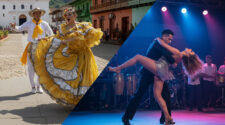
If you’re new to bachata, you may not realize there are actually a few different styles of bachata danced today.
Bachata began in the Dominican Republic, but as it spread around the world, different scenes and teaching styles grew around it. That’s why bachata socials today can include everything from quick footwork and playful musicality to pattern-heavy partnerwork and more fluid body movement. [1][4][11]
This can get confusing fast, especially if you’re just starting out. This guide breaks down the main styles of bachata, what makes them different, and what you’re most likely to see on the dance floor.
How many styles of bachata are there?
Most dancers today will run into three main styles of bachata: Dominican or traditional bachata, bachata moderna, and sensual bachata. Dominican bachata is the original style from the Dominican Republic and is usually the most footwork-heavy, playful, and music-driven of the three. Bachata moderna is more pattern-based and often feels more familiar to salsa dancers because of its turns and structured partnerwork. Sensual bachata puts more emphasis on body movement, softer shaping, and a more elastic connection between partners. [1][4][10][11]
You may also hear labels such as urban bachata, bachatango, and fusion. These are usually better understood as narrower trends, hybrid styles, or scene-specific labels rather than the three main styles most dancers use as reference points. Urban bachata often overlaps with modern bachata and may bring in more R&B, hip hop, or street-style influence depending on the scene. Bachatango blends bachata with tango-inspired movement and is best thought of as a niche fusion style rather than a core branch of social bachata today. [4][9][10]
There is no single official worldwide list, and different teachers, festivals, and local scenes do not always use the labels in exactly the same way. That’s why one class called “traditional bachata” may mean Dominican-rooted bachata in one place, while somewhere else it may just mean a simpler basic approach. In real social dancing, people also mix elements of different styles all the time. [4][11]
Dominican Bachata
If you want to understand bachata styles, start with Dominican bachata. Bachata began in the Dominican Republic, where the music and dance grew together socially long before bachata became an international festival and studio dance. UNESCO describes it as part of community life and social gatherings, and other sources trace it through everyday Dominican culture before its global spread. [1][2][5][13]
You will hear this style called both Dominican bachata and traditional bachata. For many dancers, especially bachateros who want to center the dance’s roots, traditional feels more natural. Their point is simple: bachata already comes from the Dominican Republic, so saying “Dominican bachata” can sound redundant, or like the original form is being treated as just one option among newer offshoots. At the same time, many international scenes still use Dominican bachata as a practical label to distinguish the foundational style from moderna and sensual. [4][7]
On the floor, this style often looks grounded, nimble, and playful. You may see lots of footwork, quick directional changes, and syncopation. The couple may separate and reconnect quickly. Dancers often play with the rhythm and respond to the instruments instead of just running through a long memorized combo. [1][4][6]
That doesn’t mean traditional or Dominican bachata has no turns or partnerwork. It does, but the focus is usually less on long pattern chains and more on footwork, timing, musicality, and connection. [4][6]
Bachata Moderna
Bachata moderna is the style most people will probably run into first, since it’s one of the most commonly taught forms of bachata around the world. Compared with Dominican or traditional bachata, it usually puts more emphasis on turn patterns, wraps, and structured partnerwork. [4][10][11]
It is also the style that tends to feel most familiar to salsa dancers. A lot of its partnerwork draws from salsa, ballroom, and other studio-taught partner dances, so you will often see clearer turn combinations, more defined pathways, and a more pattern-based approach overall. [4][10][11]
The label can still get a little fuzzy. In some scenes, moderna is used pretty broadly for almost any non-traditional studio bachata. In others, it means a more specific style centered on turn patterns and modern partnerwork. [4]
Compared with traditional or Dominican-rooted dancing, moderna usually puts less emphasis on intricate footwork and more emphasis on structured partnerwork. Compared with sensual, it usually uses less torso-led motion and fewer wave-based interpretations. It is usually the most pattern-driven of the three main styles. [4][11]
Sensual bachata
Sensual bachata is one of the most common styles you’ll see at festivals and socials today. It is usually associated with Spain, especially the teaching approach developed by Korke Escalona and Judith Cordero in Cádiz. Their Bachata Sensual method helped popularize a style built around smoother movement, body isolations, waves, and a more elastic connection between partners. [8][11][12]
Sensual bachata has come to refer to bachata that emphasizes body movement, circular motion, closer connection, and a softer stretch-and-return feel between partners. You’ll often see waves, torso movement, and isolations, especially during slower or more drawn-out parts of the music. [4][8][11]
That doesn’t mean it’s just about looking smooth or dancing close. Good sensual bachata still needs timing, control, and clear technique. It should stay connected to the music and feel comfortable for both dancers. Forcing body waves, dips, or close-position movement is not good sensual bachata, it is just bad dancing.
Sensual bachata also tends to create the most debate. Some dancers see it as a natural evolution of modern bachata. Others feel that some versions drift too far from Dominican roots and the musical feel of traditional bachata. It helps to separate the branded Bachata Sensual method from the broader way people use the term “sensual bachata” on the social dance floor. [4][8][11]
Other labels you may hear
Urban bachata
Urban bachata is one of those labels that can mean slightly different things depending on who is using it. In music history, it has important roots in New York Dominican diaspora bachata shaped by R&B and hip-hop influence. [9] In dance scenes, though, some people use urban almost like a synonym for modern or moderna, while others use it for a more groove-heavy, street-influenced style that may pull from hip hop, reggaeton, or modern partnerwork. So if you see a class labeled urban bachata, it’s worth checking what the teacher actually means instead of assuming everyone uses the term the same way. [4][9][10]
Bachatango
Bachatango or bachata tango usually means bachata mixed with tango-inspired movement. You’ll often see more dramatic lines, pauses, shapes, and sometimes tango-flavored turns or leg styling. It’s best thought of as a niche fusion style rather than one of the main social bachata styles, but it’s still common enough that you may run into the term in classes, demos, or older bachata discussions. [4][10]
Fusion bachata: Fusion is the broadest label of the three. Sometimes it means blending bachata with outside influences. Other times it just means mixing traditional footwork, moderna patterns, and sensual body movement in the same dance. That kind of blending is very common on social dance floors, especially among experienced dancers who don’t stick rigidly to one style. [4][10]
Which bachata style should you learn first?
If you’re a beginner, the best place to start is with the basics. Focus on timing, weight transfer, connection, and getting comfortable with the basic rhythm of bachata before worrying too much about style labels.
From there, pay attention to what people are actually dancing in your local scene and which styles excite you most. If you want the strongest foundation, traditional or Dominican-rooted basics are a great place to start. If you come from salsa, bachata moderna may feel more familiar. If your scene leans sensual, you’ll probably want to explore that too, but it still helps to build solid basics first. [1][2][4][6][11]
For most dancers, the best answer is simple: learn the basics, pay attention to your local scene, and explore the styles that make you want to keep dancing.
Why style debates happen in bachata
Style debates happen because bachata is two things at once. It’s a Dominican social dance with deep roots, its own history, and a strong cultural identity. [1][2][3] But it’s also a global dance scene now, with festivals, branded teaching methods, studio systems, and dancers constantly mixing in new ideas. [4][8][11]
Once a social dance spreads around the world, people naturally start creating labels. Teachers need names for classes. Organizers need names for workshops and festival rooms. Dancers want quick ways to describe what they do. The problem is that real dance scenes are messier than neat categories, which is why words like authentic, traditional, and real can start to carry a lot of baggage. [3][4]
The wording itself can become part of the debate. Some dancers strongly prefer traditional bachata because it keeps the original style centered as bachata, full stop. Others use Dominican bachata because it’s a practical way to distinguish the foundational style from moderna and sensual in international scenes. Labels like urban, modern, and fusion create similar friction because people often use them in overlapping ways. [4][9][10]
Respecting Dominican roots doesn’t mean pretending newer styles don’t exist. But it does mean being honest about where bachata came from and why some dancers are sensitive when the original tradition gets treated like just one option on a menu. The healthiest approach is pretty simple: learn the roots, name newer styles clearly, and don’t assume local shorthand is some universal rule. [1][2][5][4]
Frequently asked questions about bachata styles
Is sensual bachata still bachata?
Yes, sensual bachata is still bachata, though some dancers debate how far certain versions drift from Dominican roots. In practice, sensual bachata is widely danced and widely recognized as part of today’s bachata scene. The bigger question is usually how it is danced. Good sensual bachata still stays connected to bachata music, timing, and partner technique. It also helps to distinguish the branded Bachata Sensual method from the broader way people use the term sensual bachata on social dance floors. [4][8][11]
Is Dominican bachata harder?
It can feel harder at first, especially for beginners who are used to learning set patterns. Dominican or traditional bachata often asks for more timing, balance, footwork, and musical listening instead of just memorizing combinations. That does not mean it is only for advanced dancers, though. The basic step is approachable. What gets more advanced over time is the syncopation, the musicality, and the freedom to improvise. [1][4]
What style of bachata is most common?
Bachata moderna is probably the most commonly taught style overall, especially at studios, nightclubs, and general Latin dance classes. That said, local scenes can vary a lot. In the Dominican Republic and Dominican-rooted scenes, traditional or Dominican bachata is much more central. In Europe and in much of the international festival scene, sensual bachata has become extremely popular and in some places may be the most visible style on the floor. At mixed socials, you will often see dancers blending styles as well. [4][8][10][11][12]
Is bachata easier than salsa?
Bachata is usually considered easier to learn than salsa, mainly because the music is slower and the basic step is easier for most beginners to pick up. Salsa also tends to be faster and often demands more athletic movement, quicker timing, and more complex partnerwork early on. That said, mastering bachata is not easy. To dance it well, you still need strong timing, connection, body movement, and a feel for the music. Learning one dance also helps with learning the other, so the best long-term answer is usually to learn both. Since most Latin dance events include both salsa and bachata, knowing both means you get to dance more. For a deeper comparison, see our salsa vs bachata guide.
References
- UNESCO Intangible Cultural Heritage. Music and dance of Dominican Bachata. 2019.
- Deborah Pacini Hernández. Bachata: A Social History of a Dominican Popular Music. Temple University Press, 1995.
- Julie A. Sellers. Bachata and Dominican Identity / La bachata y la identidad dominicana. McFarland, 2014.
- Wilson. Bachata Dance: Sexuality, Authenticity, and Community. Texas A&M University, 2021.
- CUNY Dominican Studies Institute Library. The Deborah Pacini Hernández Bachata Music Collection. 2024.
- Areíto Arts. About Us. 2025.
- Areíto Arts. Bachata Regional Styles – Dominican Swag. 2018.
- Bachata Sensual. La historia detrás del estilo. 2026.
- Deborah Pacini Hernández. Urban Bachata and Dominican Racial Identity in New York. Cahiers d’études africaines, 2014.
- Bachateros. Dance Styles. n.d.
- The Conversation U.S. How bachata music and dance went global. 2025.
- Canal Sur Media. La bachata sensual inventada por dos gaditanos. 2024.
- Encyclopedia.com / Gale. Bachata. n.d.