
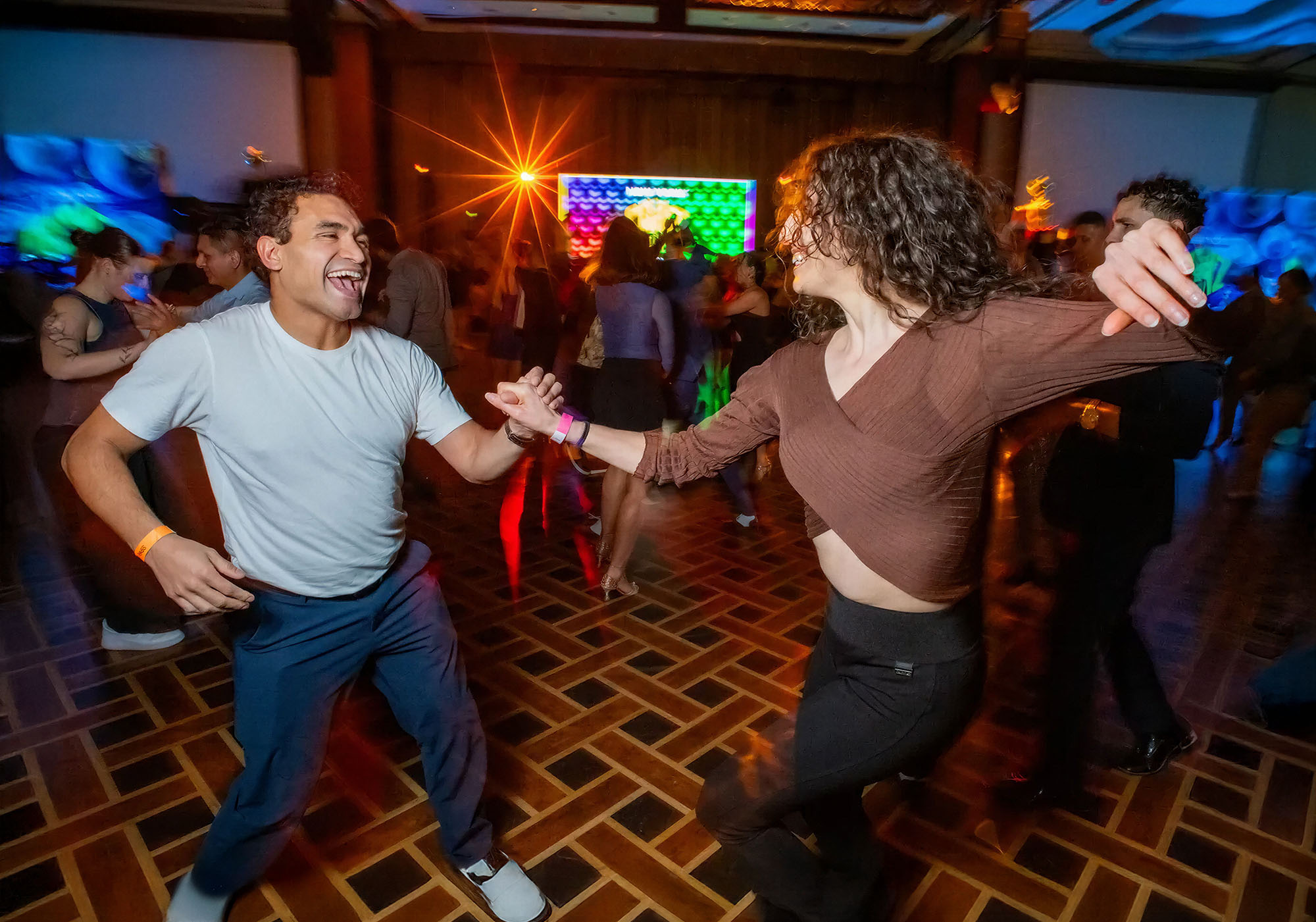
Summary. Salsa dance is a family of social dances with roots in Afro-Caribbean, Cuban, and Puerto Rican traditions, later shaped further in New York and other Latin diaspora communities. It is danced to salsa music and related Afro-Latin styles, but it is not one single universal form: LA-style salsa, New York-style salsa, Cuban salsa (casino), rueda, and Cali-style each have their own timing, floor pattern, and social feel. [1][4][13]
New to salsa? Use the Salsa Dance Guide to compare styles, learn the first steps, and find classes and social dancing.
Quick facts
| Cultural roots | Afro-Cuban son and rumba lineages, mid-century mambo culture, and later Puerto Rican, Nuyorican, and wider Latin diasporic reworkings, especially in New York. [1][4][20][22] |
| Primary music | Salsa music and related son-derived Afro-Latin dance music. [4][17][22] |
| Rhythm and timing | Usually organized over an eight-count dance phrase, with common break-step frameworks on1 or on2 and a strong relationship to clave-based phrasing. [13][14] |
| Dance format | Mainly a partner social dance with solo footwork called shines; most social dancing is improvised rather than memorized from start to finish. [12][19] |
| Signature movements | Break steps, cross-body leads, turns, directional changes, shines, and in casino-family forms, figures such as dile que no and enchufla. [3][11][12] |
| Main styles | LA-style salsa (on1), New York-style salsa (on2), Cuban salsa (casino), Rueda de Casino, and Cali-style salsa. [3][8][9][11] |
| Social setting | Clubs, socials, family and community gatherings, congresses, festivals, workshops, and performance teams. [1][8][12] |
| What beginners should expect | Counting music, rotating partners in many classes, learning a basic step and a few turns, and improving through repetition rather than instant perfection. [19] |
What is salsa dance?
Salsa dance is an umbrella term for related partner-centered social dances done mostly to salsa music and nearby Afro-Latin repertoires. In everyday speech, people also use “salsa” for the music itself, but the dance is not one fixed syllabus taught identically everywhere.[1][4]
Histories of salsa describe a field shaped by migration, club cultures, studio systems, and changing ideas about identity and performance. That is why “I dance salsa” can mean a linear slot style such as LA-style salsa or New York-style salsa, a circular Cuban form such as casino, or the fast footwork-centered style associated with Cali. [11][12]
For beginners, the most useful definition is simple: salsa is a family of improvised partner dances that share rhythmic orientation, turn-and-connection principles, and overlapping histories, while differing in timing, vocabulary, and social feel. [1][12][17]
Origins and historical development
The documented roots of salsa come before the label “salsa” itself. UNESCO describes Cuban son as a living practice transmitted through families, community gatherings, bands, and schools, and son is one of the clearest musical ancestors of later salsa. Afro-Cuban rumba is another important background tradition whose movement vocabulary and social meanings fed the wider dance world from which salsa emerged. [20][22]
New York became a crucial crossroads in the mid-twentieth century. Carnegie Hall points to the 1950s Palladium Ballroom era, when mambo and cha-cha-cha drew multiethnic crowds to bands led by Machito, Tito Puente, and Tito Rodríguez. McMains follows the U.S. dance story from late-1940s mambo through the 1970s formation of salsa as a named music-and-dance field. Scholars of Puerto Rican and Nuyorican culture stress that salsa was not simply invented whole in one country. Cuban sources were reworked in New York through migration, nightlife, recording, and identity politics. [1][2][4][6]
That is why the cleanest historical answer is also the least mythic. Salsa is neither a single Cuban invention nor a purely New York creation. It is a transnational formation with deep Cuban and Afro-Caribbean roots, major Puerto Rican and Nuyorican reshaping in New York, and later branching through other cities and scenes. By the 1970s, mass recordings and performance spectacles such as the Fania All Stars’ Live at Yankee Stadium helped symbolize salsa’s scale. [1][5][8][9]
By the 1990s and 2000s, studios, teams, congresses, workshops, and festivals helped standardize teaching vocabularies and export local styles internationally. Cali, Colombia became a major center of salsa consumption and performance, Los Angeles built influential teaching and festival networks, and casino and rueda spread through Cuban and diaspora communities. [11][12][15][17]
For a deeper look at the broader story, see our history of salsa dance article.
Music, rhythm, and musicality
Salsa dancers do not move only to counts. They move inside a layered groove. For beginners, the first practical idea is the eight-count dance phrase: step on 1-2-3, collect on 4, then 5-6-7, collect on 8. The exact style changes, but this count gives you a map for hearing repetition, tension, and release. [13]
A key term is clave. The National Park Service notes that clave is both an instrument and a rhythmic principle often discussed as 2-3 or 3-2. It may be implied rather than literally struck on claves. Teachers may also mention the tumbao, the repeating groove that helps push the music forward. Congas, timbales, cowbell, piano montuno, bass, and brass accents each offer a different clue about momentum and phrasing. [13][14]
What should you listen for first? Start with pulse, then phrase, then accents. The piano montuno gives an interlocking pattern. Cowbell and timbales sharpen the time feel. Brass hits often mark phrase peaks. A musical break is a sharp change or stop that invites a pause, hit, or burst of shines. This is why salsa can look improvised without feeling random. [13][14]
On1 and on2 are not beginner versus advanced. They are different timing frameworks. Research on music and dance interaction shows that each one directs attention to different musical features. New York mambo on2 is often prized for its relationship to phrase structure and mambo lineage, while on1 can feel more immediate to dancers who hear the main forward impulse on the first beat. Neither is the only correct choice. [3][13]
Main salsa styles
The main styles of salsa are related branches within one salsa family, not completely separate dances. A useful beginner contrast is linear versus circular. In linear or slot styles, partners tend to travel along an imagined line. In circular styles, they rotate more around one another. Cali-style adds a third strong visual cue, unusually fast footwork. [3][9][11][12]
| Style | Timing | Floor pattern | Visual feel | Common social context |
|---|---|---|---|---|
| LA-style salsa | Usually on1. [8][13] | Linear or slot-based. [8][12] | Crisp, directional, turn-friendly. [7][8] | Studios, congresses, club scenes shaped by LA teaching networks. [7][8] |
| New York-style salsa | Usually on2, often called mambo on2. [3][13] | Linear or slot-based. [3] | Smoother phrasing, strong shines culture. [3][13] | Social mambo scenes and international on2 communities. [1][3] |
| Cuban salsa (casino) | No single global rule; defined more by movement logic than one universal count dogma. [11] | Circular. [11] | Rotational, conversational, vocabulary-rich. [11] | Cuban social dance practice and diaspora casino scenes. [11] |
| Rueda de Casino | Built from casino timing and vocabulary. [11] | Group circle. [11] | Caller-led and communal. [11] | Classes, parties, festivals. [11] |
| Cali-style salsa | Often learned to salsa counts, but visually defined above all by speed and intricate footwork. [9][10] | Compact partner pathways with strong solo-footwork emphasis. [9][10] | Very fast feet and sharp rhythm. [9][10] | Cali socials, viejotecas, schools, performance groups. [5][9][10] |
LA-style salsa (on1)
LA-style salsa is often the first version beginners meet in studios. It is usually taught on1 and uses a slot structure that sends the follower down a clear line. The style is strongly associated with spins, clean lines, and a polished, stage-ready look, though social dancers use the same underlying tools in a more relaxed way. The National Park Service links Los Angeles salsa to earlier mambo culture and shows how schools, instructors, workshops, and festivals helped spread the style nationally and globally. [7][8][13]
New York-style salsa (on2)
New York-style salsa, often called mambo on2, is closely tied to mambo lineage and the New York social scene. It is also usually linear, but many dancers value it for how it sits against the phrasing of the band and for the room it gives to shines. Scholarship traces it from Palladium-era roots through later codified syllabi, teams, and international teaching systems. It is not “advanced salsa” so much as a different musical and aesthetic choice. [2][3][13]
Cuban salsa (casino)
Cuban salsa, or casino, developed in Cuba as a distinct social practice with its own vocabulary and partner logic. Rather than emphasizing a slot, casino tends to organize the couple more circularly, with redirections and rotations around a shared center. Its named figures include dile que no, enchufla, vacílala, and exhíbela, and these names should not be treated as universal across all salsa scenes. [11]
Rueda de Casino
Rueda de Casino places multiple casino couples in a circle while a caller names figures for everyone to execute together. Partner changes are common, which makes rueda feel part game, part training method, and part community dance. Because the material comes from casino, rueda is often taught alongside it rather than as a wholly separate style. [11]
Cali-style salsa
Cali-style salsa shows why one-size-fits-all definitions fail. Cali adopted salsa strongly in the 1970s and developed a local dance culture that Colombian cultural institutions describe as a whole complex of practices, techniques, spaces, and community relations. Visually, the style is famous for speed, rapid footwork, and a distinct local swagger that differs from the longer slot pathways common in U.S. studio styles. Smithsonian Folklife’s account of the city’s Vieja Guardia and viejotecas also makes clear that Cali salsa is sustained by social memory and intergenerational dancers, not only by stage teams. [5][9][10]
Colombian urban offshoot: Salsa Choke
Salsa Choke (pronounced “cho-que”) is a later Colombian urban dance and music trend influenced by salsa culture, especially in the wider orbit of Colombia’s salsa-rich scenes. It is not usually grouped with the main social salsa styles such as LA-style salsa, New York-style salsa, casino, rueda, or Cali-style, but it shows how salsa’s movement culture continued to branch into new local forms.
Core movement principles and partnerwork
Across styles, salsa shares several movement ideas even when the details differ. Think family resemblance, not exact sameness. [11][12][19]
- Basic step structure and weight transfer. Most basics shift weight cleanly over an eight-count phrase. The visible shape may be forward and back, side to side, or circular. [12][19]
- Break steps and timing orientation. The break step is where direction changes or travel is checked, and it is where on1 and on2 differences become easiest to feel. [3][13]
- Partner connection, frame, and lead/follow. Good salsa lead and follow is coordinated communication through timing, body position, hands, and shared momentum, not force. [12][19]
- Turns, directional changes, and partner coordination. Many beginner patterns are built by opening a pathway, redirecting a partner, and reconnecting. Linear styles center the slot; casino redirects more circularly. [3][11][12]
- Shines or solo footwork. Shines are solo passages danced apart from the partner, especially visible in New York and performance-oriented training. [3][12]
- Style differences. Linear styles favor slot clarity. Casino favors circular dialogue. Cali-style often foregrounds speed and intricate feet. [9][10][11]
- Improvisation over memorization. Social salsa is usually made in the moment, even if class combinations help you build vocabulary. [12][19]
Common figures and class vocabulary
- basic step: the foundational weight-shift pattern of a style. There is no single universal salsa basic. [11][12]
- side basic: a basic that opens side to side, common as a teaching drill. [12][19]
- back basic: a basic with a clear backward break, often stressed in beginner linear syllabi. [12][19]
- cross-body lead: a hallmark linear figure in which the leader opens the slot and the follower travels across. [3][12]
- right turn: a standard turn to the dancer’s right, found across scenes though setup varies. [12][19]
- inside turn: a turn toward the inside of the partnership, common in linear teaching systems. [11][12]
- copa: a compact check-and-return figure common in linear studio vocabularies. [3][12]
- dile que no: a foundational casino figure that returns the couple to open position. [11]
- enchufla: a classic casino turning figure that redirects the partnership circularly. [11]
- vacílala: a casino figure that releases and re-presents the follower with room for styling. [11]
- exhíbela or exhibela: a casino-family figure that presents the partner outward. [11]
- shines: solo footwork passages used to answer accents, breaks, or call-and-response moments in the music. [3][12][13]
These names are practical, not universal. A beginner class in LA may give you cross-body leads early, while a casino class may center dile que no and enchufla instead. [8][11][19]
Social dancing, festivals, and competition
Salsa is not only a class syllabus. A social is an event where people dance improvised partner dances in clubs, studios, community spaces, and parties. A congress or festival is larger and usually multi-day, mixing workshops, performances, vendors, and late-night socials. These circuits helped local styles travel well beyond their home cities. [1][8][12][17]
Performance is important, but it is only one branch of the scene. Formation teams, showcases, and choreographed couples helped popularize salsa during the studio boom, and some events now add judged partner divisions or improvisation-based formats often called Jack and Jill. The key beginner lesson is that the flashiest stage version is not the whole dance. Everyday salsa still lives on crowded social floors and in local communities. [1][7][12]
Clothing, shoes, and visual culture
The look of salsa changes by scene. Cultural-history sources remind us that shoes, clothing, posters, and instruments are part of salsa’s public meaning, not just decoration. Everyday socials usually favor comfort and mobility, while performances amplify polish, uniformity, and stage readability. Los Angeles scenes have often rewarded a sleek, aspirational look, while Cali’s social spaces preserve their own local dress habits and style memory. For beginners, the practical rule is simple: wear clothes you can move in and shoes that pivot safely. [7][9][12][14]
How salsa compares with related dances
Salsa is often taught, danced, and DJed alongside bachata, merengue, and cumbia, but they are not interchangeable. Each has its own history, rhythm, partner feel, and social culture. Salsa usually asks for more attention to phrasing, directional changes, turns, and style-specific timing such as on1 or on2. [12][13][21]
- Salsa: A family of related social dances with multiple regional styles, strong turn vocabulary, and timing systems such as on1 and on2. [12][13]
- Bachata: A distinct Dominican music-and-dance tradition with a different groove, rhythm, and partner feel, even when it appears at the same events as salsa. [21]
- Merengue: Another separate partner dance, often built on a steadier marching pulse that many beginners find easier to hear at first. Merengue is common at mixed Latin socials but follows different movement logic from salsa. [21]
- Cumbia: A separate dance and music tradition with its own regional variants and partner feel. In social dance settings, cumbia usually feels more grounded and groove-based than salsa, with less emphasis on salsa’s turn-pattern structure and timing debates.
- Ballroom Latin: A competition and studio framework that may include salsa in classes, showcases, and judged events, but it does not define salsa as a whole. Social salsa remains more improvisational and more tied to local scene norms. [12][19]
How to start learning salsa
- How to choose a style. Start with the style most available in your local scene, unless you already know you love a specific sound or look. [8][11][19]
- How to hear the timing. Count 1-2-3, then 5-6-7, and listen for where the phrase repeats. Timing gets clearer through movement. [13][19]
- What to wear. Comfortable clothes and shoes that allow safe pivoting are enough. You do not need a costume.
- Whether you need a partner. Usually no. Many beginner classes rotate partners. [19]
- What a beginner social is like. Expect mixed levels, some nerves, and many imperfect dances. Social dancing is where class material starts to make sense. [1][19]
- Common early mistakes. Stepping too big, gripping too hard, rushing turns, and trying to memorize patterns instead of hearing rhythm are all normal. [19]
Common misconceptions
- Myth. Salsa dancing was invented in Cuba as a single, fixed dance. Correction. Salsa draws deeply from Afro-Cuban and Cuban forms, but the named dance field and global industry developed through transnational exchange, especially through U.S. hubs such as New York and Los Angeles. [1]
- Myth. There is one universal salsa style. Correction. New York on2, LA on1, casino, rueda, and Cali-style reflect different histories, movement logics, and social settings. [9]
- Myth. On2 is the only correct or musical way to dance salsa. Correction. On1 and on2 highlight different aspects of musical structure, and neither is the sole rule of musicality. [13]
- Myth. Cali is the “World’s Salsa Capital” because salsa originated there. Correction. Cali became a major center of salsa adoption, performance, and identity, but that is different from being the sole origin point. [9]
- Myth. Salsa is just party entertainment. Correction. Salsa is also a form of community, artistic expression, and cultural memory. People use it to socialize, improvise, share musical knowledge, and sustain traditions across generations, not just to have fun at parties. [6][16][22]
- Myth. Salsa cannot really be taught. Correction. Salsa is taught worldwide through studios, universities, teams, and guided social practice. [19]
- Myth. Flashy tricks and stage spectacle are the authentic form of salsa. Correction. Stage aesthetics may be exciting, but they often reflect commercialization and performance priorities rather than ordinary social-floor practice. [7]
- Myth. Clave is always literally played on the claves instrument. Correction. Clave is also a rhythmic principle that can be implied across the arrangement. [14]
References
- Spinning Mambo into Salsa: Caribbean Dance in Global Commerce. Oxford University Press (Oxford Academic / Oxford Scholarship Online), 2015. https://academic.oup.com/book/9865
- Salsa’s Connection and Evolution in New York. Carnegie Hall, 2024. https://www.carnegiehall.org/Explore/Articles/2024/12/20/Salsas-New-York-History
- Mambo On 2: The Birth of a New Form of Dance in New York City. Centro Journal (Center for Puerto Rican Studies, Hunter College, CUNY) via Redalyc, 2004. https://www.redalyc.org/pdf/377/37716209.pdf
- Puerto Rican Music and Cultural Identity: Creative Appropriation of Cuban Sources from Danza to Salsa. CUNY Academic Works (John Jay College / CUNY Graduate Center), 1994. https://academicworks.cuny.edu/jj_pubs/22/
- The City of Musical Memory: Salsa, Record Grooves and Popular Culture in Cali, Colombia. Wesleyan University Press, 2002. https://www.weslpress.org/9780819564429/the-city-of-musical-memory/
- Rhythm & Power: Salsa in New York. Museum of the City of New York, 2017. https://www.mcny.org/exhibition/rhythm-power
- Salsa Crossings: Dancing Latinidad in Los Angeles. Duke University Press, 2013. https://www.dukeupress.edu/salsa-crossings
- Los Angeles Salsa. U.S. National Park Service, 2023. https://www.nps.gov/articles/000/los-angeles-salsa.htm
- La Vieja Guardia: Salsa Dancing in Cali, Colombia. Smithsonian Center for Folklife and Cultural Heritage, 2020. https://folklife.si.edu/magazine/la-vieja-guardia-salsa-dancing-cali-colombia
- Complejo Musical – Dancístico de la Salsa Caleña. Ministerio de las Culturas, las Artes y los Saberes (Colombia), 2022. https://www.mincultura.gov.co/direcciones/patrimonio-y-memoria/Paginas/servicios-informacion/LRPCI/complejo-musical-dancistico-de-la-salsa-calena.aspx
- “El Baile del Pueblo:” A 60-Year Legacy of Performing a History of Cubans of African Descent Through Casino Salsa. Texas A&M University Libraries (OAKTrust repository), 2016. https://oaktrust.library.tamu.edu/items/24c673a4-5bc3-4b44-b827-03b7c0ae46d0
- Salsa Dance and the Transformation of Style: An Ethnographic Study of Movement and Meaning in a Cross-Cultural Context. Dance Research Journal (via Cambridge University Press), 2008. https://www.cambridge.org/core/journals/dance-research-journal/article/salsa-dance-and-the-transformation-of-style-an-ethnographic-study-of-movement-and-meaning-in-a-crosscultural-context/FDE587B0311AA3F135B78F47C006AC7B
- Theorizing Fundamental Music/Dance Interactions in Salsa. Music Theory Spectrum (Oxford University Press on behalf of the Society for Music Theory), 2019. https://academic.oup.com/mts/article-abstract/41/1/74/5342730
- Materiales: A Digital Salsa Exhibit. U.S. National Park Service, year not listed. https://www.nps.gov/articles/000/materiales-a-digital-salsa-exhibit.htm
- Fania All Stars — Live at Yankee Stadium (National Recording Registry essay). Library of Congress, 2003. https://www.loc.gov/static/programs/national-recording-preservation-board/documents/FaniaAllStars.pdf
- Listening to Salsa: Gender, Latin Popular Music, and Puerto Rican Cultures. Wesleyan University Press, 1998. https://www.weslpress.org/9780819563088/listening-to-salsa/
- Situating Salsa: Global Markets and Local Meanings in Latin Popular Music. Routledge, 2002. https://www.routledge.com/Situating-Salsa-Global-Markets-and-Local-Meanings-in-Latin-Popular-Music/Waxer/p/book/9780815340201
- Salsa Steps toward Intercultural Education. ERIC (Institute of Education Sciences, U.S. Department of Education), 2016. https://eric.ed.gov/?id=EJ1093872
- Rumba in Cuba, a festive combination of music and dances and all the practices associated. UNESCO Intangible Cultural Heritage, 2016. https://ich.unesco.org/en/RL/rumba-in-cuba-a-festive-combination-of-music-and-dances-and-all-the-practices-associated-01185
- Music and dance of Dominican Bachata. UNESCO Intangible Cultural Heritage, 2019. https://ich.unesco.org/en/RL/music-and-dance-of-dominican-bachata-01514
- The practice of Cuban Son. UNESCO Intangible Cultural Heritage, 2025. https://ich.unesco.org/en/RL/the-practice-of-cuban-son-02299