
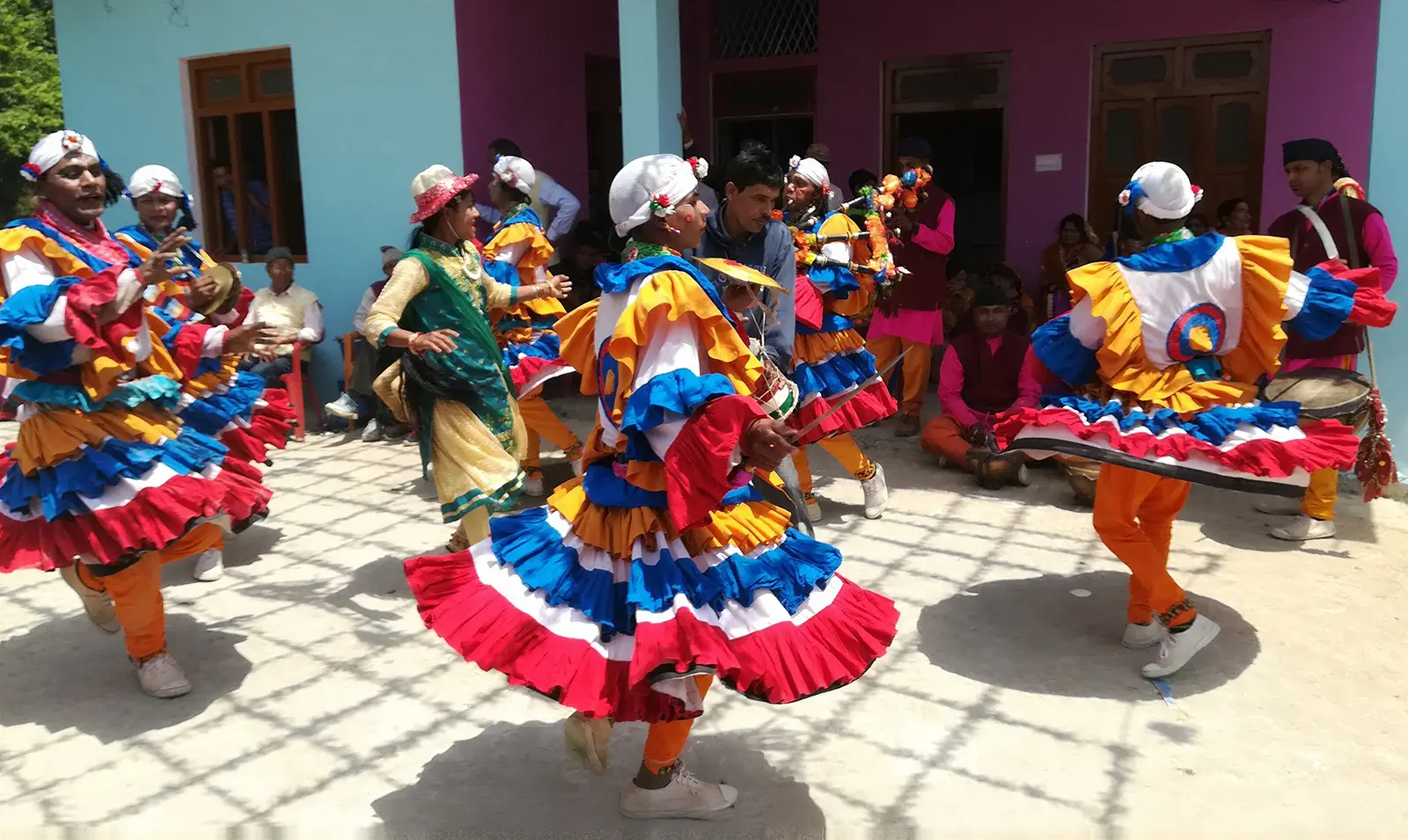
Summary. Chholiya is a traditional sword dance from Kumaon, a Himalayan region in the northern Indian state of Uttarakhand. Dancers carry swords and shields as they perform coordinated jumps and turns, creating a display of mock combat.[1][6] The dance is closely associated with Kumaoni weddings and marriage processions. It also appears at other celebrations and public cultural events.[2][5][3]
Quick facts
| Origin/Region | Kumaon, a region of Uttarakhand in northern India.[1] |
| Also known as | Choliya or Chhaliya. These are alternate spellings of Chholiya.[1][4] |
| Music | Dhol (a double-sided drum) and damau (a small kettledrum). Some groups also use bagpipes and other instruments.[2][5] |
| Movement quality | Coordinated jumps and turns combined with mock sword fighting.[6] |
| Typical context | Weddings and marriage processions. Other settings include community celebrations and public cultural programmes.[2][5][3] |
| Costume | A traditional outfit includes a jhaguli, a tunic extending below the knees, and a turban. One account describes a white jhaguli with coloured fabric details and a white turban.[10] |
| Related traditions | Chhaulo sword dance and Hudkeli storytelling and dance traditions in far-western Nepal. Their names should not automatically be treated as alternatives for Chholiya.[7][8][9] |
The word Kumaoni means connected with Kumaon. Although Chholiya draws on the imagery of warfare, its best-known setting is a wedding celebration. The swordplay is a performance rather than a real fight, and participants may also understand it as a way to protect the couple from bad luck.[1][5]
Origins & history
Accounts of Chholiya’s origins connect it with Kumaon’s warrior traditions and marriage customs. They differ in their explanations, however, and do not establish a single date when the dance began.[2][5]
In Uttarakhand: Society, Culture, and Pilgrimages, Vishwambhar Prasad Sati links the dance to Khasiya warrior communities in the Kumaon Himalayas. He names their kingdom as Khasdesh and connects the tradition with marriages conducted at sword-point.[2]
A separate account published by the Social Development for Communities Foundation describes Chholiya as a Kshatriya tradition. Kshatriya refers to a traditional warrior social group. The account connects the dance with the Chand dynasty, a former ruling family of Kumaon, and with Rajput communities historically associated with warfare. It describes Chholiya as more than a thousand years old.[5]
Performers also explain the dance’s history through stories passed down within the tradition. Narendra Prasad, a Chholiya performer from Pithoragarh district in Uttarakhand, described an earlier role accompanying armies to encourage soldiers. He said performers later began leading marriage processions and now appear at other auspicious occasions, meaning events considered lucky or suitable for celebration.[5]
Chholiya has also reached audiences beyond its traditional wedding setting. Its appearance at India’s Republic Day parade in 1958 brought Kumaon’s sword-dancing tradition to a national stage, presenting a dance rooted in local celebrations as part of India’s wider cultural heritage.[4]
Basic steps & movement
Sword-and-shield exchanges are at the heart of Chholiya’s style. Dancers combine mock combat with jumps and turns performed together. The effect depends on the group’s timing as well as the handling of the weapons.[6]
A wedding documented by the People’s Archive of Rural India offers one example of how this looks in practice. In Baijnath, a town in Kumaon’s Bageshwar district, dancers performed in pairs while carrying swords and shields.[1]
Music & instruments
The dhol (a double-sided drum) and damau (a small kettledrum with a rounded metal body) accompany Chholiya at marriage ceremonies. Together, they provide the percussion heard alongside the dancers and wedding procession.[2]
Bagpipes also feature in some groups. The instrument uses an air-filled bag to supply its pipes, producing a sustained sound alongside the drums. At the Baijnath wedding, musicians played bagpipes and drums while also taking part in the celebration through singing and dancing. Clapping added to the festive atmosphere.[1]
The Scottish bagpipes point to a later period of British military influence. Anthropologist Lokesh Ohri links their use in Himalayan performance traditions to British military bands and the recruitment of mountain soldiers. His explanation connects that influence with the period around the Anglo-Gorkha War, fought between the British East India Company and Nepal in 1814–1816.[5][11]
A 2024 account describes a 22-member group with eight dancers and 14 musicians. Its instruments include bagpipes alongside the dhol and damau. It also uses a hudaki, a small hand-played drum. But ensembles can differ from region to region.[5]
Clothing & staging
Traditional Chholiya clothing includes the jhaguli, a tunic-like garment that falls below the knees. A study of Kumaoni clothing describes a white jhaguli with coloured fabric elements. It is worn with a white turban, a cloth head wrap.[10]
Public performances may use more colourful outfits. A 2023 report describes dancers in colourful attire at special occasions, while the Baijnath wedding account also notes vibrant clothing.[4][1]
The setting can change too. Chholiya may accompany a wedding procession or appear as a cultural presentation for a wider audience. In either setting, the swords and shields make its connection to warrior traditions immediately visible.[1][6]
Related dance traditions
Across the border from Uttarakhand, far-western Nepal has its own traditions of sword dancing and musical storytelling. Chhaulo and Hudkeli offer useful comparisons with Chholiya, but shared regional features do not make their names interchangeable.[7][8][9]
Chhaulo is a sword dance associated with bravery in Nepal’s far-western hill districts. Performers dance with swords drawn from their sheaths to the accompaniment of local instruments. Culture expert Kailash Kumar Pandey described the tradition in a 2026 report on a cultural programme that presented Chhaulo and Hudkeli as separate performance items.[9]
Hudkeli has both storytelling and dance associations. A French research project on western Nepal’s oral traditions documents it as an epic performed by bard-musicians, storytellers who sing or recite long narratives with music. Nepal’s Academy of Music & Drama also identifies Hudkeli as a folk dance of Sudurpashchim Province, in far-western Nepal.[7][8]
Chhaulo’s swordplay invites comparison with Chholiya’s mock combat. Hudkeli brings a different emphasis through its storytelling tradition. Keeping these names distinct allows readers to recognise regional connections without overlooking each tradition’s own cultural setting.[7][9]
Where to experience it now
Weddings and marriage processions in Kumaon remain Chholiya’s best-known setting. Performers also appear at other celebratory occasions. Public cultural programmes provide another opportunity to encounter the dance outside a family wedding.[2][5][3]
On January 26, 2026, Chholiya featured in the state’s official Republic Day programme in Dehradun, a city in Uttarakhand.[3] Republic Day commemorates India’s Constitution coming into force on January 26, 1950.[12]
The dance has also been filmed at the Pushkar Camel Fair in Pushkar, a town in the Indian state of Rajasthan. That presentation featured male dancers visiting from Uttarakhand. It offers an example of Chholiya being performed beyond its home region, rather than identifying it as a local Rajasthani tradition.[6]
Frequently asked questions
What beliefs are associated with Chholiya at weddings?
In the Baijnath wedding account, participants associated Chholiya with warding off evil spirits and protecting the couple from bad luck. This protective meaning helps explain why a dance built around swordplay belongs in a wedding celebration.[1]
Is Chholiya always performed only by men?
Chholiya is traditionally performed by men. But more recent performances have started to incorporate women as well, although this differs by region.[1][5]
References
- People’s Archive of Rural India (2016). Drums, bagpipes and Choliya dance. https://ruralindiaonline.org/en/articles/drums-bagpipes-and-choliya-dance/
- Sati, Vishwambhar Prasad (2023). Uttarakhand: Society, Culture, and Pilgrimages. Today & Tomorrow’s Printers and Publishers. https://www.researchgate.net/publication/365583195_Uttarakanad_Society_Culture_and_Pilgrimges
- Lok Bhavan Uttarakhand (2026). Governor hoists National Flag at Lok Bhavan and Parade Ground on the occasion of Republic Day. https://governoruk.gov.in/26-01-2026-governor-hoists-national-flag-at-lok-bhavan-and-parade-ground-on-the-occasion-of-republic-day/
- The Times of India (2023). Kumaoni folk dance at Republic Day’s parade; tableau to depict Jageshwar, Corbett. https://timesofindia.indiatimes.com/city/dehradun/kumaoni-folk-dance-at-republic-days-parade-tableau-to-depict-jageshwar-corbett/articleshow/97293720.cms
- Social Development for Communities Foundation (2024). Chholiya is more than just a Himalayan Folk Dance. https://www.sdcuk.in/chholiya-is-more-than-just-a-himalayan-folk-dance/
- India Video / Invis Multimedia (undated). Choliya Dance: A folk dance from Kumaon region, Uttarakhand. https://www.indiavideo.org/rajasthan/heritage/art-forms/dances/folk/choliya-dance-uttarakhand-5455.php
- LACITO, CNRS (project period: 2007–2010). Épopée Népal: Languages and Oral Traditions of Western Nepal (project description). https://lacito.cnrs.fr/activite-scientifique/projets-associes/
- Nepal Academy of Music & Drama (2022). Hudkeli Folk Dance Performance and Workshop Held in Attariya. https://namuda.gov.np/hudkeli-dance-workshop
- The Rising Nepal / Gorkhapatra Corporation (2026). Modernisation threatens Sudurpaschim’s folk art. https://risingnepaldaily.com/news/81669/
- Neetu and Kevla Nand (2026). Fabrics of Faith: Kumauni Attire, Ornaments and Festive Decor in the Cultural Landscape of Uttarakhand. International Journal of Engineering Development and Research, 14(2), 639–649. https://www.researchgate.net/publication/406010864_Fabrics_Of_Faith_Kumauni_Attire_Ornaments_And_Festive_Decor_In_The_Cultural_Landscape_Of_Uttarakhand
- National Army Museum (undated). The Gurkhas. https://www.nam.ac.uk/explore/gurkhas
- India Government Mint (undated). 75th Republic Day. Historical background accompanying the commemorative coin. https://www.indiagovtmint.in/product/75th-republic-day-denomination-of-75-unc-folder-packing-fgco001499/