Starting a new salsa or bachata social can be nerve-racking. You may be putting hundreds or even thousands of dollars into a venue, DJ, instructor, sound equipment, staff, and promotion, not to mention the hours of work it takes to put everything together.
And until that first night actually happens, there’s always that uncomfortable question in the back of your mind: What if nobody shows up?
I’ve been part of the salsa scene for more than 20 years as a dancer, performer, coach, and organizer. Over that time, I’ve seen new socials turn into long-running staples, and I’ve also seen plenty of others disappear after a few weeks or months.
There is no single marketing trick that guarantees a packed dance floor, but the events that grow tend to do a lot of small things right. They build relationships with instructors, DJs, performers, teams, and other organizers. They give dancers a reason to come, make it easy for people to discover the event, and most importantly, create an experience people want to come back to.
If you’re launching a new salsa or bachata social, or trying to grow one that hasn’t quite caught on yet, these are the strategies that actually work.
1. Go Where the Dancers Already Are
One of the simplest ways to promote a dance event is also one of the oldest: go to other dance events.
If there’s a popular salsa social on Friday and you’re launching an event on Sunday, that’s almost your perfect audience gathered together in one place.
Flyer other dance events
Yes, physical flyers still work.
One old-school strategy is to visit other non-competing dance events and distribute physical flyers. Depending on the venue and local rules, you may also be able to flyer cars in the parking lot.
It isn’t glamorous, but the targeting is hard to beat. You’re putting your event directly in front of people who already love dancing.
But be respectful. Don’t flyer an event running on the same night as yours, don’t create a mess, and make sure you’re allowed to distribute promotional material where you’re doing it.
Flyer the broader local community
You can also promote beyond existing dancers.
Coffee shops, restaurants, libraries, community centers, college campuses, dance studios, Latin businesses, and neighborhood bulletin boards often have places for local event flyers.
Ask permission before posting anything.
This audience will be less targeted than dancers at a social, but it can be especially useful if your event has a beginner lesson and it helps to bring new people into the scene.
2. Build Relationships With Other Organizers
One mistake new organizers often make is assuming every other salsa or bachata event is a competitor.
But the truth is local dance communities work better when organizers support each other.
If another social runs on a different night and isn’t directly competing with you for students, team members, or some other part of the business, reach out and introduce yourself.
Many instructors and organizers genuinely want the overall dance scene to grow.
They may be willing to:
- Put out your flyers
- Mention your event during announcements
- Let you briefly take the mic
- Share one of your posts
- Let you promote a special event or grand opening
A 20-second announcement in front of 150 active local dancers can be far more valuable than another social media post.
The key is reciprocity. Support their events too. Share their special events when appropriate. Send dancers their way on nights when you’re not operating.
Healthy dance communities are built through relationships.
3. Perform at Other Events
If you’re an active dance performer, performing at another organizer’s event can be an especially good way to promote.
Rather than just asking an event for a favor, offering to perform provides them with audience entertainment and gives their event something to promote. In return, the MC will usually introduce you or your team, and organizers will often let you make a quick announcement afterward.
Again, this works because you’re contributing to someone else’s event instead of simply extracting attention from it.
4. Hire DJs Who Bring More Than Music
Your DJ is obviously important to the quality of the social, but don’t evaluate DJs on their music alone.
In many salsa and bachata communities, DJs are some of the most connected people in the scene.
A good local DJ may:
- Attend multiple events every week
- Know most of the instructors and organizers
- Have a strong local social media following
- Be followed by active social dancers
- Regularly promote the events where they are playing
- Bring friends and supporters with them
If you’re choosing between two DJs you like musically, and one has a strong local following and actively promotes the events they work with, that may be a meaningful advantage.
You’re not just hiring someone to play music. You’re potentially hiring someone who can help connect your event to the rest of the community.
5. Choose the Right Instructor for Your Event
The same principle applies to instructors.
If you’re not teaching the lesson yourself, think about what type of instructor will best help the event.
Hiring a local instructor
A respected local instructor can be especially valuable for a recurring social.
They may have:
- A regular student base
- Their own performance team
- Strong relationships with local dancers
- Students who already enjoy going out together
- An audience that trusts their recommendations
If the instructor tells 40 students, “I’m teaching at this social Saturday. Come take the class and stay afterward,” that can have a noticeable impact on attendance.
A locally connected instructor can also help your event feel like part of the existing community rather than something operating separately from it.
Bringing in an out-of-town artist
A visiting instructor serves a different purpose.
A recognizable regional, national, or international artist will usually be more expensive and may not bring many local students directly. What they bring is novelty and reputation.
A visiting artist can give dancers a reason to attend this particular week instead of saying, “I’ll catch the social next time.”
They can also attract more experienced dancers who want to take the workshop, meet the artist, or dance with other strong dancers who are likely to attend the social.
For a regular weekly social, a well-connected local instructor may provide more consistent value. For a grand opening, anniversary, or occasional featured event, an out-of-town artist can create a much bigger spike in interest.
6. Use Free Passes Strategically
When you’re opening a new social, one of your first problems is simply getting the right people into the room.
Consider selectively inviting a few:
- Local team directors
- Instructors
- Well-connected community members
- Strong social dancers
In many dance communities, comping directors or other influential dancers for a grand opening is normal.
The purpose isn’t just to increase your headcount.
If a respected director comes to your event and has a good time, they may tell their students about it. If several strong social dancers are there, other experienced dancers may be more excited to return.
Good dancers tend to attract other good dancers.
There is also a social-proof effect. When someone visits a new social and immediately recognizes several people they respect in the scene, the event feels established much faster.
Just don’t overdo it.
If you comp a huge number of people every week, free admission can quickly become expected. Use comps selectively, especially for a launch or special occasion, and avoid creating a huge free guest list that keeps growing.
7. Invite Local Teams to Perform
Performance teams are constantly looking for opportunities to get performance experience, especially before major festivals and competitions.
That creates an easy win-win.
Invite local teams to perform at your social. In many cases, you don’t need to pay them. Giving the performers free admission is enough, especially when they want a practice run before a larger event.
The team gets:
- Stage experience
- Video footage
- Exposure
- Another chance to perform their routine
You get:
- More people in the room
- Entertainment for your attendees
- Promotion from the team and director
- More connections to the local community
- Additional content for your social media
If you know your scene well, there is another factor worth considering: invite performers who actually like social dancing.
Some teams will arrive, perform, change clothes, and leave immediately.
Other teams will perform and then stay for another few hours to social dance.
If your goal is building the energy of the social, the second group provides substantially more value.
8. Give People a Special Reason to Come
Marketing gets easier when there is something interesting to market.
Your social itself can provide your best promotional hooks.
Run a Jack & Jill competition
A Jack & Jill or similar social dance competition can be a great occasional draw.
You don’t necessarily need a huge prize. Even a modest cash prize can be enough to make the competition interesting.
Bring in a few respected local instructors to judge it.
Now the event potentially attracts:
- Competitors
- Friends of the competitors
- More advanced dancers
- The judges
- Students of the judges
- People who simply want to watch
The instructors also lend some of their credibility to the event.
And afterward, you have competition footage that can become some of your best social media content.
Bring in a live band
Live salsa music can also make an event feel special, particularly for a grand opening, anniversary, or other major night.
Bands can promote the event to their own followers and may help you reach people who love Latin music but aren’t active social dancers yet.
There are tradeoffs.
Bands can be expensive. Some dancers don’t like extremely long live sets. You’ll also have additional sound and logistical requirements.
So think carefully about what role live music plays in your event.
Is a band part of your regular identity? Or is live music something you bring in a few times a year to create a special occasion?
Both can work. The economics just need to make sense.
9. Make It Easy for College Students to Attend
College students can be a great audience for local dance events.
They’re young, social, frequently interested in meeting new people, and can become part of your community for years.
They’re also often broke.
A clearly advertised student discount can make your event much more accessible.
If there are salsa, bachata, Latin dance, or ballroom clubs at nearby colleges, reach out directly. Offer a student rate and send them something easy to share with their members.
College teams can also become valuable community partners. They may perform at your events, attend together, and introduce a steady stream of newer dancers to the local scene.
10. Build Your Social Media Audience
Instagram and Facebook are still important for most local salsa and bachata events.
Just understand that you probably won’t have much of an audience when you start.
Build it gradually.
Follow local dancers, DJs, instructors, studios, performers, and teams. Some percentage will check out your account and follow you back.
More importantly, post things people actually want to see.
Use:
- Videos of social dancing
- Previous performances
- DJ clips
- Instructor demos
- Competition footage
- Crowd shots
- Photos of real attendees
- Short recaps after events
Your page should make someone think:
“That looks fun. I want to be there next time.”
It should not look like an endless collection of promotional flyers.
11. Post in Local Facebook Groups (But Keep Your Expectations Realistic)
Most local salsa and bachata Facebook groups are heavily promotional.
Everyone is advertising something.
That means another flyer post probably isn’t going to transform your attendance overnight.
Still, it’s worth doing.
It takes a few minutes, costs nothing, and puts your event in front of a relevant audience.
Post your important events and occasional reminders. Just don’t spam the group every day with slightly different versions of the same promotion.
You can also look beyond dance-specific groups.
Local “things to do,” nightlife, expat, college, cultural, and Latin community groups may expose your event to people outside your normal circle.
12. Have a Clean, Professional Website
A website isn’t necessarily a major discovery channel for a small local social.
People may initially find you through Instagram, a friend, another instructor, a flyer, or an event calendar.
The website helps with something different: credibility.
Imagine discovering a new social with a relatively small Instagram following. You’re not sure if it’s established, what the venue is like, or whether the information is current.
Then you visit its website and find:
- Current dates
- Clear pricing
- Instructor and DJ information
- Photos and videos
- Parking details
- Venue information
- FAQs
- Contact information
The event suddenly feels much more legitimate.
Your website doesn’t need to be complicated. It just needs to look professional and stay updated.
An abandoned website with dates from eight months ago may be worse than having no website at all.
13. Submit Your Event to Salsa and Bachata Calendars
Social media helps you reach people who already follow you or people connected to them.
Event directories reach another valuable audience: dancers who are actively looking for somewhere to dance.
Someone searching, “Where can I dance salsa tonight?”, is very different from someone casually scrolling through Instagram.
Get your event listed on relevant local and dance-specific event calendars.
And yes, that includes Salsa Vida.
Salsa Vida helps more than 160,000 monthly visitors discover salsa and bachata classes, socials, workshops, and festivals around the world. Our event pages also have strong visibility through search engines and AI platforms, helping dancers discover events even if they’ve never heard of the organizer before.
Submit your salsa or bachata event to Salsa Vida for free.
You should still use other relevant calendars in your city too. The goal is to make your event easy to find wherever dancers are looking.
14. Put Some Care Into Your Flyer
Please stop making terrible AI flyers.
AI-assisted design is fine. There are plenty of useful tools that can make design faster and easier.
But your flyer is often someone’s first impression of your event.
If it has obviously generated dancers with extra fingers, strange limbs, unreadable background text, and 35 different pieces of information fighting for attention, what does that say about the care you’re putting into the event itself?
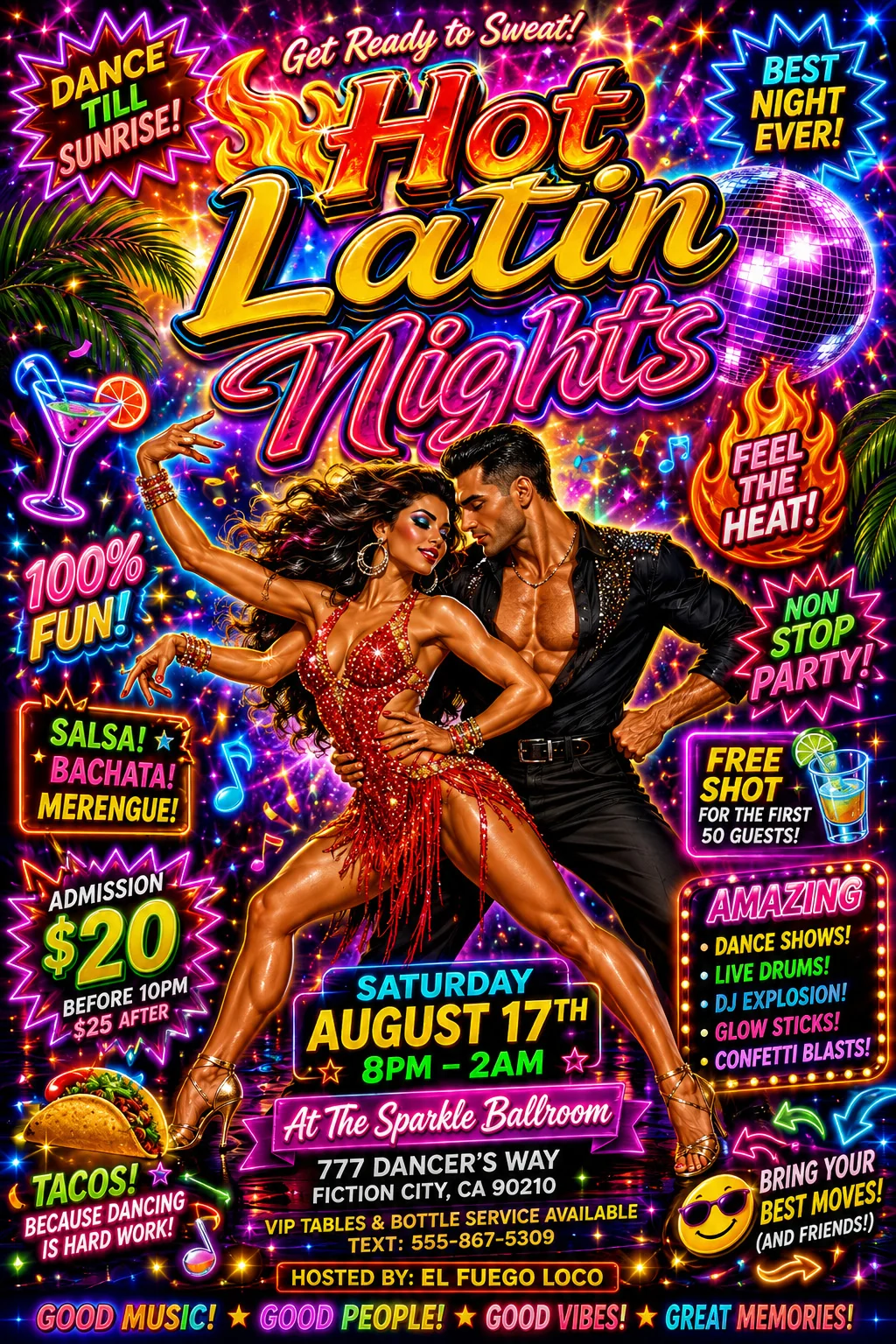
You don’t need an expensive designer.
You do need a flyer that is easy to understand.
At minimum, someone should immediately be able to find:
- Event name
- Date
- Location
- Start time
- Main attraction or theme
- Price, if appropriate
- Where to get more information
Make sure the text is readable on a phone.
Don’t use ten fonts.
Don’t make people zoom in to figure out when the lesson starts.
And if you have great photos of your actual community, consider using them. Real dancers enjoying your event often make much stronger marketing than another generic image of an impossibly perfect couple doing a dip.
15. Remember That the Dance Floor Is Part of Your Marketing
This is probably the most important thing on the list.
You can do everything above and still struggle if people don’t enjoy the actual event.
Your first attendees are your future marketing team.
If they have a great night, they:
- Come back
- Bring friends
- Post videos
- Tag your event
- Mention it to students
- Talk about it at other socials
That’s how local events really grow.
Marketing can get someone through the door once. The experience determines whether they return.
Think about the music. The floor. The temperature. The sound. The venue. The people you invite. The lesson. The atmosphere. How welcoming the room feels to someone who doesn’t know anybody yet.
Then make it easy for people who had a good time to know when you’re doing it again.
What I Would Prioritize for a Brand-New Social
If you’re reading this and thinking, “Okay, but I can’t do 15 things at once,” don’t.
For a new local event, I would focus first on:
- Create an event people actually want to attend. Good venue, good music, clear identity.
- Hire locally connected DJs and instructors.
- Personally connect with other organizers and instructors.
- Promote at existing dance events.
- Invite a few key community members to your opening.
- Bring in teams, performers, or some other programming that gives people a reason to check you out.
- Get listed on Salsa Vida and other relevant event calendars.
- Post consistently on Instagram and Facebook.
- Capture good photos and videos every night.
- Make the event good enough that people want to bring their friends back.
You don’t need to become an expert digital marketer before launching a salsa social.
You need to become part of the community.
What About Salsa and Bachata Festivals?
Most of the advice above still applies to festivals, but promoting a major festival or congress is a different challenge.
You’re no longer trying primarily to attract dancers who live 20 minutes away. You’re asking people to spend hundreds of dollars on passes, hotels, transportation, and potentially flights.
That changes the marketing.
Festival promotion can involve ambassador and affiliate programs, city representatives, team and studio partnerships, international artists, promotional tours, early-bird pricing, hotel blocks, payment plans, retargeting, email marketing, and relationships with instructors and organizers across multiple cities.
That’s enough to deserve its own guide.
But whether you’re promoting a 75-person social or a 2,000-person international congress, the basic principle doesn’t change:
The strongest dance events grow through community.
Build something people enjoy. Support the people around you. Give other members of the scene reasons to be involved. Make your event easy to discover.
Then let your attendees amplify what you’ve built.