Ballroom dances are a broad family of partner dances, ranging from waltz and tango to cha cha, rumba, and jive. These dances have very different histories and personalities, but share a place in dance studios, social events, and the competitive world of DanceSport.
The ballroom repertoire reflects a remarkable exchange of cultures. European dance traditions, Afro-Cuban music and movement, Brazilian samba, and African American swing all helped shape the dances we know today. As these styles traveled, dance teachers developed the techniques and syllabuses that became the foundation of modern ballroom competition.
Competitive ballroom is commonly organized into four main categories: International Standard, International Latin, American Smooth, and American Rhythm. Several dances appear in both International and American styles, but the steps, technique, and overall look can be quite different.
Below, we’ve put together a guide to all four categories, followed by other partner dances you may encounter at ballroom studios and some historical ballroom favorites. Once you finish this article, you’ll have a clear picture of how the different ballroom dance styles fit together!
International Standard Ballroom Dances
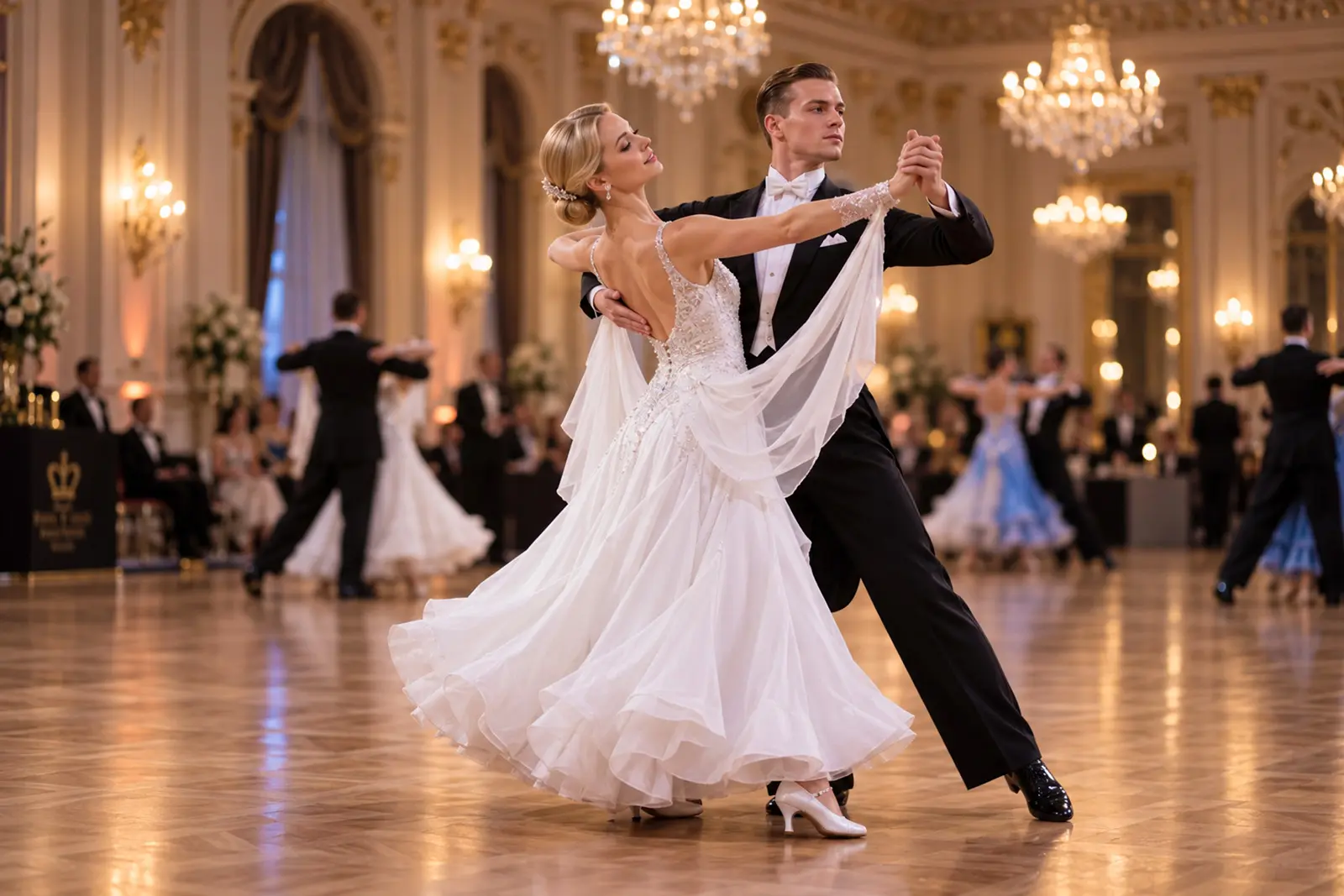
International Standard is the category most closely associated with the classic ballroom image: couples traveling around the floor together in a formal dance hold. It includes slow waltz, tango, Viennese waltz, slow foxtrot, and quickstep.
The partners maintain their hold throughout the dance, creating different shapes and positions without separating into underarm turns or solo passages. Most of these dances have a flowing quality, although tango stands out for its sharper, more grounded movement.
Slow Waltz
Slow waltz, also called the English waltz or simply “waltz”, is a graceful ballroom dance known for sweeping turns and gentle rise and fall. Danced to music with three beats per measure, couples travel smoothly around the floor with a floating quality.
It developed from the older, faster waltz traditions of Europe, with slower forms eventually becoming part of the English ballroom syllabus. International waltz combines traveling turns, changes of direction, and expressive shaping while the partners remain in hold.
Tango
International tango is the most dramatic of the Standard dances, with purposeful walks, sharp changes of direction, and sudden pauses. Rather than floating upward like waltz, the dancers stay more grounded, creating a striking contrast between stillness and explosive movement.
Ballroom tango developed from the tango tradition that emerged around Buenos Aires and Montevideo, but evolved its own technique as it spread internationally. Its compact hold, staccato action, and sharply defined shapes give it a noticeably different appearance from Argentine tango.
Viennese Waltz
Viennese waltz is the fast, continuously turning member of the waltz family. Couples sweep around the room in a flowing series of rotations, creating the grand, romantic atmosphere associated with a traditional Viennese ball.
Like slow waltz, it uses a three-beat rhythm, but the music is considerably faster. The International style centers on turns in both directions and the steps that connect them, creating a relatively compact repertoire performed at high speed.
Slow Foxtrot
Slow foxtrot is a smooth, elegant dance characterized by long, continuous movement. Where waltz has a more obvious upward and downward swing, foxtrot creates a level-looking glide, with subtler rise and fall woven into the dancers’ travel.
Foxtrot developed in the United States in the early 20th century before being refined into an International ballroom style. Closely associated with jazz, swing, and big-band music, its walking actions and passing steps give the dance a relaxed, sophisticated appearance.
Quickstep
Quickstep is the lively, fast-moving dance of the International Standard category. It combines smooth traveling steps with quick changes of direction, closing steps called chassés, and a bright, buoyant character.
It developed in the 1920s from the faster side of foxtrot, with influences from dances such as the Charleston. Advanced quickstep can include runs, hops, skips, and passages where the dancers appear to skim across the floor.
International Latin Ballroom Dances
International Latin includes cha cha cha, samba, rumba, paso doble, and jive. Compared with Standard, these dances allow more changes of hold, separation between partners, and individual expression through the hips, torso, arms, and legs.
The name describes a competition category rather than a strict geographic grouping. Cha cha, samba, and rumba have Latin American roots, while jive grew out of American swing and paso doble draws on Spanish imagery. The ballroom versions also have their own techniques, which can look very different from the social or traditional dances that influenced them.
Cha Cha Cha
Cha cha cha, usually shortened to cha cha, is a playful dance with crisp footwork, expressive hip movement, and a distinctive three-step action. The dance and music developed in Cuba in the 1950s before spreading internationally.
International cha cha uses movements such as forward and backward breaks, turns, and side-by-side figures. The basic timing is commonly counted two, three, four-and-one. Social cha cha shares that rhythmic foundation, although its styling is often more relaxed than the competitive version.
Samba
Ballroom samba is an energetic partner dance known for its rhythmic bounce, rolling body action, and changes of pace. Unlike several other Latin competition dances, it often travels around the floor rather than staying primarily in one area.
It developed from Brazilian samba influences, but is a distinct ballroom style. It should not be confused with samba no pé, the solo samba associated with Carnival, or samba de gafieira, a Brazilian social partner dance.
Rumba
International rumba is a slow, expressive dance that emphasizes the relationship between the partners. Controlled walks, deliberate weight changes, and sustained hip movement create a sensual quality, with room for both tenderness and dramatic tension.
Although its roots are Cuban, ballroom rumba is different from the Afro-Cuban rumba traditions of guaguancó, yambú, and columbia. Its steps are generally taken on beats two, three, and four, and compared with American rumba, the International version typically uses slower music and a different basic structure.
Paso Doble
Paso doble is a proud, theatrical dance inspired by the atmosphere of Spanish bullfighting. Strong walks, lifted posture, sweeping arm movements, and dramatic shapes give it a commanding presence on the competition floor.
The choreography often evokes a matador and the movement of a cape, with additional influence from Spanish imagery and flamenco-inspired gestures. Paso doble is frequently danced to music based on España Cañí, whose recognizable musical highlights help shape competition routines.
Jive
Jive is a fast, exuberant ballroom dance with quick chassés, kicks, flicks, and a lively bouncing action. It brings a playful burst of energy to the International Latin category, even though its roots are in American swing rather than Latin America.
It developed from the broader swing tradition created by African American dancers and musicians. Its basic structure has much in common with East Coast Swing, including a rock step and two triple steps, but competitive jive has its own technique and a sharper, faster character.
American Smooth Ballroom Dances
American Smooth includes waltz, tango, foxtrot, and Viennese waltz. It shares much of its foundation with International Standard, but allows couples to move between a traditional ballroom hold and more open positions.
Depending on the level and rules, dancers can use underarm turns, side-by-side movements, and passages without physical contact. This gives Smooth a more theatrical range of possibilities while retaining the traveling movement and individual character of each dance.
American Waltz
American waltz shares the three-beat rhythm, flowing turns, and gentle rise and fall of International waltz. Its distinguishing feature is the freedom to open the partnership and create shapes that are not possible while maintaining a Standard hold.
Beginners often start with a box step, basic turns, and simple underarm actions. At more advanced levels, couples combine sweeping travel with open turns, changes of position, and extended lines while keeping the underlying rhythm and character of waltz.
American Tango
American tango retains ballroom tango’s deliberate walks, sharp accents, and dramatic pauses, but combines them with the open positions of American Smooth. Partners can turn away from one another, change their connection, and return to a traditional ballroom hold.
Compared with International tango, the choreography has more freedom to use underarm turns and separated shapes. It is also distinct from Argentine tango, which has its own technique, social traditions, and movement vocabulary.
American Foxtrot
American foxtrot is a smooth, relaxed-looking dance associated with jazz standards, big-band music, and the easy elegance of classic movie musicals. It combines walking actions with turns and changes of direction, making it adaptable to both social dancing and competition.
At beginner levels, it often uses a straightforward slow-slow-quick-quick rhythm with steps that close the feet. More advanced dancing adds continuous passing steps and the open turns and side-by-side movements allowed in American Smooth.
American Viennese Waltz
American Viennese waltz combines the rotating, three-beat movement of Viennese waltz with the open choreography of American Smooth. Couples can move from traveling rotations into underarm turns, sweeping arm lines, and separated passages before returning to hold.
Its competition music is generally slower than International Viennese waltz, giving dancers more time for these changes of position. It still retains the fast, continuously turning character that distinguishes Viennese waltz from the slower American waltz.
American Rhythm Ballroom Dances
American Rhythm includes cha cha, rumba, East Coast Swing, bolero, and mambo. Like International Latin, it features expressive body movement, varied partner connections, and dances with strongly contrasting musical personalities.
The two categories share cha cha and rumba, but the American versions have their own syllabus and technical emphasis. Rhythm also replaces samba, paso doble, and jive with bolero, mambo, and East Coast Swing, making it a different program rather than simply another name for International Latin.
American Cha Cha
American cha cha shares the Cuban roots, playful character, and distinctive triple step of International cha cha. Both versions use the familiar two, three, four-and-one rhythm, making them readily recognizable as the same dance family.
The differences lie mainly in the syllabus, technique, and styling. American cha cha includes figures such as crossover breaks, underarm turns, and changes between open and closed positions, combined with crisp timing and expressive hip action.
American Rumba
American rumba is a romantic partner dance with measured steps, expressive hip movement, and a close relationship to the music. Many beginners first encounter it through the box step, which gives the dance a simple and recognizable foundation.
Compared with International rumba, American competition rumba generally uses faster music and a different basic structure. The box is commonly taught with a slow-quick-quick rhythm, and more advanced figures add turns, walking actions, and changes of connection.
East Coast Swing
East Coast Swing is a cheerful, bouncy partner dance that grew from the American swing tradition. It is often one of the first swing styles taught in ballroom studios, with accessible basic patterns and plenty of room for turns and playful interaction.
The triple-step form used in American Rhythm combines two triple steps with a rock step in a six-count pattern. Compared with jive, it generally uses slower music and a more relaxed character, while West Coast Swing uses a different structure and partner connection.
Bolero
Ballroom bolero is a slow, romantic dance that combines expressive hip movement with a flowing, expansive quality. Long side steps, controlled rise and fall, and sustained lines give it a softer appearance than the sharper dances in American Rhythm.
It draws on the Cuban bolero tradition, but the competitive ballroom version has developed its own technique. Its basic rhythm is slow-quick-quick, giving dancers time to stretch through movements and create a smooth, intimate character.
Mambo
Mambo is the fast, rhythmically driven dance of American Rhythm. Quick weight changes, expressive hip action, and energetic turns give it a lively character that will feel familiar to many salsa dancers.
It comes from the Cuban mambo tradition, which became especially influential in New York’s Latin dance scene. Ballroom mambo breaks on the second beat and has its own competition syllabus. The word mambo is also used for New York-style salsa On2, although the two are not identical. Our guide to mambo versus salsa explains the overlap.
Club, Social & Other Partner Dances
Ballroom studios often teach a wider range of partner dances than the four core competition categories. These include Latin club dances, swing styles, and other social dances with their own communities and traditions.
Some also appear as additional events at ballroom competitions or have independent competition circuits. Being a competitive partner dance does not automatically make a style part of International Standard, International Latin, American Smooth, or American Rhythm.
West Coast Swing
West Coast Swing is a smooth, adaptable swing dance with a distinctive elastic connection between the partners. It is usually danced along a narrow space called a slot, with opportunities for both dancers to improvise and respond to the music.
It developed from the wider swing tradition and can be danced to blues, contemporary pop, and many other musical styles. West Coast Swing has a substantial competition scene of its own as well as an active social dance community.
Salsa
Salsa is an energetic social dance known for rhythmic footwork, turns, and playful partner interaction. Its music and movement draw heavily on Cuban traditions, with a major part of its development taking place in New York’s Latin communities.
There are several styles of salsa, including linear styles and Cuban casino. Salsa is now danced worldwide and is frequently taught alongside other Latin and ballroom dances.
Bachata
Bachata is a partner dance from the Dominican Republic, recognized by its rhythmic weight changes and characteristic tap or accent. Traditional dancing emphasizes footwork and musical play, while modern fusion and sensual styles can incorporate more turns and body movement.
It is frequently taught alongside salsa and has grown into a major international social dance with its own festivals, competitions, and communities. Ballroom studios may also include bachata among their broader Latin dance offerings.
Argentine Tango
Argentine tango developed around the Río de la Plata in Argentina and Uruguay. It emphasizes the shared embrace, expressive walking, pivots, and a close relationship to the music, with social dancers creating their dance together rather than following a fixed routine.
It is distinct from both International tango and American tango. Argentine tango has its own social gatherings, performances, and competitions, along with related dances such as tango vals and milonga.
Hustle
Hustle is a flowing partner dance associated with the disco era. Continuous turns, quick changes of handhold, and smooth movement between the partners give it a fast, spinning appearance even when the music has a steady, moderate pulse.
The three-count form commonly taught today can be danced to disco, funk, and suitable contemporary pop. Hustle remains both a social and competitive dance and is frequently included in ballroom studio programs.
Nightclub Two-Step
Nightclub Two-Step is a flowing partner dance designed for slower popular music. It combines compact rock steps with longer side movements, creating a relaxed sway that works especially well with romantic ballads.
Developed by Buddy Schwimmer in the 1960s, it offers a structured alternative to simply swaying together. Despite the similar name, it is different from Country Two-Step, which travels around the dance floor.
Merengue
Merengue is a lively Dominican partner dance with a steady stepping rhythm and continuous hip movement. Because its basic footwork is relatively straightforward, dancers can quickly begin experimenting with turns and changes of handhold.
It is danced socially around the world and commonly taught alongside salsa and bachata. You can learn more about merengue and other styles in our guide to Latin dances.
Lindy Hop
Lindy Hop is a jazz partner dance developed by African American dancers in Harlem. It is known for its swinging rhythm, playful improvisation, and the swingout, a figure that opens and closes the space between the partners.
It is an important part of the history behind later swing styles, including East Coast Swing and jive. Lindy Hop has its own thriving social and competitive communities, and the spectacular aerials seen in performances are not required for ordinary social dancing.
Country Two-Step
Country Two-Step is a traveling partner dance associated with country music. Couples move around the floor using walking rhythms, turns, and changing partner positions, often with a relaxed upper body and a steady sense of forward movement.
It is also called Texas Two-Step and is commonly taught alongside other country partner dances. Country Two-Step has an active social and competition scene and should not be confused with the slower Nightclub Two-Step.
Historical Ballroom Dances
The history of ballroom dancing extends far beyond the modern competition syllabus. Before today’s categories were established, ballrooms hosted a changing mixture of turning couple dances and organized group dances.
These older styles help explain how varied ballroom culture has been. Some are reconstructed at historical dance events, while others continue in folk, community, and social dance traditions.
Polka
Polka is a lively turning partner dance with quick steps and a light hopping action. It became a major ballroom fashion in the 19th century and spread widely across Europe and the Americas.
Although no longer part of the main modern ballroom programs, polka remains alive in numerous social, folk, and regional dance traditions.
Schottische
Schottische is a 19th-century ballroom favorite that combines traveling steps with a turning section. Its characteristic pattern of stepping and hopping gives it a buoyant feel, usually at a more leisurely pace than polka.
Many regional versions developed as it spread. Historical ballroom reconstructions preserve its alternating travel and shared rotation, while related forms remain part of social and folk dance traditions.
Mazurka
Mazurka refers to a family of dances with Polish roots that became influential in European ballrooms. Like waltz, it uses a three-beat musical structure, but its accents and steps give it a different character, often involving hops, stamps, or a pronounced rhythmic lift.
Ballroom adaptations included forms such as the polka-mazurka. While mazurka sits outside today’s main competition programs, it remains an important part of the history of European social dancing.
Quadrille
The quadrille is an organized group dance, usually performed by four couples arranged in a square. Rather than each couple moving independently around the room, the dancers carry out a sequence of coordinated figures together.
Quadrilles were an important part of 19th-century ballroom culture. Their formations and shared patterns connect them to the wider family of square and set dances, illustrating a side of ballroom history quite different from today’s competitive couple dancing.
Ballroom Dance FAQ
Why is it called ballroom dancing?
Ballroom dancing gets its name from the ballroom, a large room used for holding balls, or formal social gatherings centered around dancing. These spaces gave couples room to dance together, and over time the term ballroom dance came to describe a wide range of partner dances associated with social dancing, dance schools, and eventually organized competition.
What are the four main types of competitive ballroom dance?
The four main categories are International Standard, International Latin, American Smooth, and American Rhythm. International Standard and Latin contain five dances each, American Smooth contains four, and American Rhythm contains five.
What are the 10 International ballroom dances?
The 10 International ballroom dances are waltz, tango, Viennese waltz, slow foxtrot, quickstep, cha cha cha, samba, rumba, paso doble, and jive. The first five form International Standard, while the remaining five form International Latin. A 10-dance competition combines both programs.
Why do some ballroom dance lists include 19 dances?
The four main International and American categories contain 19 competition entries altogether: five Standard, five Latin, four Smooth, and five Rhythm. Several dance names appear in both styles, so this does not mean 19 completely unrelated dances. American and International versions are listed separately because their techniques and syllabuses differ.
What is the difference between International Standard and American Smooth?
International Standard maintains the partner hold throughout the dance. American Smooth allows closed hold, open positions, and, depending on the level, separated movements. Standard includes waltz, tango, Viennese waltz, slow foxtrot, and quickstep; Smooth includes waltz, tango, foxtrot, and Viennese waltz.
Are salsa and bachata ballroom dances?
Salsa and bachata are primarily Latin social dances that are also taught in many ballroom studios. They can have their own competition events, but neither belongs to the core International Standard, International Latin, American Smooth, or American Rhythm programs.
Can ballroom dances be danced socially?
Yes. Many ballroom dances are enjoyed socially as well as competitively. Social dancing generally emphasizes connection, musical enjoyment, and movements suited to the available space, while competition adds formal judging, category-specific rules, and a stronger emphasis on technical presentation.
And that’s our guide to the different styles of ballroom dancing! From the sweeping movement of waltz and foxtrot to the lively rhythms of cha cha, swing, and mambo, each dance brings a different personality to the floor. Whether you’re interested in competing or simply finding a dance you enjoy, we hope this list helps you choose where to start. Let us know in the comments which ballroom dances are your favorites!