
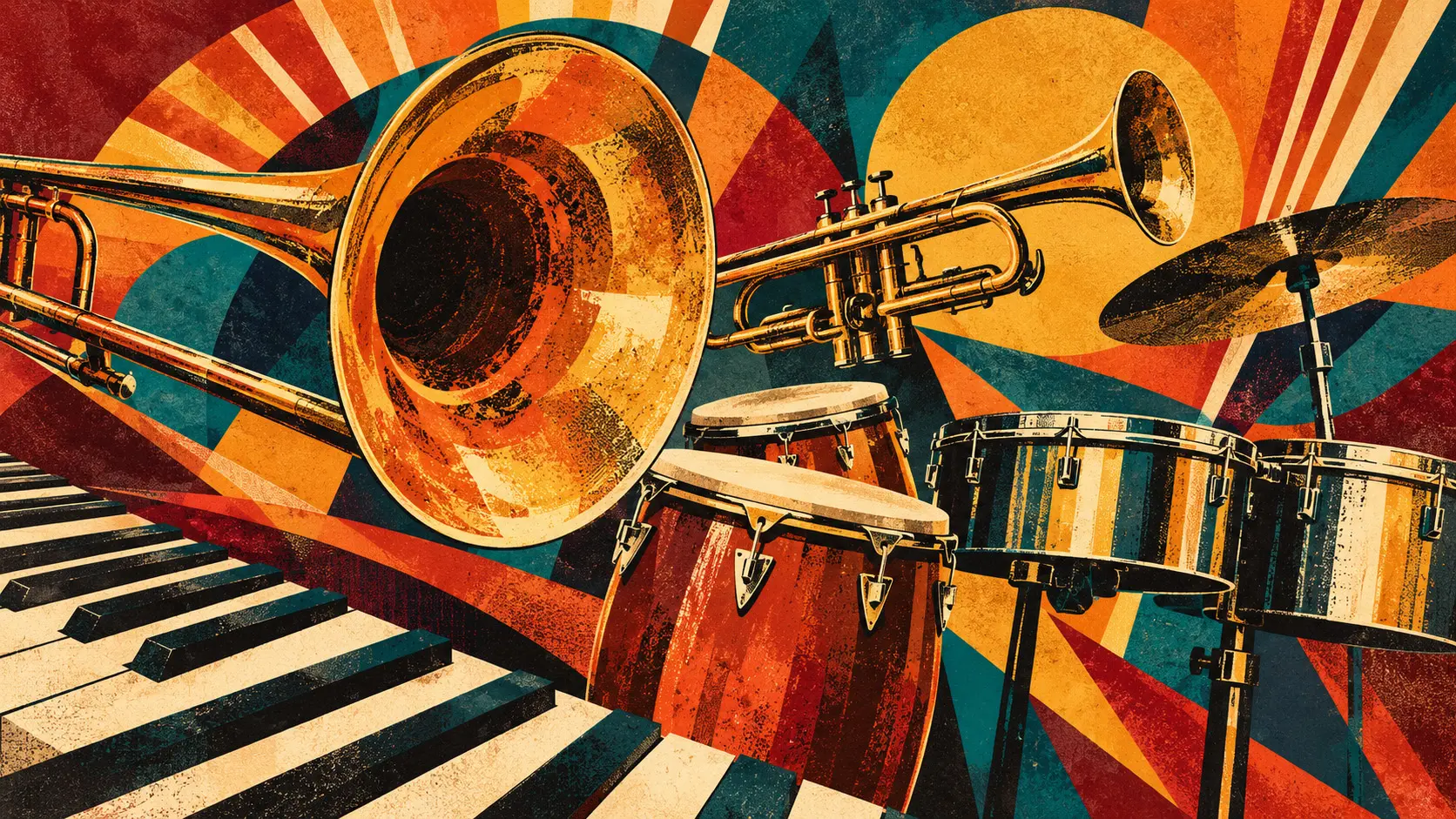
Salsa dura, meaning “hard salsa,” is a powerful, rhythm-driven style of salsa music known for punchy horns, layered percussion, and instrumental solos. Also called salsa brava, it’s closely associated with the New York salsa scene of the 1960s and 1970s, and musicians continue to play and develop the sound today.
What Does Salsa Dura Sound Like?
In salsa dura, the band is as much the focus as the singer. Congas, bongos, and timbales work together with a syncopated bass tumbao and repeating piano patterns called montunos. The underlying clave rhythm helps hold these parts together, even when it isn’t played by an instrument.[1][2]
Horns bring much of the bite. Trumpets and trombones play short, powerful phrases, answer the singer, and land on sharp musical accents. A lead singer may improvise lines while the coro (chorus) repeats a response. Extended piano, brass, or percussion solos give the musicians room to build excitement before the full band comes back together. The “hard” quality comes from this rhythmic drive and forceful playing, not simply from the speed of the music.
Where Did Salsa Dura Come From?
Salsa dura has deep roots in son cubano, son montuno, and other Afro-Caribbean traditions built around layered rhythms, repeated choruses, and improvisation. In New York, the mambo orchestras and Afro-Cuban jazz bands of the 1940s and 1950s helped lay the groundwork for a new generation of Latin dance music.[1][3]
During the 1960s, Puerto Rican and other Latino musicians in New York combined these musical foundations with influences from jazz, soul, and boogaloo. Pianist Eddie Palmieri formed La Perfecta in 1961, giving trombones a prominent role in the band’s bold sound. Willie Colón and singer Héctor Lavoe later developed their own raw, trombone-heavy approach on albums such as El Malo (1967) and The Hustler (1968). Their early recordings mixed contemporary New York influences with traditional Caribbean rhythms.[4][5]
Fania Records, founded by Johnny Pacheco and Jerry Masucci in 1964, played a major role in bringing this harder-edged sound to international audiences. The label recorded artists such as Willie Colón and Ray Barretto, while the Fania All Stars brought leading salsa musicians together for high-energy concerts full of improvisation. Their landmark performance at the Cheetah Club on August 26, 1971, was featured in the documentary Our Latin Thing, released the following year.[6]
On film: Our Latin Thing captures the Fania All Stars onstage along with the New York communities and culture surrounding the salsa boom. The performance footage shows the close interplay between singers, instrumentalists, and the rhythm section.
Our Latin Thing (Nuestra Cosa Latina), released in 1972. Restored documentary uploaded by Fania Records.
As salsa grew across Puerto Rico, Latin America, and beyond, bands developed a wide range of sounds. Today, the term salsa dura is commonly used for the harder-edged side of the classic salsa era, rather than every salsa recording made in the 1960s and 1970s.[7]
6 Essential Salsa Dura Songs
The best way to get to know salsa dura is through the music. These six recordings showcase different sides of the style, from powerful horn arrangements and explosive percussion to extended instrumental improvisation, with one classic from each artist or group.
1. “Azúcar” by Eddie Palmieri
Recorded with La Perfecta in 1965, “Azúcar” stretches far beyond the length of a typical radio single, giving Palmieri’s piano and the trombone section room to build and improvise. The extended instrumental passages and strong dance rhythm make it an early example of the band-centered energy that would become associated with salsa dura.
2. “Aguanile” by Willie Colón and Héctor Lavoe
“Aguanile” opens with a dramatic vocal invocation before moving into a driving groove. Lavoe’s voice cuts through the heavy trombone lines, while the chorus and percussion build tension toward powerful rhythmic breaks. It’s a striking example of the raw sound associated with Colón and Lavoe’s collaborations.
3. “Indestructible” by Ray Barretto
Barretto’s congas and the bright brass section give “Indestructible” a strong rhythmic punch, while Tito Allen’s expressive vocals carry the melody. The recording balances tight ensemble playing with bursts of instrumental energy, making it an approachable example of classic 1970s salsa dura.
4. “Quimbara” by Celia Cruz and Johnny Pacheco
On “Quimbara,” Celia Cruz’s commanding voice trades energy with a repeating chorus as Pacheco’s band drives forward with lively percussion and horns. The song’s momentum and rhythmic exchanges make it one of the most accessible introductions to salsa dura, especially for dancers.
5. “Agúzate” by Richie Ray and Bobby Cruz
“Agúzate” shows off Richie Ray’s energetic piano playing and the duo’s explosive musical personality. Rapid piano runs, bold horn phrases, and Bobby Cruz’s urgent vocals give the song a playful intensity that keeps pushing the arrangement forward.
6. “Fuego en el 23” by La Sonora Ponceña
La Sonora Ponceña’s recording of “Fuego en el 23” brings a distinct Puerto Rican orchestra sound to the list. Papo Lucca’s piano, a trumpet-driven horn section, and lively percussion work around a memorable chorus, showing that the harder side of salsa extended well beyond New York’s bands.
Salsa Dura vs. Salsa Romántica
Salsa romántica rose to prominence in the 1980s, emphasizing romantic lyrics, smoother vocals, and melodic arrangements influenced by pop ballads. The 1982 project Noche Caliente helped establish this approach. By comparison, salsa dura tends to place more emphasis on the band’s rhythmic drive, bold horn arrangements, and instrumental exchanges.[8]
The difference also shapes the experience on the dance floor. Salsa dura’s strong horn accents, breaks, and solos offer opportunities for playful footwork, pauses, and sharp changes in movement. Salsa romántica often has a smoother, more relaxed feel, which many dancers enjoy for flowing partnerwork and a gentler pace over a long night. Both styles offer plenty of musicality, but they invite dancers to express it in different ways.
Salsa Dura Today
Salsa dura remained part of the music scene even as salsa romántica became commercially dominant in the 1980s and 1990s. New generations of musicians have continued to draw inspiration from the classic sound, creating new recordings with the same emphasis on rhythm, horns, and improvisation.
New York’s Spanish Harlem Orchestra, led by pianist and arranger Oscar Hernández, carries on the tradition with sophisticated arrangements and a powerful rhythm section. Its 2024 album Swing Forever is one example of that approach. The Barcelona-based band Tromboranga also draws heavily on the classic salsa dura sound, putting trombones and percussion at the center of its music.[9][10]
From the classic recordings of the 1960s and 1970s to today’s orchestras, salsa dura continues to appeal to listeners and dancers who love the sound of a full band playing with power, precision, and energy.
For a wider look at how it fits into salsa’s musical landscape, explore our guide to the different styles of salsa music.
References
- Smithsonian Folkways. Music of Cuba, liner notes by John Santos, p. 4, “Band 3: Son.” URL: https://folkways-media.si.edu/docs/folkways/artwork/FW04064.pdf
- Berklee Online. “Latin Piano Styles.” Discussion of clave, montuno, and tumbao. URL: https://online.berklee.edu/courses/latin-piano-styles
- Juan Flores. Salsa Rising, Oxford University Press, 2016, chapter “Boogaloo Soul.” URL: https://academic.oup.com/book/6051/chapter/149485363
- National Endowment for the Arts. 2013 NEA Jazz Masters, Eddie Palmieri profile, p. 11. URL: https://www.arts.gov/sites/default/files/2013-JazzMasters.pdf
- Fania Records. “The Hustler.” Album notes on Willie Colón, Héctor Lavoe, and their early recordings. URL: https://fania.com/record/the-hustler/
- Fania Records. “Fania History Timeline.” Entries for 1964, 1971, 1972, and 1974. URL: https://fania.com/history/
- National Park Service. “Salsa Is More Than Salsa.” Musical styles, cultural exchange, and the international salsa movement. URL: https://www.nps.gov/articles/000/salsa-is-more-than-salsa.htm
- Fania Records. “Giant Force.” Album notes discussing Louie Ramírez, Ray de la Paz, and Noche Caliente. URL: https://fania.com/record/giant-force/
- Spanish Harlem Orchestra. “About.” The orchestra’s history, musical approach, and Swing Forever. URL: https://www.spanishharlemorchestra.com/about
- Tromboranga. “The Band.” Biography and the group’s salsa dura influences. URL: https://www.tromboranga.com/en/the-band