
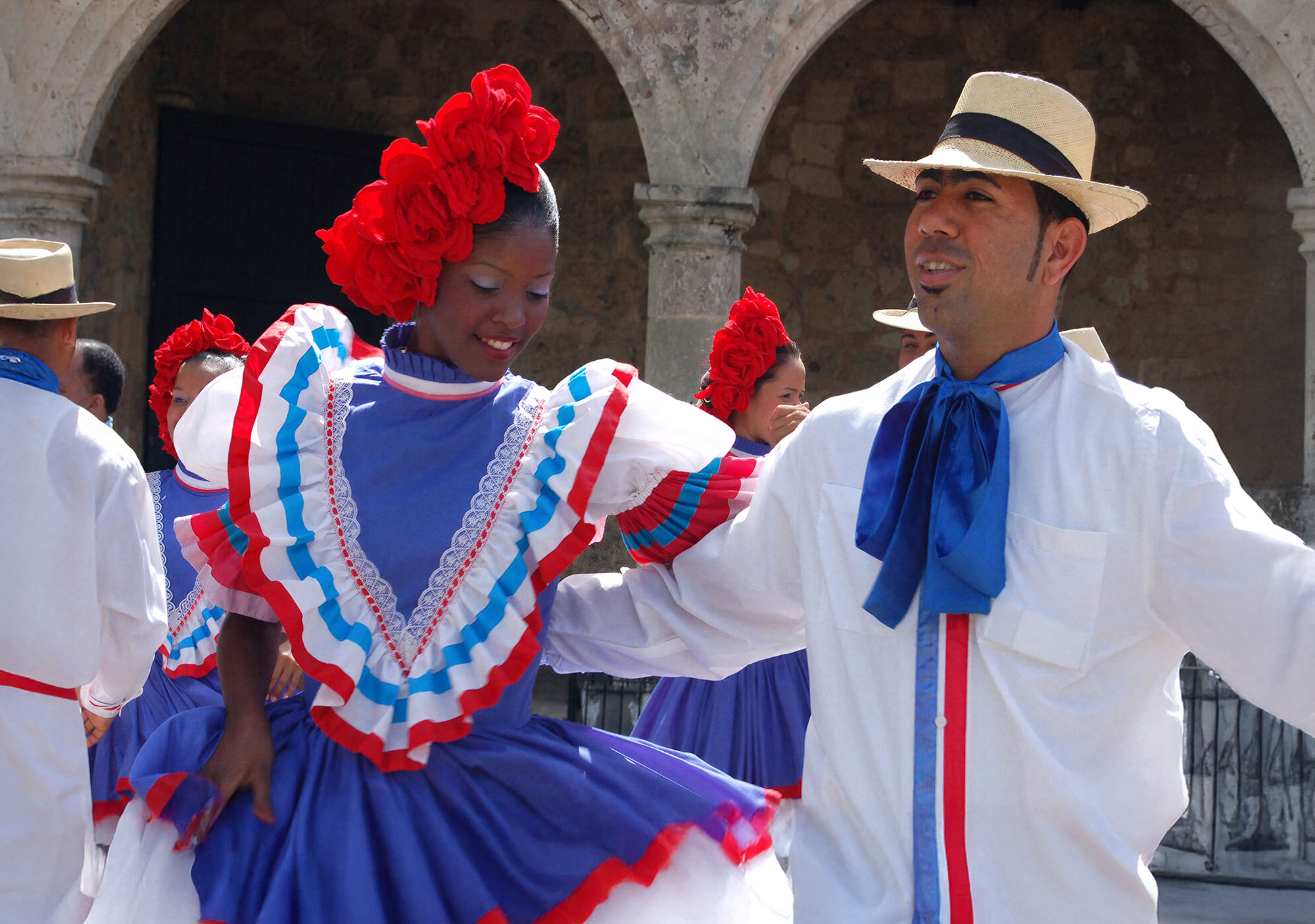
Summary. Merengue is a Dominican partner dance with a steady rhythm, simple basic step, and fun, social feel. Many dancers first meet it as an easy Latin dance for beginners, but good merengue has more musicality, style, and history than people often expect. You will learn where merengue comes from, how to recognize it, how the dance works, what the music sounds like, the main styles and variations, common myths to avoid, and where you may encounter it today. [1][2][3]
Quick facts
| Origin/Region | Dominican Republic, with early documented history tied to the Cibao, a northern Dominican region [1][4] |
| Music/Ensemble | Típico often centers accordion, tambora, and güira, while modern orquesta formats add horns, piano, bass, and other arranged elements [5][6][7] |
| Meter/Feel | Steady and driving, but not limited to one timeless groove. Variants such as pambiche and pri-pri change the feel [6][7] |
| Dance style | Social couple dance practiced in pairs, often with playful interaction [2] |
| Typical context | Parties, festivals, family gatherings, live music, community events, and Dominican communities abroad [2][3] |
| Difficulty | Beginner-friendly at the basic level, though deeper listening and style take time [8] |
| Also known as | Common style labels include merengue típico or perico ripiao, merengue de orquesta, pambiche, and pri-pri [6][3] |
What is merengue?
Merengue is a Dominican partner dance danced with a steady 1-2-3-4 rhythm, usually stepping on every beat. It is known for its simple marching or side-to-side basic, relaxed partner hold, and the hip motion that comes naturally from the weight changes. Because the rhythm is easy to hear and the basic step is straightforward, merengue is often one of the first Latin social dances beginners learn. Dancers can keep it simple or add turns, changes of position, and playful partner interaction in both closed and open hold. [2][8][1]
Merengue is also the national dance of the Dominican Republic and an important part of Dominican identity. In practice, the word merengue often refers to both the dance and the music, since the two belong closely together in Dominican culture. The music typically has a strong, steady pulse that makes the dance easy to follow, whether you are hearing traditional accordion-led merengue típico or a bigger band sound with horns. [2][1][5]
Although merengue is often taught as a very beginner-friendly dance, that does not mean it is just a basic march in place. Good merengue still has timing, connection, musicality, and style. Social dancers may keep the movement compact and relaxed, while more experienced dancers play with turns, rhythm changes, phrasing, and how they match the energy of the music. [8][2]
Origins and history
Merengue originated in the Dominican Republic, with documented history going back to the mid-1800s. Scholars generally place the merengue music-and-dance tradition in the 1850s, especially in the Cibao, a northern Dominican region closely tied to its early development. Like many Caribbean partner dances, merengue did not appear out of nowhere. It grew within a wider world of related couple dances and was shaped by a mix of local Dominican practice, African influences, and European dance traditions brought to the Caribbean through Spanish colonial rule. In particular, the idea of a partnered couple dance has roots in European ballroom and contradance traditions, which were adapted locally over time into something distinctly Dominican. [1][4][10]
The earliest clear documentary reference often cited today comes from November 26, 1854, when the word merengue appeared in the Dominican newspaper El Oasis. Scholarship notes that this early mention criticized the dance’s movements, which suggests merengue was already visible enough in society to attract commentary and debate. That 1854 reference is important because it gives us a real historical anchor, even if the dance itself had likely been developing before then. [9][4]
As merengue developed, it became more deeply associated with Dominican identity. At the same time, its history was never completely isolated from the rest of the Caribbean. Researchers note links to other regional dance traditions, including contradance and danza-family forms, and argue that Haitian-Dominican cultural exchange has often been downplayed in nationalist retellings. In other words, merengue is unmistakably Dominican, but it also grew out of a connected Caribbean world rather than a sealed-off national story. [4][10]
There are also popular legends about how merengue began, but they should be treated carefully. Stories that it started exactly in 1844 at the moment of Dominican independence, or that its step came from the limp of a wounded soldier, are memorable pieces of folklore rather than settled historical fact. Hutchinson’s work on the cojo, or “limp,” suggests it is better understood as a layered stylistic idea within dance and carnival culture, not as proof of one single origin story. [4][11]
Merengue kept changing as Dominican society changed. During the U.S. occupation from 1916 to 1924, scholarship describes a smoother variant called pambiche or apambichao, often linked in these accounts to the label “Palm Beach” and to shifts in dancing style. Later, under Rafael Trujillo’s rule from 1930 to 1961, merengue was promoted more strongly as a national symbol, while big-band and salon formats helped expand its sound and public reach. That is part of why merengue’s rise cannot be reduced to one single event or decree. It developed over time through social life, politics, and the media. [7][6][10]
By the 1950s, merengue was also spreading beyond the Dominican Republic. It circulated in the United States through record-label networks such as Ansonia Records, and the NYU Latinx Project notes that the merengue “A lo oscuro” sold more than 75,000 copies by October 1954. From the 1960s onward, a strong merengue típico scene connected Santiago and New York City, showing how Dominican communities abroad helped carry the tradition into new settings while also reshaping it. UNESCO added “Music and dance of the merengue in the Dominican Republic” to its Representative List of the Intangible Cultural Heritage of Humanity in 2016, and today merengue remains a central part of Dominican culture as well as a familiar dance across the wider Latin dance world. [12][3][14][2]
Music and instruments
Merengue music is easy to recognize once you know what to listen for. It usually has a strong, steady pulse that keeps the dance moving, along with a bright scraped sound and a driving drum pattern. Two of the most important instruments are the tambora, a double-headed drum, and the güira, a metal scraper that gives merengue much of its crisp, energetic texture. Together, they create the rhythmic foundation that makes merengue feel so continuous and danceable. [13][5][6]
If you want to hear that sound clearly, merengue típico is a great place to start. This traditional style, also often called perico ripiao, is built around accordion, tambora, and güira. Contemporary típico groups may also add instruments such as alto saxophone and electric bass. Older ensembles once used string instruments before the accordion became central in the late 1800s, but today the accordion-led sound is one of the clearest musical signs of traditional merengue. [2][5][13]
At the same time, merengue is not only an accordion-based style. Many people know merengue through larger bands and orchestras that use instruments such as piano, trumpet, saxophone, trombone, bass, tambora, and güira. That fuller, brassier sound became especially important as merengue spread through radio, recordings, dance bands, and public performance. Even so, instruments like tambora, güira, and accordion still carry a strong connection to merengue’s traditional roots. [6][7]
There is also more variety in merengue music than many beginners expect. Different styles can change the tempo, texture, and overall feel, including forms such as típico, pambiche, and pri-pri. Some merengue feels fast and driving, while other versions are smoother or more relaxed. For dancers, the best approach is not to memorize one rigid formula, but to listen for the pulse, the scrape of the güira, and the way the band shapes the energy of the song. [6][7][8]
How merengue is danced
Merengue is usually danced as a partner dance with a simple step on every beat, which is one reason it is often considered one of the easiest Latin dances to start with. The basic movement is steady and repetitive, and couples can keep it simple with a relaxed side-to-side or marching feel. From there, they may add turns, changes of position, and playful interaction without needing a huge vocabulary of patterns. [2][8]
Even though the basic step is simple, merengue is not always effortless. Some songs can get quite fast, and dancing continuously on every beat can take more stamina than beginners expect. So while merengue is easy to start, it can still be physically demanding when the music picks up. [8][13]
In social settings, merengue is usually danced in a casual, playful way rather than treated as an ultra-technical dance. Partners often dance in closed or open hold, stay fairly compact, and focus more on enjoying the rhythm than on showing off complicated movement. Good dancers still pay attention to timing, connection, and the feel of the music, but most social merengue is meant to be fun, relaxed, and easy to join. [2][8]
That is also why merengue has remained more of a casual social dance than a highly codified performance or competition dance. You do sometimes see it in ballroom settings or mixed dance events, but it has never developed the same kind of global technical scene that bachata has in recent years. Merengue is still widely danced, just usually in a more informal and social spirit. [8][2]
- Start with small, steady steps that match the beat.
- Keep the connection relaxed and the movement compact.
- Add simple turns or position changes once the basic rhythm feels natural. [2][8]
Variants and related forms
Merengue is not just one single sound or style. The best-known traditional form is merengue típico, which is strongly associated with the Cibao and with Dominican communities in places such as Santiago and New York. If you want the most rootsy and immediately recognizable version of merengue, this is usually the place to start. It is built around accordion, tambora, and güira, and it keeps a very direct connection between the music and the dance. [3][14][5]
Another major branch is orchestral merengue, also called merengue de orquesta or salon merengue. This version uses a bigger band sound with instruments such as horns, piano, and bass, giving it a fuller and more polished feel. It became especially important in the 20th century as merengue spread through radio, recordings, dance bands, and public performance. For many listeners outside the Dominican Republic, this bigger-band version is the merengue sound they know best. [7][10][6]
There are also smaller style variations within merengue itself. Pambiche or apambichao is often described as smoother or a little slower in feel, and some accounts connect it to the U.S. occupation era and the phrase “Palm Beach.” UNESCO materials also mention pri-pri, a variant associated with 12/8. The main takeaway is that merengue has never been just one fixed groove. Different regions, musicians, and eras have all shaped it in different ways. [7][6]
Merengue has also continued to evolve in modern settings. UNESCO materials mention merengue de calle, and scholarship on New York scenes discusses hybrids such as merengue con mambo as well as versions influenced by hip-hop, reggaetón, rock, and house. So even though some styles are often treated as more traditional or more authentic, merengue has always changed as it moved through different places and communities. [6][14][10][3]
Merengue has also influenced other Dominican partner dances, especially bachata. Older social bachata has long shared space with merengue in Dominican dance culture, and some of the simpler side-to-side partner logic feels familiar across both dances. Today bachata has exploded globally and branched into many styles of its own, but it developed in a dance world where merengue was already an established social staple. [2][10]
Where you may encounter merengue today
Merengue is still a big part of social dancing in the Dominican Republic, where you can find everything from family parties to clubs and events built around merengue music itself. Outside the Dominican Republic, it also remains highly visible in Latino communities abroad, especially in places such as New York City and across the United States. In practice, many dancers first encounter merengue not in a dedicated merengue scene, but at mixed Latin nights, community events, family celebrations, and clubs where DJs play a range of Latin genres. In the U.S., merengue is especially common in broader Latino dance spaces, including many Mexican and mixed Latino scenes, where it is often treated as a familiar party staple even by people who do not think of themselves as “merengue dancers.” [6][2][3]
At the same time, merengue is less common at highly specialized salsa socials, bachata socials, and large congress-style events, where the music is usually more narrowly focused. In those spaces, if merengue appears at all, it is often just a song or two to change the energy, unless the event has a specific merengue class, workshop, or Dominican focus. [2][3]
Where you can find merengue:
- Mixed Latin nights, especially salsa, bachata, cumbia, and merengue events
- Dominican clubs, cultural events, and festivals
- Family parties, weddings, and community celebrations
- Beginner Latin dance classes and general social dance nights
- Latin playlists, live bands, and DJs mixing up the energy of the room
Common misconceptions
- Myth. Merengue began in 1844 as a patriotic battlefield dance. The real history is less neat than that. The earliest commonly cited documentary reference comes from 1854, and researchers place merengue within a broader Caribbean dance world rather than tying it to one exact founding moment. [9][4]
- Myth. The “limp” story proves where merengue came from. That story is part of merengue folklore, but it is not solid proof of a single origin. Researchers treat the cojo, or limp, as a more layered idea that shows up in dance and carnival culture. [11]
- Myth. Merengue is just a simple one-step. The basic step is easy to learn, but good merengue is more than marching in place. Strong dancers are listening to the phrasing, responding to the rhythm, and matching the feel of the music. [8]
- Myth. All merengue sounds the same. It does not. Merengue includes different variants, ensemble types, and rhythmic feels, including styles such as pambiche and pri-pri. [6][7]
- Myth. Merengue developed in total isolation from the rest of the Caribbean. Like many dance traditions in the region, merengue grew within a wider Caribbean world of shared influences and exchange, even if later national stories sometimes downplayed that. [4][10]
References
- “Merengue.” Oxford Encyclopedia of Latinos and Latinas in the United States, Oxford Reference / Oxford University Press, n.d. https://www.oxfordreference.com/display/10.1093/oi/authority.20110803100151255
- “Music and dance of the merengue in the Dominican Republic.” UNESCO Intangible Cultural Heritage (2003 Convention) – Representative List, 2016. https://ich.unesco.org/en/RL/music-and-dance-of-the-merengue-in-the-dominican-republic-01162
- Hutchinson, Sydney. “Merengue Típico in Santiago and New York: Transnational Regionalism in a Neo-Traditional Dominican Music.” Ethnomusicology, Society for Ethnomusicology, 2006. https://www.jstor.org/stable/20174423
- Hutchinson, Sydney. “Entangled Rhythms on a Conflicted Island: Digging up the Buried Histories of Dominican Folk Music.” Resonancias, 2016. https://pdfs.semanticscholar.org/0103/71cf36045df91bf966e522dcadbc66909ac5.pdf
- “Merengue Típico from the Dominican Republic.” Smithsonian Folkways Recordings, Smithsonian Institution, 2008. https://folkways.si.edu/la-india-canela/merengue-tipico-from-the-dominican-republic/caribbean-latin-world/music/album/smithsonian
- “Inventory extract submitted to UNESCO: The Dominican Merengue (Inventory of Intangible Cultural Heritage, Dominican Republic).” UNESCO Intangible Cultural Heritage supporting documentation, 2015. https://ich.unesco.org/doc/src/32118.pdf
- Torres-Saillant, Silvio, and others. Juan Luis Guerra and the Merengue: Toward a New Dominican National Identity. CUNY Dominican Studies Institute, The City College of New York, 2013. https://www.ccny.cuny.edu/sites/default/files/dsi/upload/Juan-Luis-Guerra-and-the-Merengue.pdf
- Hutchinson, Sydney. “Dancing lo típico: A Choreomusical Perspective on Merengue.” the world of music (new series), Vol. 9 No. 2, 2020. https://www.jstor.org/stable/26970279
- “Brochure merengue (Día del Merengue – 26 de noviembre).” Ministerio de Relaciones Exteriores, República Dominicana, 2025. https://mirex.gob.do/wp-content/uploads/2025/02/brochure_merengue.pdf
- Austerlitz, Paul. Merengue: Dominican Music and Dominican Identity. Temple University Press, 1997. https://www.bibliovault.org/BV.book.epl?ISBN=9781439922699
- Hutchinson, Sydney. “A Limp with Rhythm: Convergent Choreographies in Black Atlantic Time.” Yearbook for Traditional Music, International Council for Traditional Music, 2012. https://www.cambridge.org/core/journals/yearbook-for-traditional-music/article/abs/limp-with-rhythm-convergent-choreographies-in-black-atlantic-time/327E2D97FA1EF001217702F24C0FD476
- “Ansonia Records and Dominican Merengue’s Place in Latin Music History.” NYU Latinx Project, n.d. https://www.latinxproject.nyu.edu/intervenxions/ansonia-records-and-dominican-merengues-place-in-latin-music-history
- “Merengue and Dominican Identity with Paul Austerlitz.” Afropop Worldwide, 2016. https://www.afropop.org/articles/10658
- Hutchinson, Sydney. “Merengue ‘típico’ in New York city: a history.” Camino Real: estudios de las hispanidades norteamericanas, 2011. https://ebuah.uah.es/dspace/handle/10017/11125