
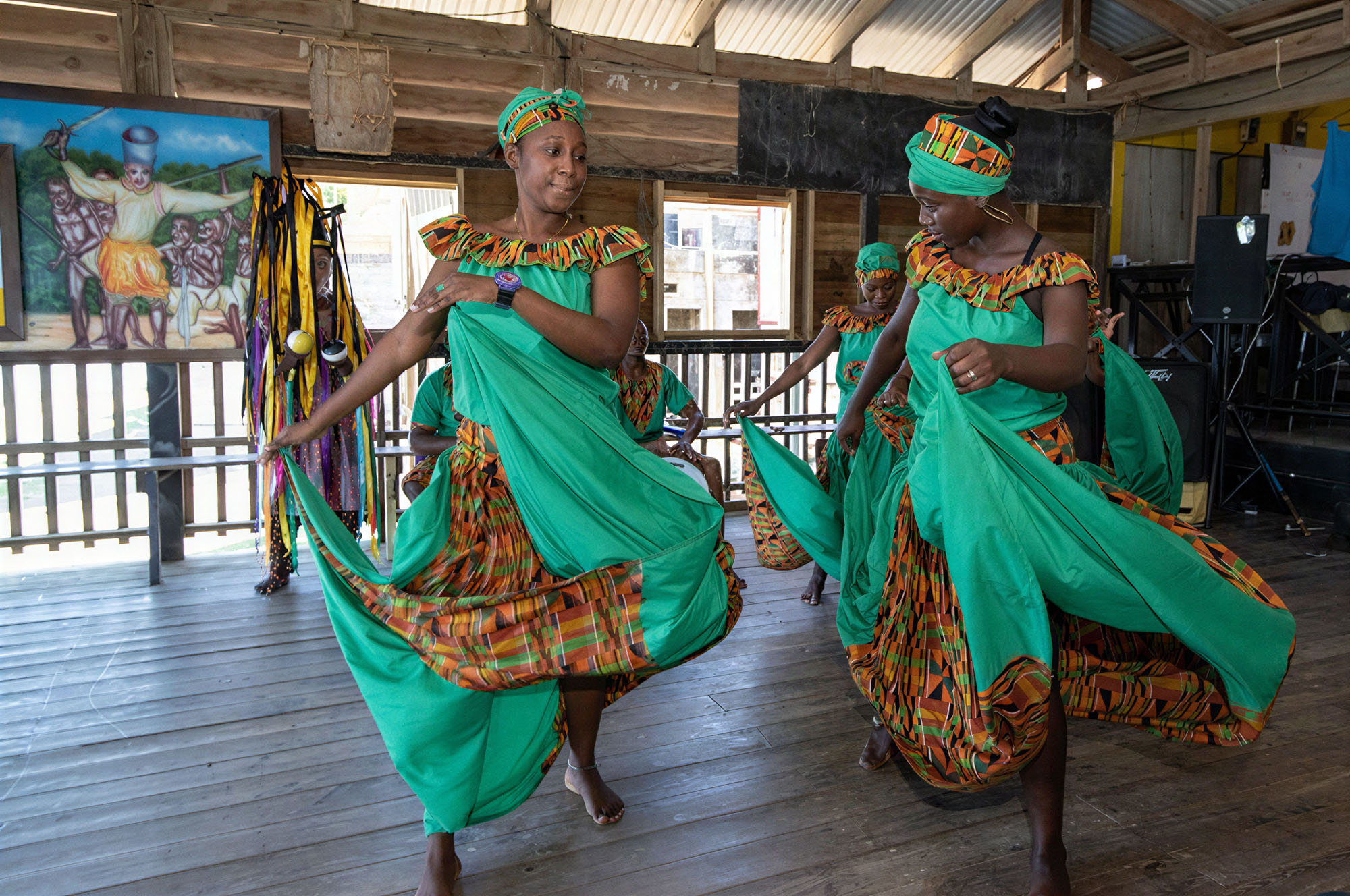
Summary. Punta is a music and dance tradition of the Garifuna, a people with African and Indigenous Caribbean roots. It is known for fast hip movements and playful, improvised exchanges between dancers.[1][7][12] Punta is practiced in Garifuna communities along the Caribbean coasts of Belize, Guatemala, Honduras, and Nicaragua, as well as in Garifuna communities in other countries.[1][4] Garifuna history reaches back to Saint Vincent, where British authorities forced the Garifuna into exile in 1797.[4] At parties, holidays, and some funeral gatherings, dancers may step into a circle of singers and clapping spectators to challenge one another in turn.[12][11]
Quick facts
| Origin/Region | Practiced mainly in Garifuna communities in Belize, Guatemala, Honduras, and Nicaragua. Garifuna history reaches back to Saint Vincent, but the exact place and date where Punta began are not known.[1][4][12] |
| Music | Garawoun drums, also written garaon, with primero and segunda parts, singing, handclaps, and other percussion.[3][5][11] |
| Movement style | Fast or circular hip movement leads the dance. A woman and a man often dance separately inside a circle of people who sing and clap.[10][12] |
| Costume | Formal performances may use colorful Garifuna clothing, including full patterned skirts, blouses or dresses, head ties, long-sleeved shirts for men, and sometimes metal anklets.[3][12] |
| Where it is danced | Parties, community gatherings, holidays, nightlife, and some funeral observances.[3][11] |
| What makes it difficult | Dancers must combine strong hip movement with controlled posture, careful footwork, musical timing, and quick responses to a partner.[10][12] |
| Related traditions | Hunguhungu, chumba, and Wanaragua are separate Garifuna dance traditions. Punta rock is a modern related style that uses electric or electronic instruments.[4][5][12] |
The Garifuna are a people with African and Indigenous Caribbean roots. Their culture and identity developed on Saint Vincent, and today their largest communities are mainly found along Central America’s Caribbean coast. Garifuna can refer to the people, their culture, or their Arawak language. Garinagu is another word used for the Garifuna people as a group.[1][3][8]
Origins & history
Garifuna culture and identity developed on Saint Vincent as Indigenous Caribbean peoples and Africans came together during the colonial period. Saint Vincent is known as Yurumein in Garifuna tradition. The island became the homeland of a distinct people whose music, language, and dance reflect both parts of that history.[1][3][4]
In 1797, British authorities forced the Garifuna from Saint Vincent. Survivors settled along the Caribbean coast of Central America, especially in what are now Honduras, Belize, Guatemala, and Nicaragua.[4] They carried their drumming, singing, dancing, language, and community traditions with them.
No one knows exactly when or where Punta began. Today, it is one of the best-known Garifuna music and dance traditions in the Central American communities formed after the exile. It is used for both celebration and funeral observances.[3][12][11] Punta is also part of a larger family of Garifuna dances. A Belizean guide lists it alongside hunguhungu, Wanaragua, chumba, and other forms, each with its own rhythm and performance style.[3]
In the 1970s, musicians created Punta rock by adding electric and electronic instruments to Punta’s rhythms.[12][11] This newer style brought Punta rhythms into popular music, while traditional Punta continued at community events. Not everyone welcomed the change. One Louisiana account says many younger listeners embraced Punta rock, while some older people felt it was not truly traditional. The debate shows how Garifuna music has continued to balance tradition with new ideas.[11]
UNESCO recognized Garifuna language, dance, and music in 2001. In 2008, they were added to UNESCO’s Representative List of the Intangible Cultural Heritage of Humanity.[1][4] Today, traditional and modern forms continue across Central America and in Garifuna communities in other countries. Traditional Punta remains active at social and family gatherings.[11]
Steps & style hallmarks
Punta is led by the lower body, especially the hips, legs, and feet. Some descriptions focus on a quick side-to-side sway. Garifuna dancer Nodia Mena describes circular hip movement with an upright upper body and slowly moving feet.[10][11] These descriptions do not have to conflict. One describes the direction of the hip movement, while the other explains how the dancer controls the upper body and feet. In both styles, the lower body can look fast and expressive even when the rest of the body moves more slowly.
In one common setup, a woman and a man dance separately inside a circle instead of holding each other in a set partner position. The people around them sing, clap, watch, and help drive the exchange. The dancers may face one another, move apart, and respond to the drums while keeping most of the movement in the hips and lower body.[12]
Much of the interaction is improvised. One dancer may follow or pursue the other in a courtship-like exchange, and then the roles may reverse. Each dancer can answer with a new movement or variation. They may also try to outdo one another until one dancer finishes and someone else enters the circle.[12] The pursuit, role changes, and new hip patterns give each pair room to make the exchange their own.
The circle is an active part of the dance. Singers and spectators clap and answer the lead singer. Dancers waiting outside the circle may step in when someone finishes or runs out of ideas. The group keeps the performance moving from one pair to the next. This paired circle is common, but it is not the only way Punta can be danced. It is a clear example of how individual skill and group participation work together.[12]
Music & instruments
Traditional Punta uses Garifuna drums, singing, handclaps, and other percussion. A Belizean source writes the drum name as garawoun, while some English-language sources use garaon.[3][11] The primero and segunda drums play different patterns at the same time, creating what musicians call a polyrhythm.[5] Together, they form a layered rhythm that dancers respond to. Other drum roles may change from one group to another, and not every group uses the same three-drum setup.[5][10][11]
Other percussion may include maracas made from calabash gourds, turtle shells, conch shells, and similar instruments made from local materials.[12] Singers and clapping participants are also part of the performance. Together, they create the pulse that dancers answer inside the circle.
Punta can refer to both a rhythm and a type of dance song. Research also notes that women often compose Punta songs.[7] An EBSCO overview says the lyrics are usually sung in Garifuna.[12] In Nodia Mena’s description of Punta gatherings, one woman led the singing while the others waited for her signal to respond. She remembers songs about love, desire, betrayal, fear, pain, happiness, and daily life.[10] More broadly, UNESCO describes Garifuna songs as a way to pass history and useful knowledge from one generation to the next.[2]
Costume & staging
Stage performances and formal events may feature colorful Garifuna clothing. A Belizean cultural guide describes women’s clothing made from checkered fabric. A full skirt may be worn with a blouse or dress and a head tie knotted at the back. Skirts may be gathered or made in panels with pleats near the bottom. Blouses may be fitted at the waist and buttoned in front.[3] Another Punta source describes bright full skirts for women, long-sleeved tops for men, and metal anklets in some performances.[12]
There is no single costume required for every Punta event. Modern stage performances may also use clothing influenced by African fashion and by Black communities outside Africa. Informal social dancing may be more casual and varied.[3] In one childhood memory of the Feria de San Juan, Nodia Mena wore a small red top and a wide floral-print skirt.[10]
Related dance traditions
Punta is part of a larger group of Garifuna dances that includes hunguhungu, chumba, and Wanaragua. These dances may use similar drums and call-and-response singing, but each has its own rhythm, movement, and social or ceremonial purpose.[3][5] Wanaragua, for example, tells a story of resistance against colonial forces rather than using Punta’s usual back-and-forth between two dancers.[4]
Punta rock is the best-known modern relative of Punta. It keeps Punta’s basic rhythms while adding electric or electronic instruments. This creates a popular style of music that can be heard outside the traditional dance circle.[12]
Where to experience it now
Punta remains part of community life in Belize, Guatemala, Honduras, and Nicaragua. It also continues in Garifuna communities in the United States. Punta may appear at home gatherings, parks, clubs, holidays, and some funeral observances.[1][4][11] In New Orleans, women have helped keep Garifuna traditions strong through teaching, storytelling, organizing, and community celebrations. Their work is part of a wider pattern in which women play an important role in passing traditions to younger generations.[6][11]
Hostal Garifuna in Orinoco, Nicaragua, currently lists an introductory Punta lesson as part of its community tourism program.[9] Offerings can change, so travelers should confirm that the lesson is available before planning a visit. Local Garifuna cultural groups, festivals, and community events are also good places to look for performances or workshops.
Frequently asked questions
Is Punta a courtship dance?
It can include a courtship-like exchange, but that is only one part of the tradition. In one common form, a man follows or pursues a woman before the dancers switch roles. The pair may also challenge one another through improvised movement.[12] This pursuit gives dancers a structure to play with, but it is not a literal story that every pair must act out. Punta is also danced at celebrations, holidays, and funerals, where its meaning goes far beyond courtship.[11]
Is Punta danced at funerals?
Yes. At some funerals, Garifuna participants dance Punta at the home of the person who died. One account says the dance may help guide the person who died while also bringing some comfort to the family.[11] Nodia Mena separates joyful Punta linked with happiness or births from a more sorrowful way of dancing after a death.[10]
What are Punta songs about?
Punta songs may cover love, desire, betrayal, fear, pain, happiness, events, rituals, and community concerns. Researcher Oliver Greene describes Punta as a type of dance song that is often composed by women.[7] Nodia Mena’s personal account gives one example of how these themes are sung and remembered at a Garifuna gathering.[10]
Where does the name "Punta" come from?
No one knows for certain where the word comes from. One theory connects it with a West African word written as bunda. Other theories connect it with Spanish words related to a tip, point, or place. Another story says the name comes from dancing on the tips of the toes.[12][11] None of these theories has been proven.
Why is Punta sometimes misunderstood?
Descriptions that focus only on sensual hip movement can miss the music, improvisation, grief, celebration, and group participation that surround the dance. Nodia Mena says some non-Garifuna viewers treated her dancing as sexual, which made her feel anxious and afraid.[10] Her account shows why Punta should be understood within Garifuna culture instead of being viewed as entertainment alone. The same hip-centered dance can express very different emotions at a lively party, a holiday gathering, or a funeral.
References
- Language, dance and music of the Garifuna. UNESCO Intangible Cultural Heritage, 2008. https://ich.unesco.org/en/RL/language-dance-and-music-of-the-garifuna-00001
- Language, Dance and Music of the Garifuna. UNESCO Multimedia Archives, 2010. https://www.unesco.org/archives/multimedia/document-1733
- The First Primer on the People Called Garifuna. National Institute of Culture and History Belize, 2024. https://nichbelize.org/wp-content/uploads/2024/06/The-First-Primer-on-the-People-Called-Garifuna-by-I.-Myrtle-Palacio-2024-Edition.pdf
- Garifuna: The Voice of the Ancestors. Smithsonian Folklife Festival, 2013. https://festival.si.edu/2013/one-world-many-voices/language-communities/garifuna/smithsonian
- Traditional Music of the Garifuna (Black Carib) of Belize. Smithsonian Folkways Recordings, 1982. https://folkways.si.edu/traditional-music-of-the-garifuna-of-belize/american-indian-world/album/smithsonian
- Women and the Ancestors: Black Carib Kinship and Ritual. University of Illinois Press, 1983. https://www.press.uillinois.edu/books/?id=p066658
- Ethnicity, Modernity, and Retention in the Garifuna Punta. Black Music Research Journal / University of Illinois Press, 2002. https://www.jstor.org/stable/1519956
- Garifuna. Journal of the International Phonetic Association / Cambridge University Press, 2024. https://www.cambridge.org/core/journals/journal-of-the-international-phonetic-association/article/garifuna/D0A9932B5665EFC5BE64E673ADD08DA8
- Learn how to dance Punta. Hostal Garifuna. https://www.hostalgarifuna.net/index.php/en/live-garifuna-culture/hostal-garifuna-courses-and-training/learn-how-to-dance-punta
- My Experience with the Punta dance. We See You Magazine. https://www.weseeyoumagazine.com/post/my-experience-with-the-punta-dance
- From Punta to Chumba: Garifuna Music and Dance in New Orleans. Louisiana Folklife. https://www.louisianafolklife.org/lt/articles_essays/garifuna.html
- Punta. EBSCO Research Starters. https://www.ebsco.com/research-starters/music/punta