
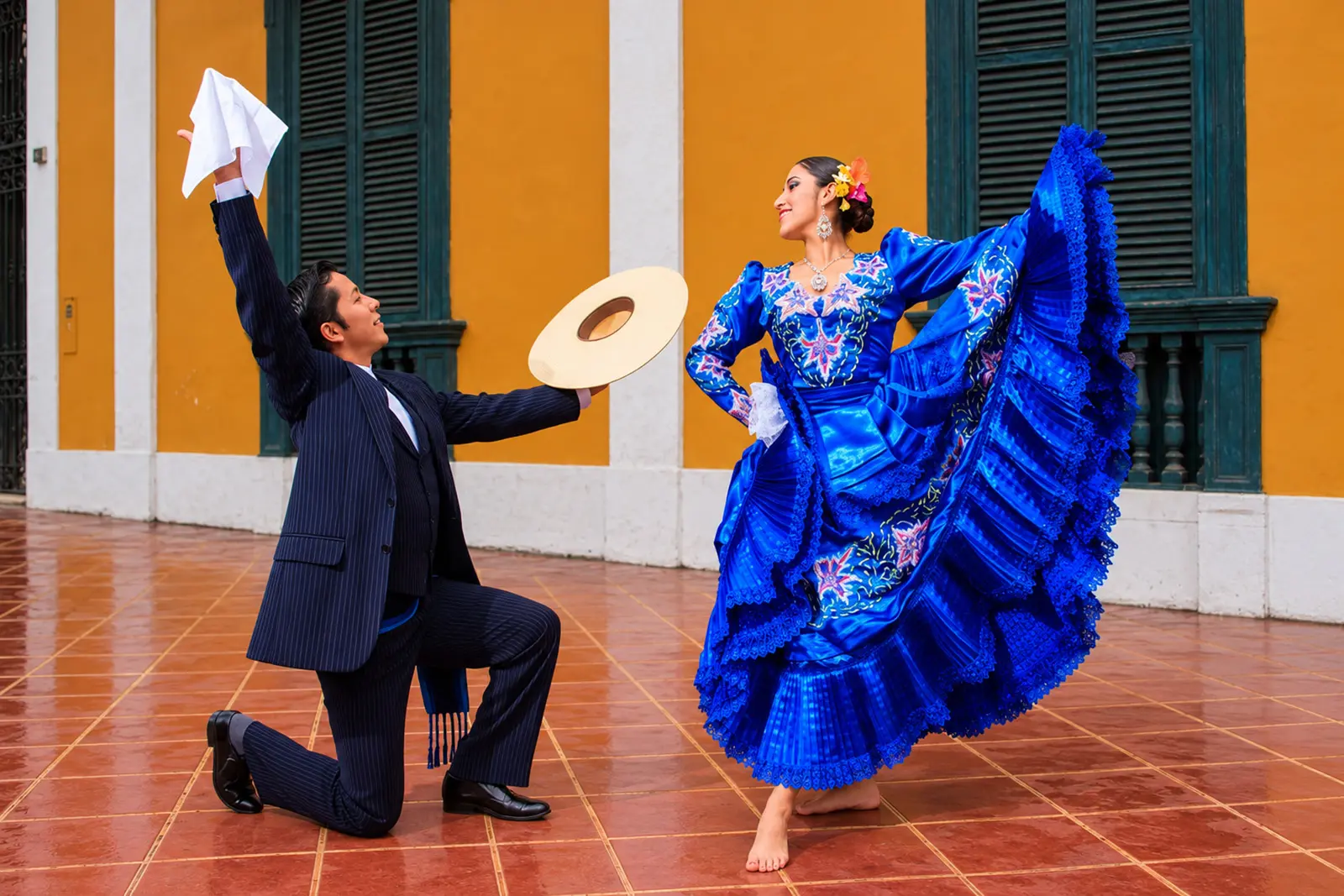
Marinera Dance
Summary. Marinera is a Peruvian dance tradition known for playful courtship and expressive handkerchief movements. Music and singing are also part of the tradition.[2] Its best-known style is Marinera Norteña from northern Peru. Marinera Limeña, from the capital city of Lima, has a slower pace and a more upright posture.[3] Regional differences shape everything from the music and footwork to the clothing.
Quick facts
| Origin/Region | Peru, with regional forms along the coast and in the Andean highlands.[3][4] |
| Music | Accompaniment and musical structure vary by region. Recorded examples include singing with a cajón, a wooden box drum, as well as harp and other percussion.[9][10] |
| Movement quality | A playful courtship between partners. Norteña is brisk and energetic, while Limeña is slower and more restrained.[2][3] |
| Typical context | Community performances and dance classes, as well as competitions. Peru celebrates National Marinera Day on October 7.[2][3][12] |
| Regional forms | Norteña from northern Peru and Limeña from Lima. Southern forms include Puneña from the Puno highlands and Arequipeña from Arequipa.[3][4] |
| Technique | Traveling steps and turns coordinated with handkerchief movements. Norteña also features rhythmic footwork and expressive skirt handling.[5][6] |
Origins & history
Marinera belongs to a family of dances linked to zamacueca, an earlier partnered dance. Researcher Ignacio Ramos Rodillo notes that zamacueca may have appeared at Lima’s San Juan de Amancaes festivities in the eighteenth century. It grew more popular around the time of Peruvian independence.[7]
Its exact beginnings remain uncertain. Drawing on work by Rodrigo Chocano and other scholars, Ramos Rodillo describes African and Indigenous influences alongside Spanish traditions and European social dancing.[7]
In early 1879, writer and journalist Abelardo Gamarra promoted the name marinera for a dance widely known in Peru as chilena. The new name honored Peru’s navy, known in Spanish as the Marina de Guerra del Perú. The change came at the beginning of the War of the Pacific, a conflict involving Peru and Bolivia against Chile. It gave the dance a patriotic Peruvian name at a time of growing hostility toward Chile.[7][4]
For decades, the names zamacueca and chilena remained in use alongside marinera as regional styles continued to develop. By the late nineteenth and early twentieth centuries, Marinera Limeña was taking on a more established sequence of sung sections and dances.[7]
On January 30, 1986, Marinera received Peru’s Patrimonio Cultural de la Nación, or National Cultural Heritage, designation. It was the country’s first such recognition of intangible cultural heritage, meaning a living tradition rather than a physical site or object.[2]
Peru prepared a UNESCO nomination between 2024 and 2026, consulting people who practice and teach Marinera in ten Peruvian regions. The nomination was submitted in March 2026 and was still awaiting approval as of September 2026, with a decision expected in December 2027.[1][2]
Steps & style hallmarks
Marinera’s partnered forms present courtship through movement. Dancers use handkerchief gestures alongside turns and changes of direction to create a playful exchange. In Norteña, intricate footwork and traveling steps give the dance a lively character as partners move around the floor.[3][5]
Norteña features zapateo, or rhythmic footwork, coordinated with turns and handkerchief movements. Dancers also use faldeo, the deliberate handling and movement of the skirt. The skirt becomes part of the dancer’s expression as the partners respond to each other.[6]
The dance follows a traditional sequence while allowing room for improvisation. Dancers vary their energy and movement in response to the music and their partner, giving each performance its own character.[5][6]
Music & instruments
Marinera’s accompaniment varies by region and setting. A Smithsonian Folkways recording from Lambayeque, a region in northern Peru, features singing and a cajón, a wooden box drum.[9] Another recording from the same region credits harp and percussion.[10]
Marinera Limeña has a distinctive sung format. Dance teacher Pedro Padilla describes a classic full sequence of three marinera sections followed by the resbalosa, a further dance section. The performance ends with the fuga, or closing section.[8]
Singers take turns presenting and answering verses, and dancers follow the exchange as it unfolds. Their voices help guide the dancing. Competitions may use a shorter format with one marinera and its fuga instead of the full sequence.[8]
The musical meter, or how beats are grouped, also varies. Northern and Lima marineras are written in 6/8, with six smaller counts grouped into two main beats. Arequipeña forms are written in 3/4, with three main beats in each repeating group.[4]
Costume & staging
Norteña’s footwear offers an immediate clue to the style: men dance in shoes while women dance barefoot.[3] Men may wear a poncho, a loose outer garment worn over the shoulders, with a broad-brimmed straw hat. This look reflects northern Peruvian rural dress, including that of the chalán, a traditional horse rider or handler.[4]
Limeña has a more formal look. Women may wear ankle-length dresses with puffed sleeves and high-heeled shoes.[3] Padilla describes women’s dresses as long and understated. Men wear a suit and tie with a light-colored shirt, finished with polished shoes.[8]
In Puneña, women’s clothing includes polleras, full layered skirts, worn with white blouses. Colorful sashes and fringed shawls add to the outfit. Hair is worn in braids beneath a bombín, a rounded bowler-style hat. White ankle boots complete the look.[3]
Some staged Norteña performances pair dancers with horses of the Peruvian Paso breed. Skilled riders known as chalanes guide the horses to music from a live band.[3]
Regional styles & related traditions
Marinera Norteña
Norteña means “northern.” This style is associated with the northern Peruvian regions of La Libertad and Lambayeque, as well as Piura. Its fast-paced footwork and turns create a spirited exchange between the partners. The handkerchief remains a central part of the performance.[3][5]
Marinera Limeña
Limeña refers to Lima. Compared with Norteña, this style has a slower pace and more restrained footwork. Dancers maintain an upright posture and use the handkerchief throughout the exchange.[3] Its traditional sung format also gives the relationship between singers and dancers a prominent role.[8]
Marinera Puneña
Puneña comes from Puno in Peru’s southeastern highlands. It can place greater emphasis on group movement, though dancers may also form loose pairs.[3] A Puno dance sequence begins with Marinera and continues into huayno pandillero, also called pandilla. This is a local form of huayno, an Andean music and dance tradition.[4]
Marinera Arequipeña
Arequipeña comes from Arequipa in southern Peru. PROMPERÚ, Peru’s tourism and export promotion agency, connects it with an older regional dance called Montonero. Its pace is slower than the northern and Lima forms, and its music is counted in three main beats rather than two.[3][4]
Where to experience it now
Dance schools and cultural centers teach Marinera across Peru. In the north, classes are available in Trujillo and Chiclayo, as well as Piura. Lima and the southern city of Arequipa also have teaching institutions.[3] Many academies focus on Norteña, so checking which regional style a class teaches is a useful first step.
One option in Lima is the Pontificia Universidad Católica del Perú, or Pontifical Catholic University of Peru. Its music and dance center offers beginner and advanced Norteña workshops. The beginner course does not require previous dance experience, while advanced training develops partner coordination and improvisation.[5][6]
Outside Peru, Club Libertad provides one route to finding Marinera communities. Based in Trujillo, the cultural organization reports 24 branches in Peru and 36 international branches. Its network extends across the Americas and Europe, with branches in Japan as well.[11]
Competition coverage offers another way to watch. For the 2026 National and World Marinera Competition, TVPerú announced live broadcasts across Peru and online viewing for audiences abroad.[12] When watching, notice how the dancers use their handkerchiefs and respond to one another. Comparing performances from different regions also makes the contrasts in movement and clothing easier to see.
Frequently asked questions
Why is it called Marinera?
Marinera is named after the Peruvian Navy, or Marina de Guerra del Perú. In 1879, Peruvian writer Abelardo Gamarra promoted the name marinera for the dance, which had previously been widely known as chilena. The new name honored Peru’s navy during the War of the Pacific.[7]
What types of Marinera are there in Peru?
Peru has several regional styles of Marinera. The best known are Marinera Norteña from northern Peru and Marinera Limeña from Lima. Other important forms include Marinera Puneña from Puno and Marinera Arequipeña from Arequipa.[3][4]
Is Marinera on UNESCO’s cultural heritage list?
As of September 2026, Marinera was still awaiting UNESCO approval. Peru submitted its nomination in March 2026, with evaluation expected in 2027 and a decision anticipated that December.[1][2] Marinera has held National Cultural Heritage status in Peru since 1986.[2]
References
- Diario Oficial El Peruano / Editora Perú (2026), “La marinera busca ser Patrimonio Inmaterial de la Humanidad: Mincul presenta candidatura ante la UNESCO.” https://www.elperuano.pe/noticia/292538-la-marinera-busca-ser-patrimonio-inmaterial-de-la-humanidad-mincul-presenta-candidatura-ante-la-unesco
- Agencia Peruana de Noticias Andina / Editora Perú (2026), “¿Cuándo será evaluada la candidatura de la marinera como patrimonio de la humanidad?” https://andina.pe/agencia/noticia-cuando-sera-evaluada-candidatura-de-marinera-como-patrimonio-de-humanidad-1069112.aspx
- PROMPERÚ / Peru.info, “Marinera: What are its variants and where can you learn them?” https://peru.info/en-us/tourism/blogperu/3/17/marinera-what-are-its-variants-and-where-can-you-learn-them
- PROMPERÚ / Peru.info, “Marinera from Peru: all versions of our best-known dance.” https://peru.info/en-us/talent/blogperu/6/24/peruvian-marinera–all-versions-of-this-typical-dance
- Pontificia Universidad Católica del Perú (2026), “Marinera Norteña – Nivel Básico.” https://cemduc.pucp.edu.pe/talleres-de-escuela-abierta/talleresdedanza/taller-de-marinera-nortena-basico/
- Pontificia Universidad Católica del Perú (2026), “Marinera Norteña – Nivel Avanzado.” https://cemduc.pucp.edu.pe/talleres-de-escuela-abierta/talleresdedanza/taller-de-marinera-nortena-avanzado/
- Ignacio Ramos Rodillo, Taller de Letras, Pontificia Universidad Católica de Chile (2024), “Entre la Joya y la Perla del Pacífico. Zamacueca, cueca chilena y marinera limeña: cultura plebeya y transnacionalidad (1880-1920).” https://tallerdeletras.letras.uc.cl/index.php/TL/article/view/82436
- Diario Oficial El Peruano / Editora Perú (2022), “Los cultores de la marinera limeña buscan ampliar su difusión a nuevos públicos.” https://www.elperuano.pe/noticia/193408-los-cultores-de-la-marinera-limena-buscan-ampliar-su-difusion-a-nuevos-publicos
- Smithsonian Folkways Recordings (1996), “Marinera.” https://folkways.si.edu/el-jefe-victor-gamarra/marinera/latin-world/music/track/smithsonian
- Smithsonian Folkways Recordings (1996), “Marinera: 300 Pounds of Gold / 300 Libras de Oro.” https://folkways.si.edu/jorge-mendoza-and-baltazar-quesquen/marinera-300-pounds-of-gold/300-libras-de-oro/latin-world/music/track/smithsonian
- Club Libertad de Trujillo, “Club Libertad – Centro Cultural Trujillano.” Institutional self-report; accessed September 2026. https://www.clublibertad.com.pe/club.htm
- Instituto Nacional de Radio y Televisión del Perú / TVPerú (2026), “TVPerú transmitirá el Concurso Nacional y Mundial de Marinera 2026.” https://www.tvperu.gob.pe/node/135126