
What is Salsa Caleña?
Salsa caleña is a style of salsa dancing that developed in and around Cali, Colombia. Also known as Cali-style salsa or Colombian salsa, it is famous for its fast, intricate footwork.
The speed does not come from the feet alone. Rapid knee movements and the twisting of the hips make the footwork appear even faster than it is.
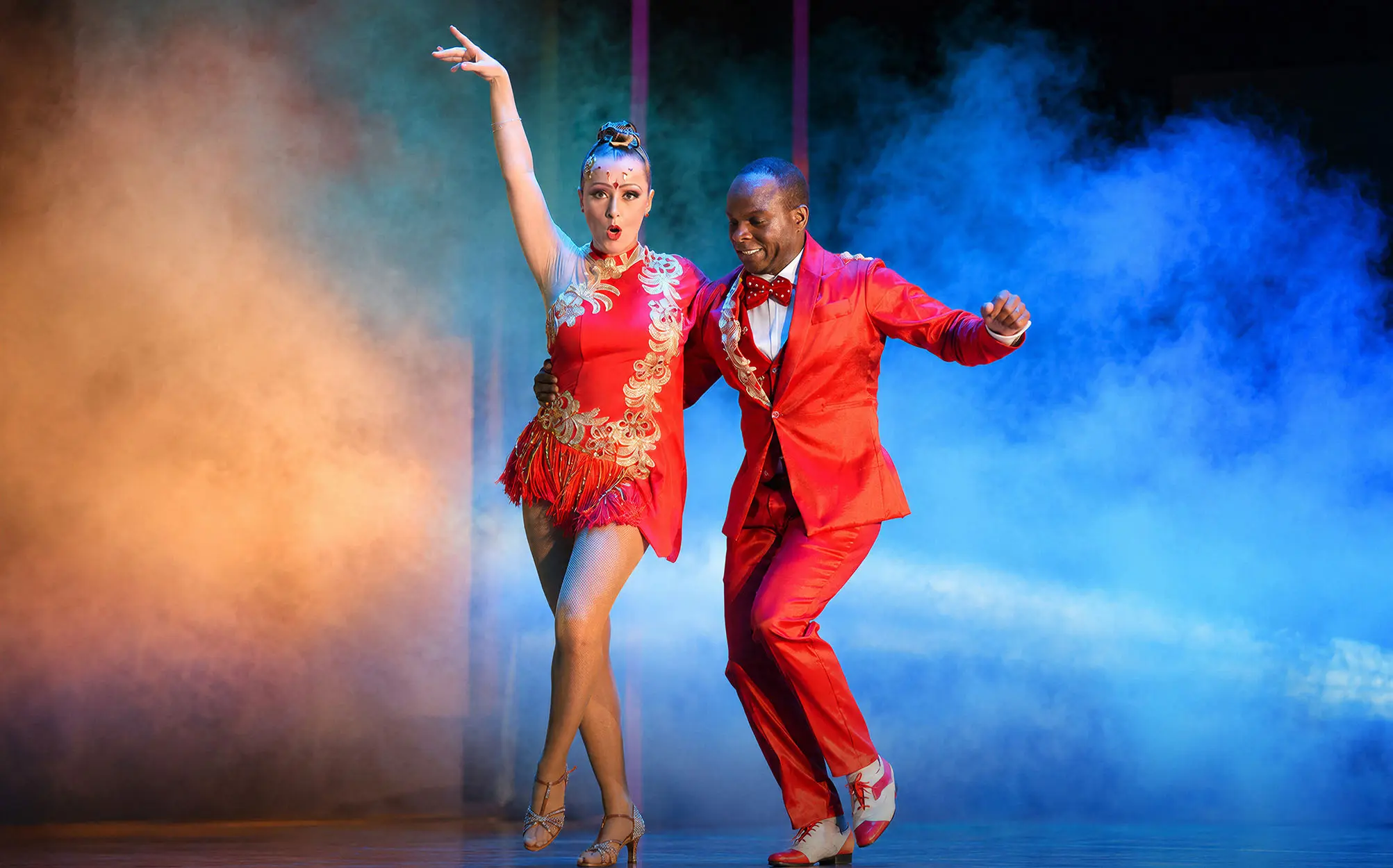
Social salsa Caleña focuses on footwork, partner dancing and musicality. Stage and competition performances may also include lifts, drops and acrobatic tricks, but these are not required when dancing socially.
Where did Salsa Caleña come from?
Salsa caleña originated in and around Cali, Colombia, and its name translates roughly as “salsa from Cali.”
The style developed separately from US styles such as New York-style salsa and LA-style salsa.
During the first half of the twentieth century, Afro-Caribbean records reached Cali through commercial routes connecting the port of Buenaventura with Panama and the Caribbean. By the 1940s, dancers in Cali’s popular neighborhoods were already dancing to older Cuban music.
Mexican rumbera films also influenced Cali’s dancers during the 1950s and 1960s. These music-and-dance films gave local dancers new visual ideas that they could combine with Colombian movement traditions.
Cumbia was one important influence, especially in the circular movement and backward-breaking actions seen in Salsa Caleña. Other influences included Colombian dances and rhythms such as porro and currulao, together with mambo, guaracha and Charleston.
Common Cali footwork steps include the básico, punta-talón, trenzas, caleñito and latino, although the names and execution can vary between schools. One common teaching pattern uses steps on counts 1, 2 and 3, followed by a pause on 4, then steps on 5, 6 and 7, followed by another pause on 8.
Local DJs sometimes played records at faster speeds, and dancers responded by developing quicker and more intricate movements. A popular Cali story credits Licímaco Paz with accidentally playing a record made for 33 RPM at 45 RPM during the 1960s. Dancers reportedly loved the faster sound.
The Feria de Cali, founded in 1958, helped bring the city’s music and dancing from neighborhood venues to a much larger public. Richie Ray and Bobby Cruz’s appearance at the 1968 Feria became another important turning point, followed by Cali’s major salsa boom during the 1970s.
The music used for Salsa Caleña is driven strongly by percussion. Claves, cowbells, timbales and congas provide clear rhythms, accents and breaks for the dancers to follow, often alongside piano and brass instruments.
Competition remains an important part of Cali’s salsa scene, particularly through the Festival Mundial de Salsa and other salsa dance competitions. These events helped develop the colorful costumes, specialized dance shoes, lifts and acrobatic tricks now associated with stage Salsa Caleña.
Cali is known as “La Capital de la Salsa,” or the “Capital of Salsa,” because of the enormous presence of salsa dancers, schools, clubs and festivals throughout the city.
In 2022, Colombia recognized the Salsa Caleña music-and-dance complex as national Intangible Cultural Heritage. The recognition covers much more than the dance steps: it includes musicians, social and professional dancers, teachers, record collectors, DJs, researchers and the craftspeople who make instruments, costumes and dance shoes.
Salsa Caleña remains most concentrated in Cali and elsewhere in Colombia. However, Colombian instructors and overseas dance schools also teach the style internationally, introducing more dancers to Cali’s distinctive footwork and musicality.