Salsa music can be challenging to count and dance to at first because so many instruments and rhythms are playing at once. Salsa is polyrhythmic: different rhythmic patterns overlap and work together. Once you start recognizing the instruments and their rhythms, it becomes easier to find your timing, respond to the music, and enjoy dancing.
Interactive Salsa Instruments
About the sounds
This salsa groove combines recorded percussion with original musical parts arranged in GarageBand using sampled acoustic instruments and electric bass. Changing tempo keeps the instruments in tune.
The conga part includes heel, fingertip, slap, and open strokes. This is a complete basic one-drum tumbao, with the quieter touches between the accents. The piano and bass follow a four-bar C–F–G–F progression (I–IV–V–IV). The montuno includes octaves, arpeggios, and passing tones, while the bass anticipates the next chord. The güiro alternates long and short scrapes, and the campana adds quieter strokes around its main accents. Changing clave direction restarts the band on count 1 and shifts all the parts together.
A practice ensemble lets you combine instruments freely. In a live band, the bongo player often switches to the campana, and the arrangement changes throughout a song.
- Bongos and mounted timbale bell: Versilian Community Sample Library (CC0).
- Congas: Congas Edition, performed by Frédéric Chartier on Meinl Marathon drums and recorded by Sylvain Kuntzmann. These adapted samples remain under CC BY-SA 3.0.
- Metal timbale hits: Suicidity (CC0), with a Versilian recorded bell. Maracas: Xavimart, Gonzalo, and Roberto’s FreePats World Percussion recordings (CC0).
- Piano, bass, claves, campana, and güiro: original Salsa Vida musical parts exported from GarageBand using Steinway Grand Piano, Fingerstyle Bass, Latin percussion, and Orchestral Kit instruments.
Salsa Vida arranged the parts, balanced their levels, and prepared continuous loops. Tempo processing uses Signalsmith Stretch (MIT). Full recording credits and edits. Basic tumbao reference: Victor Rendón, Etudes for Latin Percussion Ensemble, p. 16. Piano rhythm reference: Jonny May’s montuno lesson.
Salsa instruments at a glance
| Instrument | Listen for |
|---|---|
| Congas | Deep open tones and sharp slaps |
| Bongos | Quick, high-pitched taps |
| Campana (cowbell) | A strong, hollow metallic pulse |
| Timbales | Crisp shell clicks and drum rolls |
| Claves | A bright, repeating five-hit pattern |
| Güiro | Long and short raspy scrapes |
| Maracas | A light, steady rattle |
| Piano | Repeating notes and chords |
| Bass | Low, rounded notes |
| Trumpet | Bright, piercing melodies and accents |
| Trombone | Broad, brassy phrases and slides |
| Saxophone | A rich, reedy horn sound |
| Vocals | Lead singing and chorus responses |
The percussion section: drums, bells, clicks, and scrapes
Congas: the rolling tumbao
Congas are tall, hand-played drums with a warm, rounded voice. A player can bring out a low thump, a ringing open tone, a sharp slap, and quieter touches. In Cuba, congas are also called tumbadoras.
A familiar salsa conga pattern is the tumbao, also called marcha. In the common version, there is a crisp slap on beats 2 and 6 of the dancer’s eight-count, with ringing open tones near 4 and 8. Players add variations, use more drums, or change the pattern to match the arrangement, so treat this as a listening example, not a rule for every song.
Listen for: the contrast between the dry slap and the two round, singing drum tones. Jazz at Lincoln Center’s Bobby Sanabria demonstrates the basic groove.
Bongos: the quick, conversational martillo
Bongos are two small drums joined together. One sounds higher, the other lower. Compared with congas, bongos have a tighter, brighter attack. Fingers produce quick taps, muted notes, and little answers to the band.
One common bongo groove is martillo, meaning hammer. Its taps keep an even flow while other instruments stretch across the beat. The bongocero, or bongo player, may improvise between those taps.
Listen for: a high, ticking pattern with an occasional lower, more open note. Rhythm Notes demonstrates martillo before moving to other uses.
The bongo player’s hand bell: a new level of energy
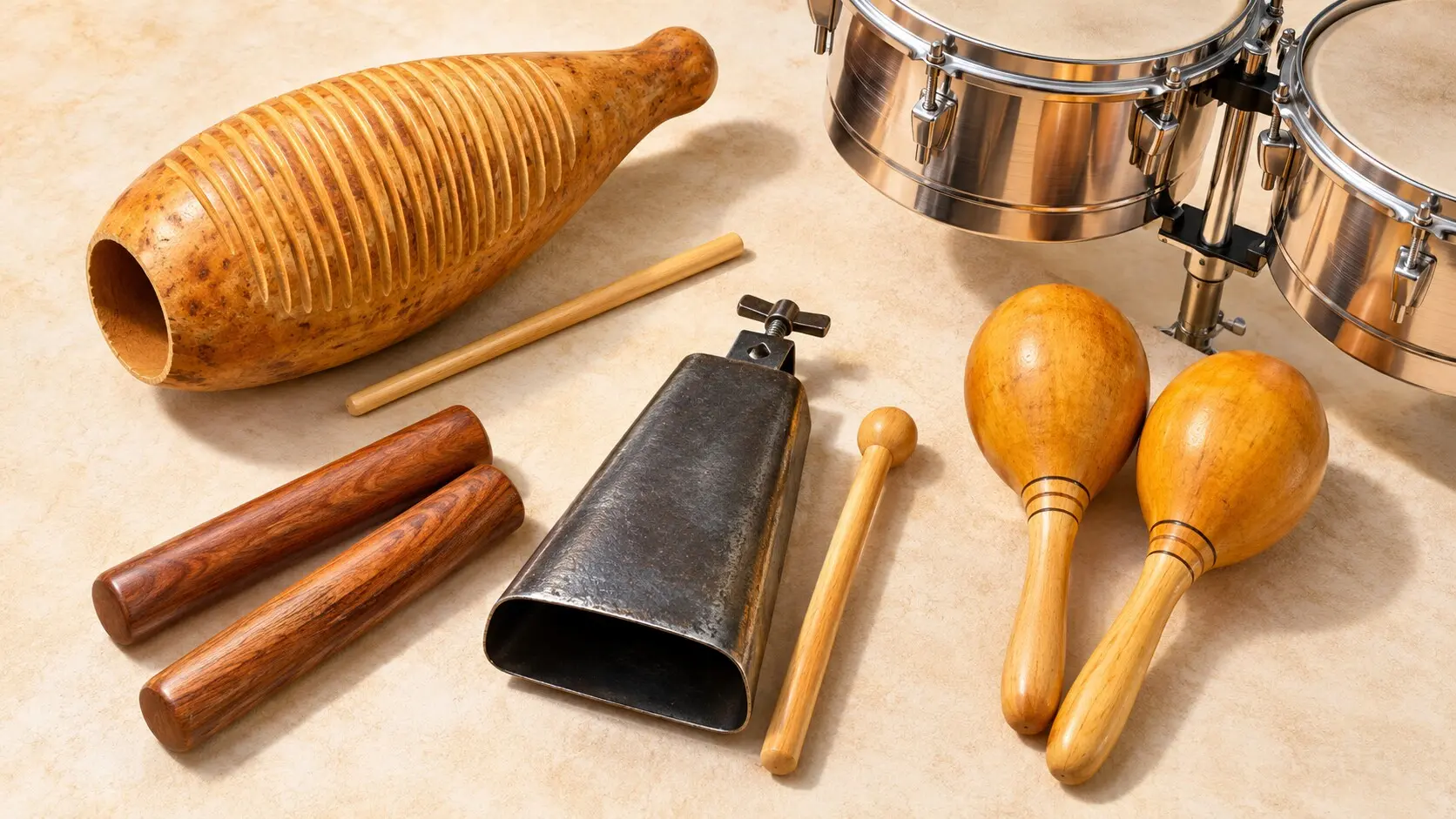
Here is a sound worth learning early. In many salsa arrangements, the bongo player switches to a large handheld metal bell, often called the campana, as the song enters a louder section. The drum taps give way to a strong, hollow clang. It may mark a broad pulse and add smaller strokes around it.
That change can make the song feel bigger without becoming faster. A bell gives the dancer a clear place to feel the pulse, although its accents are not a guaranteed label for count 1. Also, the handheld bongo bell is different from the bells attached to a timbales setup, even when they work together.
Listen for: the ringing hand bell and its accented calls in this salsa demonstration by percussionist Joaquín Arteaga.
Timbales: crisp shells, bright bells, and dramatic fills
Timbales are two shallow drums, often with metal shells, played with sticks. They produce ringing hits, sharp rimshots, and rapid rolls. But a timbales player, called a timbalero, does much more than solo.
In quieter passages, the player may tap a repeated cáscara pattern on the side, or shell, of the drum. It sounds like quick, dry wooden clicks. When the arrangement opens up, the player may move to a louder mounted bell, often called a mambo bell. A rolling fill known as an abanico can announce a change. The exact patterns and switches vary with the music.
Rhythm Notes teaches these sounds and transitions.
Claves: two wooden sticks and a bigger rhythmic idea
Claves, the instrument, are two short wooden sticks struck together. Their clear, cutting tok can be easy to pick out in a sparse arrangement. But clave also names a rhythmic pattern that helps organize what the whole band plays. A song can follow clave even when nobody is striking wooden sticks.
In a common son clave pattern, five strokes spread across two measures, or bars. One bar has three strokes and the other has two. 3-2 puts the three-stroke side first; 2-3 puts the two-stroke side first. A related rumba clave shifts one of the strokes.
Listen for: the five-hit cycle repeating over two bars, and then notice how drum and piano phrases sit around it. Edgardo Cambón demonstrates son and rumba clave on the sticks themselves in this Dance Papi lesson. The video starts at the son clave explanation and count-in. For more, see our guide to clave in salsa.
Güiro: the raspy scrape
The güiro is a ridged scraper, traditionally made from a hollow gourd. A player drags a stick over its grooves to produce a scratchy rrrash, then shorter scrapes.
In some Cuban dance rhythms, the player alternates a long scrape with shorter strokes. The exact phrase depends on the style and arrangement. The güiro can be subtle in a full recording, so listen for a faint rasp filling the gaps between stronger hits. It is especially easy to notice in music with a charanga influence.
Listen for: how changing the length and direction of a scrape changes the groove in this beginner demonstration.
Maracas: the soft rattle between the beats
Maracas are handheld shakers, often played as a pair. They may sound like a bright shik-shik or a softer rustle, depending on the shell, filling, and technique. They fill the spaces between bigger drum sounds.
The shaker strokes may sound simple, but skilled players shape accents and the feel of each phrase. Singers sometimes play maracas, güiro, or claves while performing. Percussion educator Lalo Dávila’s Latin percussion primer for Pearl includes examples for both güiro and maracas.
Listen for: the steady rattle and stronger accents in percussionist Andy Polanco’s Spanish-language demonstration of maracas in salsa and son.
Piano and bass: the musical engine under the percussion
Piano: the repeating montuno
Listen past the drums and you may hear the piano repeating a little climbing, tumbling, or bouncing figure. A common name for this repeating pattern is montuno, or guajeo. It usually outlines the chords, which are groups of notes that give the song its harmony, while also working like another rhythm instrument.
Because many notes land between strong beats, the piano can seem to skip forward. It may repeat a short idea, change chords, then burst into a solo. Montuno can also mean the later call-and-response section of a song.
Pianist Paul Tobey’s lesson shows how a short pattern grows into a richer salsa part.
Bass: the low notes that pull you forward
Electric or upright bass can carry the low, grounded bass line. A common salsa bass tumbao is a short repeating phrase that identifies the chords and connects with the drums.
Here is the surprising part: in many classic salsa grooves, the bass does not hit every strong beat, and it may avoid beat 1. A note can arrive just before a new chord or phrase, making the whole band feel as if it is leaning forward. This is called anticipation. Smithsonian Folkways’ salsa lesson highlights that anticipated bass movement alongside the piano.
Bassist Alexis Ortega demonstrates a beginner salsa tumbao with a backing track.
Horns and voices: the lines that make the song speak
Trumpet: bright melodies and sharp accents
A trumpet has a bright, focused sound that can soar over the band. Trumpet players use three valves to change notes. They may carry the melody, answer the singer, or hit short, punchy phrases together. Those coordinated accents can feel like a musical exclamation point.
Trombone: a broad, brassy sound
A trombone often sounds lower, broader, and heavier than a trumpet. Its long slide changes the length of the instrument’s tubing, allowing the player to move between notes or slide smoothly from one to another. Trombone-led bands have a powerful sound closely associated with salsa dura.
Listen for: the weight of the trombones in Willie Colón and Héctor Lavoe’s “La Murga.” The National Park Service’s salsa exhibit uses this recording as a trombone example.
Saxophone: a warm, reedy voice
Saxophones have a reed in the mouthpiece, which makes them woodwind instruments even though their bodies are metal. Their rich, sometimes raspy sound can blend with trumpets and trombones or stand out in a solo. Some salsa arrangements use saxophones alongside brass, while others feature only trumpets or trombones.
Vocals: the coro and pregón conversation
A singer is part of the rhythm, too. During the verse, the lead may tell a story. Later, the coro, or backing chorus, repeats a short line while the lead answers. That answer is a pregón; skilled singers, sometimes called soneros, may improvise each time. This is call and response.
Listen to how the chorus gives you something familiar to return to while the lead voice keeps changing. The horns may join that conversation, too. Not every vocal line is improvised, and some salsa is instrumental, but this exchange is one of the most inviting ways to hear a song’s structure. The Royal College of Music’s Latin music guide explains the singers’ roles alongside the rhythm section.
Hear the instruments in a salsa song
Try Susie Hansen’s “La Salsa Nunca Se Acaba (The Salsa Never Ends).” Use it to practice picking out the instruments you’ve just heard individually. Play the song more than once, choosing a different sound to follow each time.
- Find the congas. Listen for the rounded, ringing drum tones and the sharper slap of the tumbao. Keep following that pattern when the rest of the band catches your attention.
- Separate the percussion sounds. A wooden click, a raspy scrape, and a metallic bell have very different sounds. Try naming the instrument when you recognize one.
- Follow the piano, then the bass. The piano’s higher, repeating figures and the bass’s low notes can be easier to separate when you concentrate on one at a time.
- Notice the melody and voices. Pick out the lead singer and the answering chorus, then shift your attention to an instrumental phrase. Listen for the contrast between a held note and a short accent.
- Put your feet to it. Dance your basic while following the tumbao. Then keep the same steps and listen to another instrument. Notice where its notes fall in relation to your feet.
Hansen’s band also features her electric violin, a reminder that salsa can include sounds beyond drums, piano, bass, and brass. Her album notes and musician credits introduce the players and their instruments. Find more tracks in our salsa music hub.
Salsa instruments: frequently asked questions
What are the main instruments in salsa music?
Many bands feature congas, bongos, timbales, bells, piano, bass, and a changing combination of horns and singers. Claves, güiro, and maracas add distinctive clicks, scrapes, and rattles. The exact lineup depends on the group and style.
Which instrument keeps the beat in salsa?
Clave is the rhythmic foundation of salsa. Its repeating pattern guides how the other parts fit together, even when nobody is playing the wooden sticks. Congas, timbales, campana, güiro, bass, and piano support that framework and give dancers different ways to hear the timing.
What is the difference between congas and bongos?
Congas are taller drums with deeper, rounder tones and a common tumbao groove. Bongos are a small joined pair with a higher, sharper sound and a common martillo pattern. Their parts complement each other.
Can salsa music have flute, violin, or guitar?
Absolutely. Flutes and violins are prominent in charanga-related sounds, while the Cuban tres and guitars connect to son and other related ensembles. Salsa is flexible, not a fixed instrument checklist.
What should a beginner dancer listen to first?
I recommend starting with the tumbao, usually played by the congas. Then learn to recognize the clave. Next, listen for strong sounds such as the campana and güiro. The campana often makes the strong beats, 1, 3, 5, and 7 in a dancer’s eight-count, especially clear. The güiro’s longer scrapes can give you another timing cue.
Try Salsa 360 to hear the conga tumbao, clave, and cowbell separately or together while watching where the dancers’ steps fall. Slow it down and switch between On1 and On2 to see how the same rhythms relate to different timings.