
Argentine Tango
Summary. Argentine tango is a partner dance that developed in Buenos Aires in Argentina and Montevideo in Uruguay.[1] Both cities lie along the Río de la Plata, the broad river mouth between the two countries. The dance is known for its close partner connection and expressive walking. Couples move in a close or open embrace, shaping their steps and pauses around the music.[6][7] Now practiced internationally, tango also has a rich tradition of instrumental music and song.[1][14]
Quick facts
| Origin/Region | The Río de la Plata region of Argentina and Uruguay, especially Buenos Aires and Montevideo.[1] |
| Music | Tango music, either instrumental or sung. Its traditional sound is closely associated with the bandoneon, a button-operated instrument whose folded middle section expands and contracts as it is played.[1][9] |
| Movement quality | Expressive walking and turning, punctuated by pauses and intricate legwork. Partners dance in a close or open embrace.[6][7][20] |
| Typical context | Milongas, the social gatherings where people dance tango, as well as classes and stage performances. Tango also has a competition tradition.[8][11][15] |
| Related traditions | Milonga is also a related musical and dance tradition. Canyengue is an early tango style. Candombe is a separate tradition rooted in Black communities of Argentina and Uruguay.[2][5][13] |
| Partner connection | Leading and following help partners coordinate their movement. Some dancers learn or switch between both roles.[6][7] |
Although the name Argentine tango is widely used, the tradition belongs to both sides of the Río de la Plata. Buenos Aires and Montevideo share in its history, and both remain important centers of tango culture.[1] Its social dancing is part of a wider artistic tradition that includes poetry as well as music. Amateur and professional artists continue to pass it on through teaching and performance.[1]
Origins & history
Tango emerged in the second half of the nineteenth century among lower-income communities in Buenos Aires and Montevideo.[1][14] European immigrants lived alongside descendants of enslaved Africans. Tango also drew on criollo communities, meaning locally rooted populations shaped by the region’s Spanish colonial history.[1] It developed through contact between these communities.[12]
Earlier forms associated with tango’s development include the habanera, a music and dance form linked to Havana in Cuba, and tango andaluz from Andalusia in southern Spain. Other proposed influences include milonga from the Pampas grasslands of Argentina and Uruguay, along with candombe.[14]
Black musicians and dancers helped shape early tango. Historian Paulina L. Alberto traces these contributions through a family of Afro-Argentine musicians and their connections with candombe, a music and dance tradition rooted in the region’s Black communities.[13] Researchers continue to debate exactly how candombe and other African-derived musical forms influenced tango’s sound.[17]
By the early twentieth century, tango groups were developing into larger ensembles known as orquestas típicas, or traditional tango orchestras. This orchestra form was established by the 1930s.[10] Argentina’s National Institute of Musicology identifies 1935 to 1955 as a period that includes tango’s Golden Age in the 1940s.[3]
The crowded dance floors of the 1940s also helped shape the dance. Milonguero style developed a compact, close embrace that allowed partners to move together in limited space.[4]
The National Institute of Musicology labels 1955 to 1980 the Nuevo Tango period.[3] Meaning “new tango,” the term is associated in music history with the work of Astor Piazzolla.[12] This musical use of the name is separate from its use for newer approaches to dancing tango.
In 2009, Argentina and Uruguay jointly secured tango’s inscription on UNESCO’s Representative List of the Intangible Cultural Heritage of Humanity, which recognizes living cultural traditions.[1] In Uruguay, a UNESCO-supported project helps pass on the tradition through bandoneon teaching and mentor training, alongside skills for making the instruments.[19]
Steps & style hallmarks
Walking is at the heart of social tango. One partner may move forward while the other steps backward, with their upper bodies traveling together.[6] The effect can be quiet and unhurried. A well-placed pause can carry as much expression as a more elaborate movement.[7]
Partners communicate through the embrace, the way they hold each other as they dance. In a close embrace, they may meet chest to chest. An open embrace leaves space between their upper bodies.[7] Small shifts of weight help prepare a step or change of direction.[6]
Social dancers improvise, combining familiar movements as the music unfolds.[7] One recognizable figure is the back ocho, named for the figure-eight pattern it traces. The dancer alternates backward steps with pivots (turns on the supporting foot without taking a new step). A giro is a turning figure in which one partner steps around the other.[7][20]
Tango’s distinctive flicks and leg hooks include boleos and ganchos. In a boleo, the free leg whips or flicks in response to a change of direction, often during a pivot. A gancho, meaning “hook,” bends one leg around a partner’s leg before releasing.[20]
On a shared social floor, dancers adapt their steps and legwork to the space around them. Milonguero style favors a close connection and compact movements suited to crowded rooms.[4] Stage performances have more room for expansive legwork and lifts.[21]
The leader suggests a direction or change in timing, while the follower interprets and responds. Both partners adjust to what they feel from the other person.[6][7] Dancers may also switch roles, so leading and following are not necessarily tied to gender.[7]
Music & instruments
The bandoneon is one of tango’s most recognizable instruments and an essential part of its traditional sound. It is a type of concertina, played by pressing buttons while pushing and pulling its bellows, the folding middle section that moves air through the instrument.[9]
A traditional tango orchestra, or orquesta típica, combines bandoneons and violins with piano and double bass, which supplies the lowest notes. Some ensembles add other bowed string instruments such as the viola and cello.[23]
Tango’s musical character varies by period and performer. Some recordings emphasize a strongly marked beat, while others give more prominence to a flowing melody or expressive singing. Changes in speed and volume also help shape the music.[2] A strong accent might invite a decisive step, while a quieter passage may leave room for a pause.[7]
Canyengue, the early tango style, has a strongly marked rhythmic feel. Argentina’s cultural heritage inventory associates its music with guitar and the transverse flute, which is held sideways, as well as the tuba, a large brass instrument with a low sound.[5]
Costume & staging
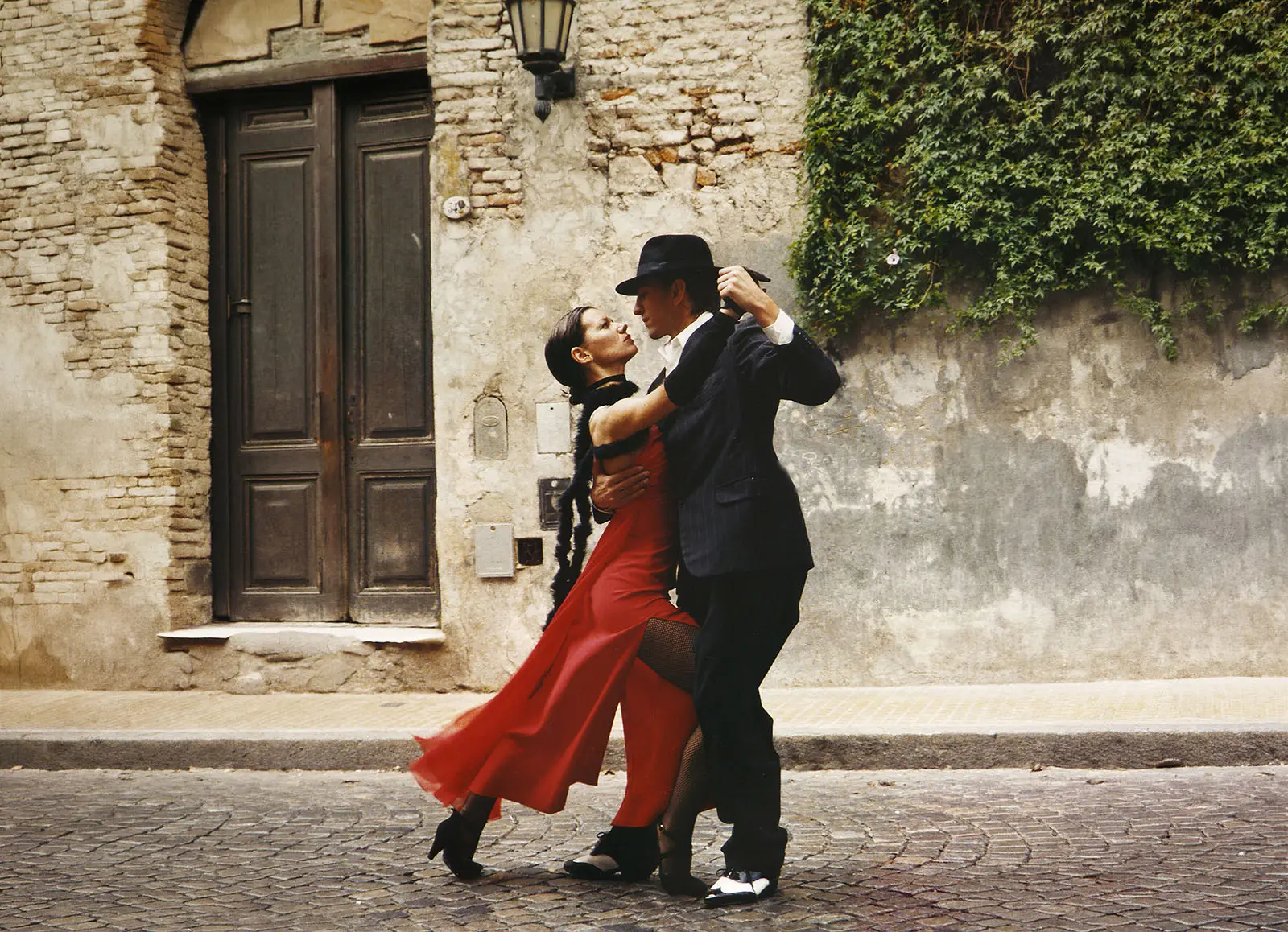
A familiar tango look pairs a man in a sharply cut black or dark suit with a woman in a fitted dress, often red, with a flowing or slit skirt that allows the legs to move freely. Heeled dance shoes commonly accompany dresses, while suits are often paired with leather dance shoes. Cinema and art have helped make the dark suit and red dress an iconic image of tango.[22]
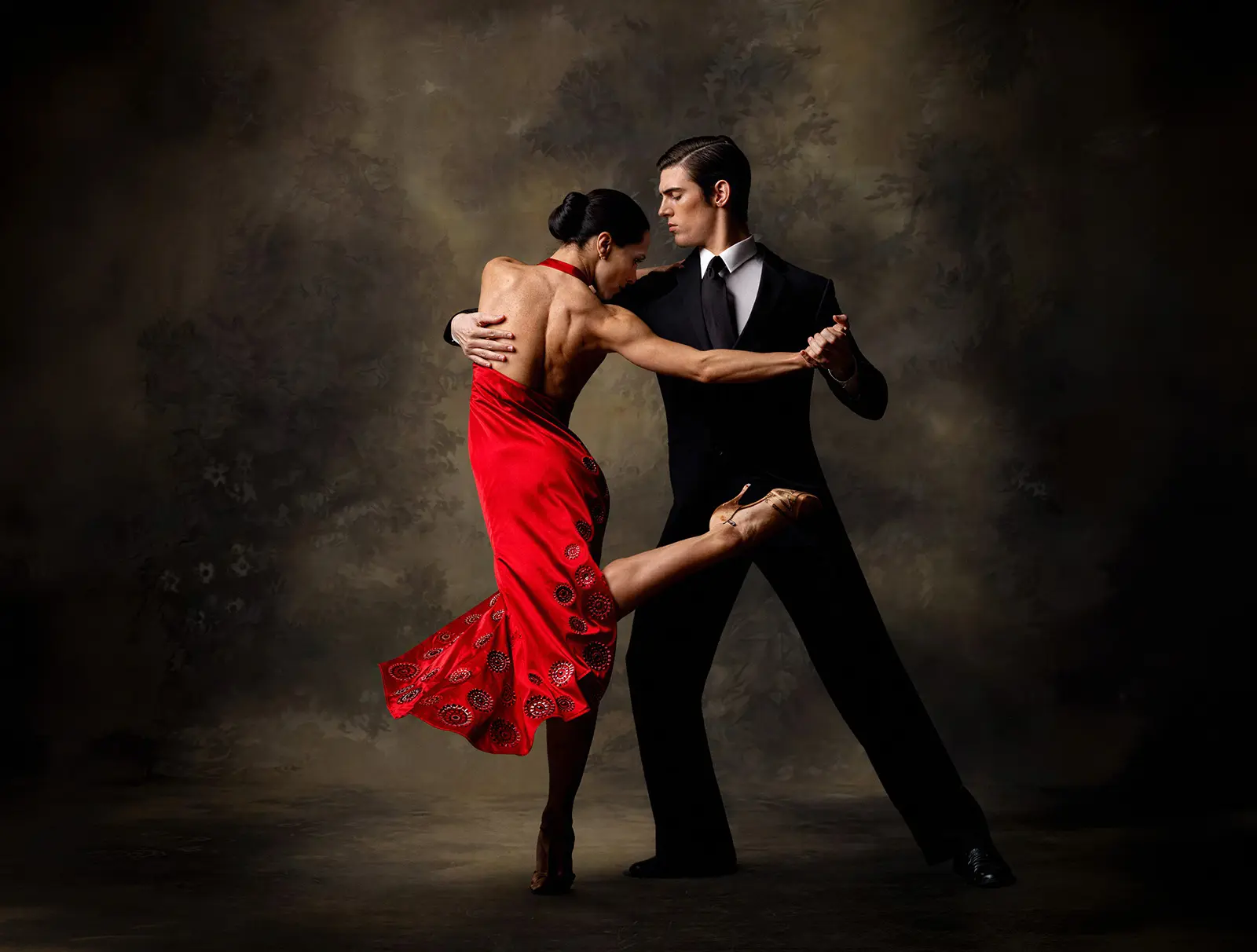
Stage tango uses choreography and theatrical presentation to highlight the dancers’ movements. Performances can feature sweeping legwork and lifts.[21] A dramatic dip, with one dancer leaning backward while supported by their partner, is one possible finishing pose. Costumes range from classic formalwear to brighter or more contemporary designs.[22]
At social milongas, clothing ranges from suits and elegant dresses to more relaxed outfits.[18][22] Beginner classes can be even more informal, with some requiring no special clothing or shoes.[11]
Related dance traditions
Milonga names both a related musical and dance tradition and the social gatherings where people dance tango. As a dance, it is associated with a lively musical form.[2] A milonga evening typically includes tango and milonga music, along with vals, the waltz-related music danced in tango settings.[8]
Candombe is a separate music and dance tradition with its own community history. Its connections with early tango remain an important subject of research.[2][13]
Canyengue is a partnered tango style documented at milongas since the late nineteenth century. Partners hold each other closely with their upper bodies angled into a V shape and their knees partly bent.[5]
Buenos Aires’ tango championship has separate categories for Tango de Pista, meaning “dance-floor tango,” and Tango Escenario, or “stage tango.”[15]
Influence on other dances
Tango is one of the most iconic Latin dances, with its close embrace and dramatic poses familiar from film and television.[22][29] Its influence extends beyond its own dance floors, inspiring movement and choreography in other partner dances.
Bachatango combines bachata with tango-inspired movement. Dancers weave tango-style turns and legwork into bachata’s rhythm, using pauses and extended poses to give the dance a more theatrical feel.
Tango also appears in salsa choreography. Its flicks and leg hooks can complement the rapid footwork of salsa caleña, the style from Cali in southwestern Colombia, while a held pose adds contrast to a fast sequence.[20][28] BNF, a Colombian dance company based in Medellín, brings the two dance forms together and has taught salsa-and-tango workshops at the Switzerland Salsa Festival.[24][25]
Tango has also influenced fusion approaches in the international kizomba scene. Dancers have borrowed tango movements for both performances and social dancing. The two dances’ emphasis on close partner connection offers common ground for these blends.
Where to experience it now
Buenos Aires and Montevideo remain important places to experience tango in traditional dance halls.[1] At a milonga, attendees share the dance floor, and some events also offer classes or live music.[8]
Buenos Aires has neighborhood milongas as well as professional tango shows.[18] The Tango BA Festival y Mundial brings several parts of this culture together. Its 2026 program included concerts and dance classes, alongside social dancing and the world championship.[15]
Tango is also practiced well beyond its home region. In Europe, encuentros milongueros are gatherings centered on close-embrace social tango. These events began with efforts to recreate Buenos Aires dance settings, then developed into a distinct European practice connecting communities across different places.[16]
Frequently asked questions
Why is it called Argentine tango?
The name distinguishes the Río de la Plata tradition from other forms of tango, particularly ballroom tango. Despite the label “Argentine,” its cultural roots are shared by Argentina and Uruguay.[1][26]
Are there other styles of tango?
Yes. Ballroom versions include International Standard tango and American Smooth tango. International Standard keeps a closed ballroom hold, while American Smooth also allows partners to separate.[26] Finland has developed its own tango tradition in music and social dancing.[27] Within Argentine tango, styles such as canyengue and milonguero differ in their embrace and approach to movement.[4][5]
What are a tanda and a cortina?
A tanda is a set of three or four songs played together at a milonga. Partners typically dance the set together before separating and finding another partner for a later tanda.[7] A cortina is a short musical interlude that separates the sets.[8]
What is a cabeceo?
A cabeceo is a nonverbal invitation to dance, made through eye contact and a small movement of the head. It is commonly used to find a partner at traditional milongas in Buenos Aires.[7]
Is social tango the same as stage tango?
No. Social tango is improvised with a partner on a shared dance floor. Stage tango is designed for an audience and often uses planned choreography, with room for larger movements and lifts.[7][18][21]
References
- UNESCO (2009). Decision of the Intergovernmental Committee: 4.COM 13.01: Tango. https://ich.unesco.org/en/decisions/4.COM/13.01
- Ministerio de Educación y Cultura, Uruguay (2023). Patrimonio Cultural Inmaterial del Uruguay: Tango y Milonga Oriental. https://www.gub.uy/ministerio-educacion-cultura/patrimonio-uruguay/patrimonio-cultural-inmaterial-del-uruguay
- Instituto Nacional de Musicología Carlos Vega, Argentina (2020). Antología del tango rioplatense. https://inmcv.cultura.gob.ar/noticia/programa-de-investigacion/
- Argentina.gob.ar (2023). Baile social milonguero. https://www.argentina.gob.ar/cultura/manifestaciones-de-patrimonio-cultural-inmaterial/caba/baile-social-milonguero
- Argentina.gob.ar (2023). Baile Tango Canyengue. https://www.argentina.gob.ar/node/372194
- Adaptive Behavior, SAGE Publications (2026). A Framework for Interpersonal Synergy Research: Contexts, Theories, and Methods. https://journals.sagepub.com/doi/10.1177/10597123261429301
- Dance Research Journal, Cambridge University Press (2025). Queer/Tango/Theory: Gendered Semiosis, Dancing the Binary, and Dancing on Out. https://www.cambridge.org/core/journals/dance-research-journal/article/queertangotheory-gendered-semiosis-dancing-the-binary-and-dancing-on-out/31214F7FD9AC9C7A76EC11EB663C6094
- Gobierno de la Ciudad Autónoma de Buenos Aires. BAMilonga: Institucional. https://buenosaires.gob.ar/gcaba_historico/institucional-1
- UNESCO (2020). The Bandoneon: sound of Tango. https://ich.unesco.org/en/assistances/the-bandoneon-sound-of-tango-01634
- Ministerio de Educación y Cultura, Uruguay (2021). Seleccionados “Orquesta Típica Uruguay es Tango”. https://www.gub.uy/ministerio-educacion-cultura/comunicacion/noticias/seleccionados-orquesta-tipica-uruguay-es-tango
- Argentina.gob.ar (2023). Tango al Paso en el Centro Cultural Borges. https://www.argentina.gob.ar/noticias/tango-al-paso-en-el-centro-cultural-borges
- Cambridge University Press (2024). A Brief History of Tango. https://www.cambridge.org/core/books/abs/cambridge-companion-to-tango/brief-history-of-tango/46082B9A3C0529CCD1DF68474A7F7ECF
- Cambridge University Press (2024). Nineteenth-Century Afro-Argentine Origins of Tango. https://www.cambridge.org/core/books/abs/cambridge-companion-to-tango/nineteenthcentury-afroargentine-origins-of-tango/AC8DBFF85744E811D3315E22FADFC776
- Ministerio de Educación y Cultura, Uruguay (2022). Ruta del Tango. https://www.gub.uy/ministerio-educacion-cultura/comunicacion/noticias/ruta-del-tango-0
- Gobierno de la Ciudad Autónoma de Buenos Aires (2026). Tango BA Festival y Mundial 2026. https://buenosaires.gob.ar/gcaba_historico/noticias/tango-ba-festival-y-mundial-2026-empezo-la-gran-fiesta-de-la-cultura
- Cambridge University Press (2024). Encuentros Milongueros: Europe’s Twenty-First-Century Tango Dance Practice. https://www.cambridge.org/core/books/abs/cambridge-companion-to-tango/encuentros-milongueros-europes-twentyfirstcentury-tango-dance-practice/AC6B9101D7A808906CF04D488F9AF426
- Revista Argentina de Musicología / Asociación Argentina de Musicología (2017). Bases para una aproximación razonable a la cuestión del componente afro del tango. https://ojs.aamusicologia.ar/index.php/ram/es/article/view/218
- Gobierno de la Ciudad Autónoma de Buenos Aires. A passion for tango. https://turismo.buenosaires.gob.ar/en/article/passion-tango
- UNESCO (2026). The sound of Tango – Phase II. https://ich.unesco.org/en/assistances/the-sound-of-tango-phase-ii-02463
- Argentine Tango Vancouver. Terminology. https://argentinetangolab.com/terminology/
- Gobierno de la Ciudad Autónoma de Buenos Aires (2026). Reglamento Tango BA Mundial de Baile 2026. https://documentosboletinoficial.buenosaires.gob.ar/publico/PE-DIS-MCGC-DGFNC-65-26-ANX.pdf
- The National Secretariat of Culture of Argentina. Tango fashion. Google Arts & Culture. https://artsandculture.google.com/story/XQUx_o8smgebVA
- Gobierno de la Ciudad Autónoma de Buenos Aires. Orquesta Típica. https://buenosaires.gob.ar/gcaba_historico/tango/orquesta-tipica
- BNF Entertainment. Company brochure. https://www.bnf.com.co/wp-content/uploads/2024/08/Brochure_entertainment_Agosto-1.pdf
- Eider Rua / BNF. BNF – Salsa and Tango Class – Eider y Camila – Switzerland Salsa Festival. YouTube. https://www.youtube.com/watch?v=skRKsuWGHPE
- World DanceSport Federation. DanceSport Disciplines. https://www.worlddancesport.org/About/Dance-Styles/DanceSport-Disciplines
- thisisFINLAND (2013). Cool Finnish tango sways audiences. https://finland.fi/arts-culture/cool-finnish-tango-sways-audiences/
- Academia Maritza Arizala. Salsa colombiana. https://www.maritza-arizala.com/salsa-colombienne/
- The Guardian (2024). Strictly Come Dancing: quarter-final results – as it happened. https://www.theguardian.com/tv-and-radio/live/2024/nov/30/strictly-come-dancing-the-quarter-final-live