
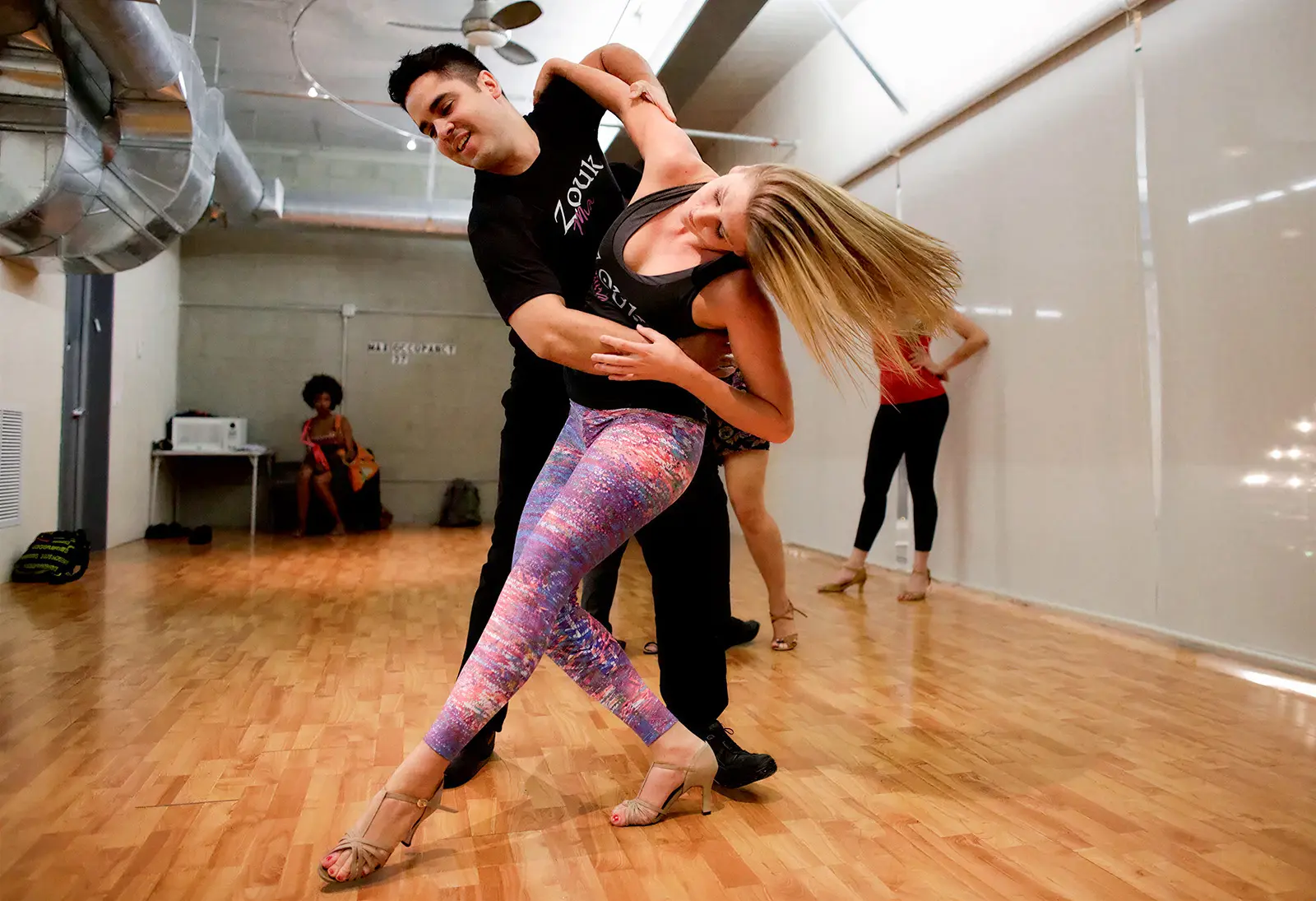
Summary. Brazilian Zouk is a partner dance from Brazil, known for its flowing body movement. Dancers combine turns with waves through the torso, while more advanced movements can include sweeping head movements and tilted turns.[1] In social dancing, partners typically improvise in response to the music and each other, while stage performances may use set choreography.[1][11] The dance developed from Lambada in the early 1990s as Brazilian dancers adapted it to Caribbean zouk music.[3][4] It has since spread internationally through teaching and social dance events.[3]
Quick facts
| Origin/Region | Brazil. Developed from Lambada in the early 1990s, with different accounts emphasizing different regional roots.[3][4] |
| Music | Caribbean zouk alongside contemporary R&B (rhythm and blues) and pop. Hip-hop and other genres are also used.[1] |
| Movement quality | Flowing partner work with turns and body waves. Head movements and off-axis tilts, where the body leans away from its upright alignment, depend on the dancers’ experience and control.[5][1] |
| Typical context | Social dances and classes, as well as stage performances and larger dance gatherings called congresses. Jack & Jill competitions pair dancers at random for an improvised dance.[6][11] |
| Related traditions | Lambada is its direct predecessor. Earlier regional context includes Carimbó, a music-and-dance tradition from Pará in northern Brazil. Other Brazilian partner dances also contributed to Lambada’s development.[4][7] |
| Partner connection | Open holds leave more space between partners; closed holds bring their bodies closer.[1] |
At its core, Brazilian Zouk is built from small weight transfers, forward-and-back steps and turns. Dancers connect these movements smoothly as they travel across the floor or change direction with a partner. The basic movements can stay compact or become more expansive depending on the music and available space.[4]
Partners can move between open and closed connections within a dance.[1] The way they hold one another is also called an embrace. From this foundation, dancers may add body waves, off-axis tilts and head movement as their experience and control develop.[5][1] Social dancing is usually improvised through lead-and-follow communication, while stage routines may be choreographed in advance.[6][11]
Origins & history
Brazilian Zouk’s roots lie in Lambada, a Brazilian music-and-dance tradition that became a major cultural phenomenon during the 1980s.[3] Its history reaches back further: a 1976 recording by the musician Pinduca is cited as an early documented use of “Lambada” for a song.[4]
In Porto Seguro and nearby Arraial d’Ajuda, on the coast of Bahia in northeastern Brazil, Lambada developed distinctive torso and head movements. Dancers also drew on Forró, a Brazilian music-and-dance tradition. Other influences included the partnered samba style known as Samba de Gafieira and the social partner dance Brazilian Bolero.[4]
As Lambada’s popularity declined in the early 1990s, dancers began adapting it to Caribbean zouk music.[3][4] This music came from the French Antilles, particularly Guadeloupe and Martinique, islands in the French Caribbean.[8][9] Some called the emerging practice “French Lambada” because of the songs’ French Creole lyrics. Here, French Creole refers to French-based Caribbean languages. The label described the music, not a French origin for the dance.[3]
Accounts of Brazilian Zouk’s development place different weight on its regional roots. The Brazilian Zouk Dance Council (BZDC) identifies Rio de Janeiro as its birthplace and credits Renata Peçanha and Adílio Porto with adapting Lambada to Caribbean zouk music there. Their work reshaped the dance’s technique and partner hold. Through classes and teacher training, they also established an approach that influenced later generations of dancers.[3]
A 2023 study by Ana Carolina Navarro and her coauthors takes a wider view of the earlier history. It traces musical exchange in Pará, a state in northern Brazil, and follows Lambada’s development in Porto Seguro and Arraial d’Ajuda before the shift to Caribbean zouk music. Both accounts place Lambada at the center of Brazilian Zouk’s history, but they emphasize different stages in its development. There is no single, universally accepted creation story.[4][3]
The name “Brazilian Zouk” was chosen by majority vote at the 2006 Minas Zouk Congress in Belo Horizonte, a city in southeastern Brazil. Further meetings and presentations at international congresses between 2006 and 2012 helped establish the name more widely.[3]
From about 2007, Brazilian teachers helped expand the dance internationally by moving abroad or traveling to teach. The BZDC highlights the growth of communities in Australia and New Zealand, as well as across Europe. Workshops and congresses gave dancers opportunities to learn the style and build local social scenes.[3]
Basic steps & movement
Brazilian Zouk uses a range of movements rather than one required sequence. Dancers shift their weight as they travel in straight lines or circles, often linking their steps with turns. Dancers may keep these movements compact or make them more expansive to suit the music and the available space.[4]
One foundation is the forward-and-back basic, a repeating pattern of steps forward and backward. Researchers describe it as one of the straight-line patterns introduced as Lambada developed into Brazilian Zouk in Rio de Janeiro. Teachers also adopted slower rhythmic stepping to make the dance easier to learn.[4]
Body waves, also called undulations, are rolling movements that pass through the torso. They give the dance much of its flowing appearance. Rather than treating each position as a separate pose, dancers connect one part of the movement to the next.[4]
Another recognizable feature is an off-axis tilt or turn. In these movements, a dancer leans away from their usual upright alignment while maintaining a controlled connection with their partner. The follower’s head movement can be led through changes in the angle of the upper body. It is part of a coordinated body movement, not simply a toss of the head or hair.[1]
Head movement should match the dancer’s experience and control. The BZDC includes body waves and level-appropriate head movement in its competition fundamentals, along with preparation for each movement.[5] These judging expectations do not make head movement a requirement for every social dance. A partnership can also focus on upright steps and turns.
Improvisation still depends on clear communication. Partners adapt to one another’s balance and respond to changes in the music. A smaller step or a pause may suit the moment better than a large movement. This attention to the partnership matters as much as the range of steps a dancer knows.[5]
Styles & modern branches
Brazilian Zouk does not have one universally accepted system for dividing the dance into styles. Different interpretations developed as the dance changed across regions and teaching communities. The BZDC notes that Brazilian Zouk acquired different characteristics in different parts of Brazil and abroad, while academic research describes several distinct branches.[3][4] As a result, a style name may describe a broad historical lineage, a teaching method or a newer creative approach. The boundaries are not always agreed upon.
Two broad historical lineages are commonly associated with Rio de Janeiro and Porto Seguro. Traditional Brazilian Zouk, often called Rio-style Zouk, was systematized through the work of Renata Peçanha and Adílio Porto. Its movement vocabulary includes both straight and circular travel, with basic patterns that were organized for teaching.[4] In Porto Seguro, the dance remained closer to Lambada’s faster and more continuously moving character. This lineage is commonly called Lamba, LambaZouk or Zouk-Lambada.[4][14]
Several later branches have also been documented. Zouk Flow was systematized around 2002 by Brazilian teacher and DJ Bruno Barreto, known as Arknjo. It emphasizes continuous movement and smooth transitions between one action and the next. NeoZouk, associated with Mafie Zouker, places greater emphasis on freedom of creation and circular movement. Urban Zouk developed later with strong hip-hop influence, using sharper accents and more segmented movement than many other branches.[4]
Other names are used by particular schools and communities. SoulZouk, developed by Xina in Rio de Janeiro, describes itself as a methodology centered on body mechanics, partner connection and musical interpretation.[15] MZouk developed its own teaching lineage in Mallorca, Spain, where it continues to be taught through a dedicated school.[16] These are established approaches within their own communities, but their names are not used everywhere. Dancers may therefore encounter different definitions of Brazilian Zouk styles depending on the country, school or teacher.
Zoukchata, BachaZouk & the influence on bachata
Brazilian Zouk has also crossed into the international bachata scene. Dancers have used names such as Zoukchata for dancing that blends elements of bachata and Brazilian Zouk. The term BachaZouk began to be used more formally in 2022 for a community built around dancers who study and combine both traditions.[19] These names do not describe one universally standardized dance style, and different teachers may combine the two forms in different ways.
Zouk influence has also become increasingly visible in some modern bachata dancing, particularly within sensual and fusion styles. Research on contemporary bachata describes dancers using fluid, Brazilian-Zouk-influenced styling, while noting that the boundaries between modern fusion styles can be difficult to define.[18] Body waves, upper-body movement and techniques related to head movement are areas where the two dance communities increasingly overlap.
Music & instruments
A Brazilian Zouk social can move between traditional zouk and contemporary music. R&B and pop are common choices, alongside hip-hop and other genres.[1] This variety gives dancers room to interpret different musical moods while using the same partner-dance skills.
The music that gave the dance its name has its own Caribbean history. Zouk emerged during the 1970s, blending funk and rock with local traditions. Guadeloupe’s gwoka music was one influence. Another was the ti-bwa rhythmic tradition from Martinique.[10] The band Kassav’ played a central role in developing the genre, which also made use of electronic drums and studio recording technology.[4]
Caribbean zouk music and Brazilian Zouk dancing are therefore related, but they are not the same tradition. The word “Brazilian” identifies the partner dance that grew from Lambada.[9][3] Caribbean music was central to that transition, even though today’s dancers use a much broader range of songs.[1]
Clothing & staging
At classes and social dances, there is no standardized costume for Brazilian Zouk. Dancers generally choose comfortable clothing or dancewear that allows them to move freely.[12] Competition clothing rules are more specific. The BZDC permits reasonable dancewear, including accessories such as hats and sunglasses. Jackets and capes are also allowed, but performance-style costumes are generally discouraged unless the event has a theme.[6]
Under the same rules, clothing cannot be discarded or exchanged between partners during a round. Shoes are mandatory; socks alone do not qualify. Neither do dance half-soles, which cover only part of the foot.[6] These are requirements for BZDC competitions, not a universal dress code for Brazilian Zouk.
Stage competitions can also differ sharply from social dancing. At the Brazilian Zouk World Championships, the Pro-Original division uses fully choreographed routines, while Pro-Showtime requires lifts.[11] A lift takes both of one dancer’s feet off the floor while their partner supports their weight. By contrast, BZDC Jack & Jill competitions prohibit lifts.[6] A stage performance should not be taken as a model for what every social dance involves.
Related dance traditions
Lambada is Brazilian Zouk’s direct predecessor, rather than an interchangeable name for the same dance. Early Lambada featured a close embrace and rhythmic footwork, with hip movements communicated through body contact. Its later development included torso and head movements as well as influences from other Brazilian partner dances. Brazilian Zouk grew from this history as dancers adapted to Caribbean zouk music and developed new approaches to movement and teaching.[4]
Carimbó provides another part of the regional background. This music-and-dance tradition comes from Pará in northern Brazil. Its name derives from the curimbó, the main drum played in gatherings where people form a circle around the music and dancing.[7] It belongs to the wider Brazilian history discussed in accounts of Lambada, but it is not another name for either Lambada or Brazilian Zouk.[4]
Where to experience it now
Brazilian Zouk can be found at local social dances and classes in many countries.[3] Many communities offer regular classes where newcomers can learn the basic steps before trying them in social dancing. Zouk has also become part of the wider Latin partner-dance scene. At some multi-dance congresses, it is featured alongside salsa, bachata and kizomba, with dedicated workshops and social dancing.[13]
Another way to experience Zouk is through Jack & Jill competitions. In the BZDC format, dancers improvise with a randomly assigned partner to a randomly selected song. The challenge is to adapt to someone new rather than perform a rehearsed routine. The format draws on social dancing, although competitors are also judged on how they present their dance.[6]
Frequently asked questions
Why is it called Brazilian Zouk?
The name distinguishes the Brazilian partner dance from the Caribbean music genre called zouk. Brazilian dancers developed the dance from Lambada while adapting to that music, and the name “Brazilian Zouk” was chosen at a community meeting in 2006.[3][9]
Do you have to do head movements in Brazilian Zouk?
No. Head movement is one recognizable part of Brazilian Zouk, especially at more advanced levels, but it is not required throughout a dance. The BZDC describes head movement as something that should match a dancer’s level and be properly prepared.[5] Beginners can dance Brazilian Zouk using basic steps, turns and body movement without large head movements.
Can anyone lead or follow?
Leading and following are dance roles, not fixed gender roles. Under BZDC competition policy, dancers may compete in either role regardless of gender or sex. They may also compete in different roles at different competitions.[6]
References
- Zouk Minneapolis. “What is Brazilian Zouk?” https://www.zoukminneapolis.com/what-is-brazilian-zouk
- University of Michigan Maize Pages / Zouk Dance Club. “April Brazilian Zouk Dance Social” (2026). https://maizepages.umich.edu/event/12377198
- Brazilian Zouk Dance Council. “History of Brazilian Zouk Dance” (2025). https://www.brazilianzoukcouncil.com/educational/history/origin-bzdc
- Ana Carolina Navarro, Isabela Maria Azevedo Gama Buarque, and Luciano Luporini Menegaldo. “Tensions of the Historiographic Traces of Brazilian Zouk.” Revista Brasileira de Estudos da Presença, Universidade Federal do Rio Grande do Sul (2023). https://doi.org/10.1590/2237-2660129684vs02
- Brazilian Zouk Dance Council. “Judging Criteria” (2025). https://www.brazilianzoukcouncil.com/rules/judge-criteria
- Brazilian Zouk Dance Council. “Competitor Guide” (2025). https://www.brazilianzoukcouncil.com/rules/competitor-guide
- Instituto do Patrimônio Histórico e Artístico Nacional. “Carimbó.” https://bcr.iphan.gov.br/bens-culturais/carimbo/
- Journal of African Cultural Studies, Taylor & Francis. “Decolonizing time through dance with Kwenda Lima: Cabo Verde, creolization, and affiliative afromodernity” (2019). https://doi.org/10.1080/13696815.2018.1512849
- Research in African Literatures, Indiana University Press. “Zouk and the Articulation of French Caribbean Culture: History, Identity, Creolization, and Relation in Kassav’s ‘Medley Gwoka’ and ‘Kavalié o Dam’ (Live)” (2021). https://doi.org/10.2979/reseafrilite.52.3.10
- Philharmonie de Paris. “Week-end Caraïbes : une célébration des cultures créoles” (2025). https://philharmoniedeparis.fr/fr/magazine/actus/week-end-caraibes-une-celebration-des-cultures-creoles
- Brazilian Zouk World Championships. “Competition – Divisions.” https://www.brazilianzoukworldchampionships.com/competition-divisions/
- Brazilian Zouk OC. “FAQ.” https://zoukoc.com/faq
- SF SBK Congress. “Salsa, Bachata, Kizomba & Zouk Congress.” https://www.sfsbkcongress.org/
- Brazilian Zouk Dance Council. “Gilson Damasco.” https://www.brazilianzoukcouncil.com/profile/gilson-damasco
- SoulZouk. “SoulZouk – Movement, Connection and Flow.” https://soulzouk.com/
- MyDance / Spiral Dancers. “Escuela oficial de Mzouk.” https://www.mydance.zone/spiraldancers
- Bachata Sensual. “La historia detrás del estilo.” https://bachatasensual.com/sobre-nosotros/
- Nia Qiu Wilson. “Bachata Dance: Sexuality, Authenticity, and Community.” Master’s thesis, Texas A&M University (2021). https://hdl.handle.net/1969.1/195238
- Chesco Leveratto / BachaZouk. “BachaZouk: More Than a Fusion, A Shared Identity” (2025). https://www.bachazouk.com/posts/what-is-bachazouk