
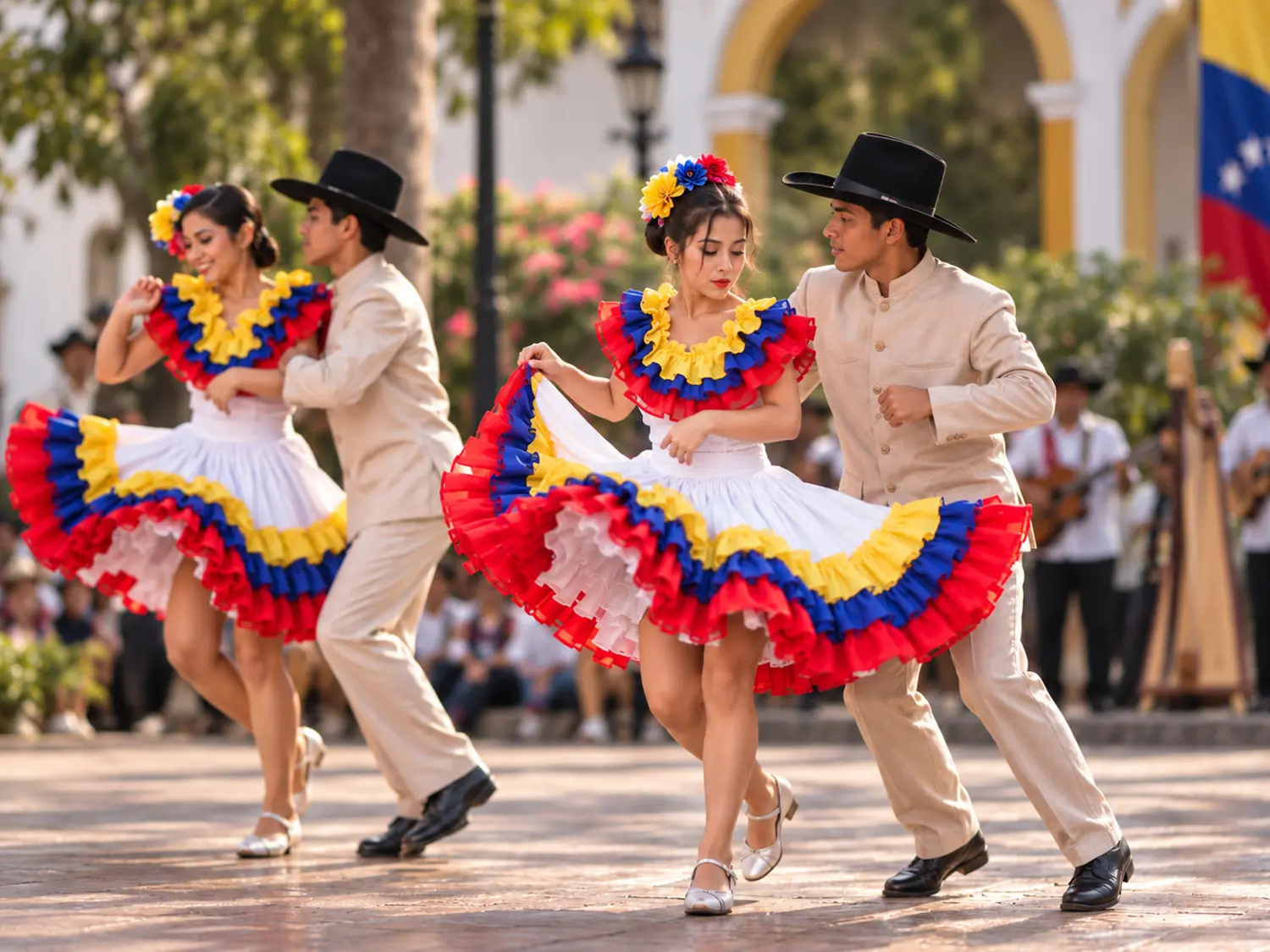
Summary. Joropo is a Venezuelan music and dance tradition also practiced in neighboring Colombia, particularly in the shared plains region known as the Llanos.[1][7] It brings together partner dancing and instrumental music, with singing and poetry woven into the celebration.[1] Fast footwork is especially prominent in joropo llanero, the plains form shared by both countries. Other regions have their own styles, performed at family gatherings as well as public festivals.[1][7][11]
Quick facts
| Origin/Region | Venezuela. The joropo llanero variation is also practiced in Colombia’s Llanos.[1][7] |
| Music | Instruments vary by region. Plains ensembles often feature a harp with cuatro (a small four-stringed guitar) and maracas (handheld rattles).[1][7] |
| Movement style | Partner dancing that responds closely to the music. Llanero competitions emphasize speed and agile footwork.[5][11] |
| Costume | Regional dress varies. A historical Colombian Llanos example features hats and light trousers for men, with wide skirts and decorated blouses for women. Both wear alpargatas, canvas shoes with plant-fiber soles.[6][15] |
| Where it is danced | Family celebrations and public gatherings in Venezuela, including religious and cultural festivals. Colombia also hosts major joropo events.[1][11] |
| Partner connection | Partners can begin in a waltz-style hold, facing each other with some space between them before moving through joropo patterns.[1][17] |
| Related traditions | Plains music includes the driving golpe and the gentler pasaje. Regional traditions include joropo oriental from eastern Venezuela and the Colombian partner dance known as joropo criollo.[8][9][10] |
The name joropo covers a family of regional traditions that developed in different parts of Venezuela and Colombia. Joropo llanero comes from the shared plains culture of the Llanos, while eastern Venezuela has joropo oriental and the Venezuelan Andes have their own regional forms. Each has its own musical character and ways of dancing, giving joropo a range of sounds and styles across the region.[1]
Origins & history
Joropo developed through historical encounters between Indigenous peoples and communities of African and European origin in Venezuela.[1] Its Spanish connections include traditions from Andalusia in southern Spain and fandango, an older Spanish dance and its accompanying music.[13][16] Smithsonian Folkways also suggests that the repeating rhythmic drive of plains music may reflect the influence of enslaved Africans and their descendants.[7]
Luis Felipe Ramón y Rivera proposed that joropo took a recognizable form in the late 1700s and early 1800s.[13] Over time, joropo developed regional traditions with their own musical character and ways of dancing.[1]
One of these forms is joropo llanero, rooted in the shared culture of the Llanos. These broad grasslands around the Orinoco River extend across eastern Colombia and western Venezuela, and the word llanero refers to the region and its people.[7] In Colombia, the tradition is practiced in the departments (administrative regions) of Arauca, Casanare, Meta, Vichada and Guaviare.[4]
Plains music reached much larger audiences during the twentieth century. From the late 1940s through the 1970s, recordings and radio helped popularize Venezuelan performers. Television and film extended that reach, bringing an existing regional tradition to a wider public.[7]
More recently, both countries have formally recognized their joropo traditions. In 2019, Venezuela added joropo to its National Inventory of Intangible Cultural Heritage, which records living cultural traditions.[2] Colombia’s Law 2509 of July 31, 2025, recognized joropo llanero dance and its music as national intangible cultural heritage.[4] Also in 2025, UNESCO added “Joropo in Venezuela” to its Representative List of the Intangible Cultural Heritage of Humanity.[2]
Steps & style hallmarks
Couples can begin joropo in a waltz-style hold, facing each other with some space between them before moving through the dance’s characteristic steps.[1][17] In llanero teaching, listening is central to the movement. Dancers learn to recognize musical changes and respond with their steps.[5]
Two useful terms help explain the footwork. Zapateo is rhythmic stamping that makes the dancers’ steps audible. Escobillao uses short forward-and-back foot movements that brush the floor. The contrast is between sounding the rhythm with the feet and keeping the steps low and sweeping.[17]
In joropo llanero, dancers follow la cuerda, the musical cues that guide their footwork.[5] In a traditional sequence, the couple moves from low, sliding steps into a passage where the man stamps the rhythm while the woman brushes her feet across the floor. They then return to the sliding step before another passage of footwork.[19] Dancers respond to different cues in the music, so couples sharing the floor do not necessarily begin stamping at the same time.[18]
The speed can be striking in competition. At the International Joropo Tournament in Villavicencio, a Colombian city in the Llanos region, couples perform rapid sequences with agile zapateo.[11] To get a feel for the dance, watch how the partners stay connected and listen for changes in the music. The relationship between the steps and the sound is more revealing than speed alone.[1][5]
Music & instruments
Joropo’s sound changes from region to region. UNESCO’s Venezuelan documentation includes harp and cuatro alongside maracas. Violin and accordion also appear in the regional instrument traditions it describes.[1]
In the plains sound popularized through commercial recordings, the melody is often carried by a harp or bandola llanera. The bandola llanera is a small four-stringed instrument played with a pick. A cuatro, a small four-stringed guitar, provides rhythmic accompaniment. Maracas complete the core group, with acoustic or electric bass becoming a later addition.[7]
The cuatro’s strumming can sound almost drumlike. Maracas are handheld rattles, often made from gourds containing seeds or small pebbles. Skilled players use them to produce complex rhythms and subtle changes in tone. Together, these instruments create a rhythmic foundation that dancers can answer with their feet.[7]
Singing and poetry are also part of the wider tradition. Songs may explore love or the natural world. Others draw humor from everyday situations or describe daily life.[1] Joropo can therefore be a shared musical celebration rather than simply instrumental accompaniment for dancing.[1]
The dancers also contribute to the sound. In a Smithsonian Folkways account, musician Carlos Rojas Hernández describes their footwork as an essential part of rural social joropo. When musicians perform on a concert stage without dancers, that rhythmic layer is lost. The change is not just visual: it affects what the audience hears.[7]
Costume & staging
Joropo has no single costume, but clothing can reflect the region and the setting in which it is danced. A 1972 Colombian archive record from the Llanos shows men in light trousers and shirts with broad-brimmed hats. Women wear wide skirts in bright colors or prints with light, decorated blouses. Both wear alpargatas, traditional canvas shoes with soles made from plant fibers.[6][15]
UNESCO’s photographs also show colorful clothing in Andean joropo from Mérida State, in Venezuela’s Andes mountains.[3]
Regional variations & related music
Several related dance and music traditions are practiced under the joropo name in Venezuela and Colombia, each reflecting its regional setting.[1][9][10]
One is joropo oriental, the regional tradition of eastern Venezuela. Its music is led by string instruments and makes extensive use of improvisation, meaning performers create musical ideas in the moment. It offers a different sound and approach from the plains style often seen in dance competitions.[9]
Another is joropo criollo, a partnered form within Colombia’s joropo traditions.[10]
Within plains music, the hard-driving golpe contrasts with the slower and more melodic pasaje. These names describe musical forms rather than fixed sequences of dance steps.[8] For dancers, the contrast offers a useful way to listen: notice the difference between a driving passage and a gentler song.[8]
Where to experience it now
In Venezuela, joropo is part of year-round social life. People dance at family celebrations and public gatherings, including religious and cultural festivals. Some parties last several days, and people of all ages take part.[1] These settings offer a different experience from watching a staged show: the dancing belongs to the celebration itself.[1]
Villavicencio hosts the annual International Joropo Tournament, founded in 1962. Its program brings together singing and instrumental contests alongside dance competitions. The fast partner performances are a chance to see competitive llanero footwork, though they represent only one part of the broader tradition.[11]
Joropo also reaches audiences beyond the Llanos. In Bogotá, the 2025 edition of Joropo al Parque presented both traditional and innovative styles.[12] Beginner-friendly activities have offered another way to take part. Villavicencio’s 2025 Gran Maratón de Joropo, a community joropo marathon, included “Joropo Express” sessions introducing basic steps.[14] These are examples of past programs. Check the organizers’ current announcements for upcoming dates and classes.
Frequently asked questions
How is joropo learned?
Joropo is often learned by listening and watching others, then trying the movements. Family and community members pass on their knowledge, while joropo schools also provide organized instruction for children.[1]
Is there one correct joropo style?
No. Joropo includes several regional traditions with their own ways of playing and dancing. The plains style is one form; eastern Venezuela’s joropo oriental is another.[1][9]
Is joropo only a dance?
No. Dance belongs to a wider tradition of music and sung poetry. The songs can tell stories about everyday life or express feelings about love and the natural world.[1]
References
- UNESCO (2025), Joropo in Venezuela. https://ich.unesco.org/en/RL/joropo-in-venezuela-02092
- UNESCO (2025), Decision of the Intergovernmental Committee: 20.COM 7.b.1, Joropo in Venezuela. https://ich.unesco.org/en/Decisions/20.COM/7.b.1
- UNESCO (2025), Photographs: Joropo in Venezuela. https://ich.unesco.org/fr/7b-liste-representative-01412?call=slideshow&id=02092&include=slideshow_inc.php&mode=scroll&width=620
- Cámara de Representantes de Colombia (2025), JOROPO, Proyecto de ley / Ley 2509 del 31 de julio de 2025. https://www.camara.gov.co/joropo-1198/
- Instituto Distrital de las Artes (Idartes), Bogotá (2024), Taller: El Joropo llanero, sus variables y apropiación son. https://www.idartes.gov.co/es/agenda/taller/el-joropo-llanero-sus-variables-y-apropiacion-son
- Banco de la República de Colombia / Banrepcultural (1972), Bailarines de joropo. https://babel.banrepcultural.org/digital/collection/hernan-diaz/id/807/
- Smithsonian Folkways Recordings, Smithsonian Institution (2011), ¡Cimarrón! Joropo Music from the Plains of Colombia. https://folkways.si.edu/magazine-summer-2011-cimarron-joropo-plains-colombia/latin-world/music/article/smithsonian
- Smithsonian Folkways Recordings, Smithsonian Institution (2011), Grupo Cimarrón perform ‘Zumbaquezumba’ (Resound, Resound). https://folkways.si.edu/zumbaquezumba/latin-world/music/video/smithsonian
- Smithsonian Folkways Recordings, Smithsonian Institution (2009), Y Que Viva Venezuela! Maestros del Joropo Oriental. https://folkways.si.edu/y-que-viva-venezuela-maestros-del-joropo-oriental/latin-world/music/album/smithsonian
- Smithsonian Folklife Festival, Smithsonian Institution (2011), Grupo Cabrestero. https://festival.si.edu/2011/colombia/participant-portfolios/grupo-cabrestero/smithsonian
- Fondo Nacional de Turismo de Colombia (FONTUR) (2024), Festival Internacional del Joropo. https://calendarioferiasyfiestas.fontur.com.co/agenda/festival-internacional-del-joropo
- Alcaldía Mayor de Bogotá / Bogota.gov.co (2025), Entre cantos recios y zapateo, se vivió el cierre de Joropo al Parque 2025. https://bogota.gov.co/mi-ciudad/cultura-recreacion-y-deporte/bogota-celebro-el-cierre-de-la-cuarta-edicion-de-joropo-al-parque2025
- Universidad Andina Simón Bolívar, Sede Ecuador (2014), Joropo: sonoridades de la vida, estéticas de la existencia. https://repositorio.uasb.edu.ec/bitstream/10644/4277/1/TD052-DECLA-Joropo-Lambuley.pdf
- Alcaldía de Villavicencio (2025), Corcumvi invita a la gran maratón de joropo para fortalecer la identidad llanera en Villavicencio. https://villavicencio.gov.co/corcumvi-invita-a-la-gran-maraton-de-joropo-para-fortalecer-la-identidad-llanera-en-villavicencio/
- Real Academia Española and Asociación de Academias de la Lengua Española, Alpargata. Diccionario de la lengua española. https://dle.rae.es/alpargata
- Real Academia Española and Asociación de Academias de la Lengua Española, Fandango. Diccionario de la lengua española. https://dle.rae.es/fandango
- Venezuela Tuya, El joropo. Descriptions of partner dancing and footwork. https://www.venezuelatuya.com/tradiciones/el_joropo.htm
- Ministerio de Cultura de Colombia / Sistema Nacional de Información Cultural (SINIC), Colombia Cultural: Danza – Casanare. https://www.sinic.gov.co/SINIC/ColombiaCultural/ColCulturalBusca.aspx?AREID=3&COLTEM=221&IdDep=85&SECID=8
- Ministerio de Cultura de Colombia / Sistema Nacional de Información Cultural (SINIC), Colombia Cultural: Danza – Arauca. https://www.sinic.gov.co/SINIC/ColombiaCultural/ColCulturalBusca.aspx?AREID=3&COLTEM=221&IdDep=81&SECID=8