
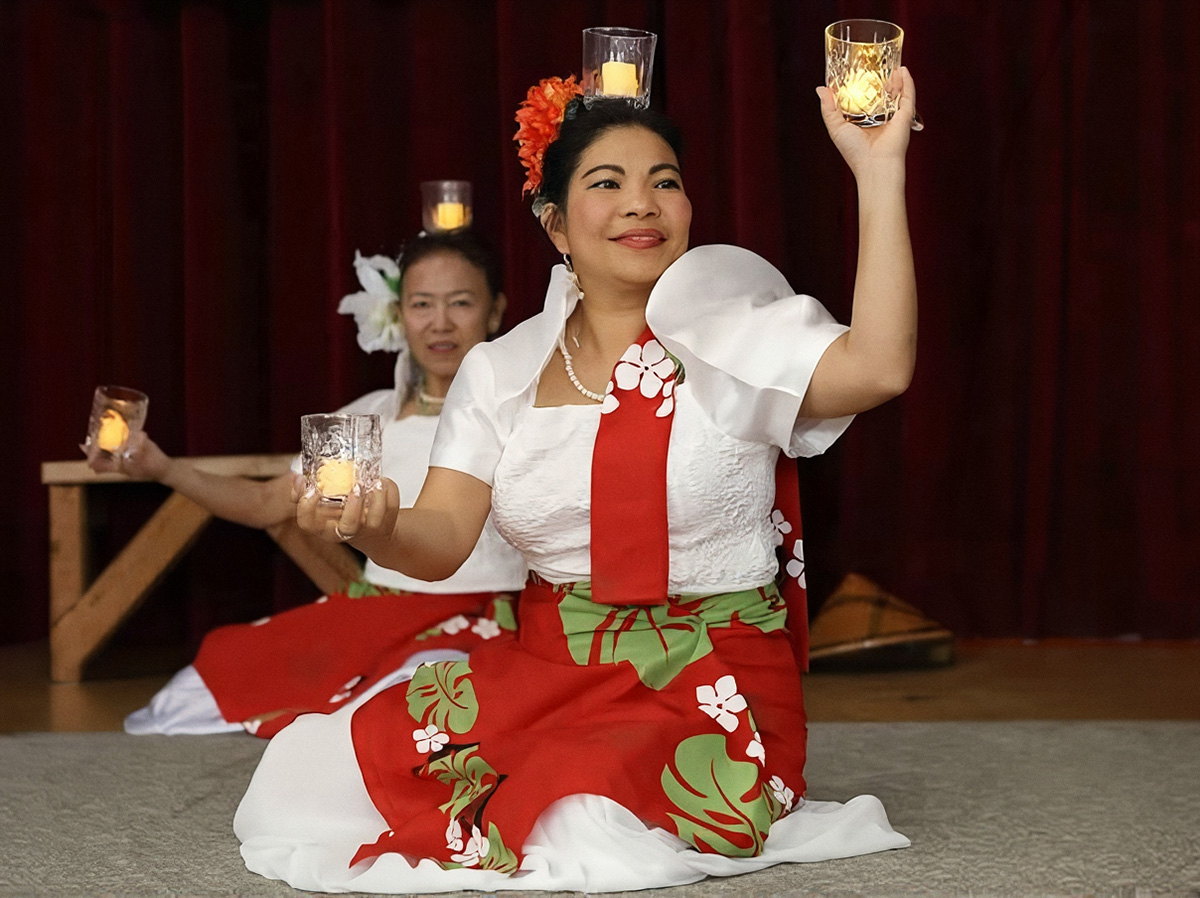
Summary. Pandanggo sa Ilaw is a lively lamp-balancing dance from Mindoro in the Philippines. In its traditional form, a woman performs waltz steps and turns while balancing three small oil lamps: one on her head and one on the back of each hand. It belongs to a wider family of Philippine pandanggo dances adapted from the Spanish fandango, which local communities reshaped through their own steps, music, props, costumes, and performance traditions. Pandanggo sa Ilaw’s glowing lamps and careful balance make it one of the most visually distinctive forms of Filipino dances.[1]
Quick facts
| Origin/Region | Mindoro, an island southwest of Manila in the Philippines.[1] |
| Music | A lively melody in triple meter composed by Antonino R. Buenaventura, based on the rhythm once clapped by onlookers.[1] |
| Movement quality | Soft but lively waltz steps, cross-waltzes, turns, and swaying balance steps performed with a steady upper body.[1] |
| Traditional props | Three small oil lamps called tinghoy: one on the head and one on the back of each hand.[1] |
| Performance format | Performance formats include solo, partnered, and group arrangements. In the historical description, a female dancer carries all three lamps.[1][2] |
| Typical context | Cultural programs, folk-dance concerts, community celebrations, school presentations, and Filipino heritage events.[1][2][3] |
| Technical challenge | Keeping all three lamps level through turns, traveling steps, changes of direction, and low movements while maintaining balanced posture.[1][2] |
| Related traditions | Other Philippine forms include Pandanggo Ivatan, Pandanggo Rinconada, and Pandanggo sa Sambalilo.[1] |
Origins & history
The story of pandanggo begins with the fandango, a lively Spanish dance that became popular in the Philippines during the colonial period. Philippine communities blended fandango steps with local dance practices and created many forms known as pandanggo. These dances changed from place to place through their movement, music, props, clothing, and social setting. They were commonly performed for entertainment and celebration.[1]
Pandanggo sa Ilaw developed as a distinctive Mindoro form within this wider dance family. The historical description preserved in the CCP Encyclopedia of Philippine Art identifies three lighted tinghoy, or small oil lamps, as its defining props. The woman balances one on her head and one on the back of each hand while dancing waltz-based steps.[1]
The dance was originally accompanied by the rhythmic clapping of onlookers. After dance researcher Francisca Reyes-Aquino and her team documented the dance, she asked team member Antonino R. Buenaventura to compose a melody for it. He wrote the lively triple-meter music now associated with Pandanggo sa Ilaw and kept the rhythm of the earlier clapping accompaniment. The tune became so familiar that it has often been mistaken for an anonymous folk song.[1][4]
Over time, folk-dance companies, schools, and Filipino communities abroad brought the dance into concerts, heritage programs, and community celebrations. These productions sometimes changed the formation or replaced open oil flames with safer lights, but the challenge of moving gracefully while balancing three lights remained at the center of the dance.[2][3]
Steps & performance
Pandanggo sa Ilaw combines a lilting waltz rhythm with careful control. Its standard steps include the waltz and cross-waltz, waltz turns, sway-balance steps with a pointed foot, and a step-cross-step-point pattern. These steps let the dancer travel, turn, and change direction while keeping her head and hands steady enough to support the lamps.[1]
The lights make even a small loss of balance visible. Some contemporary performances add deeper bends, faster turns, or movements closer to the floor, increasing the difficulty without making the dance look tense.[2] The moving lights are often described as resembling fireflies at dusk, but this is best understood as a popular interpretation rather than a firmly documented account of the dance’s original meaning.[5]
There is no single performance formation used everywhere. One historical description focuses on a woman carrying all three tinghoy, but it does not make clear whether she performs alone. It also mentions a man’s costume without explaining his role or suggesting that he carries lamps. Later community versions include groups of women as well as partnered performances in which a man helps his partner balance the lights.[1][2] In practice, the setup varies from one performance to another.
Music
Antonino R. Buenaventura’s music has a lively three-beat pulse that gives the dance its waltz-like lift. The first beat feels strongest, followed by two lighter beats, which suits the swaying steps and turns. Because the melody preserves the rhythm once clapped by spectators, it connects the staged musical setting with the dance’s earlier community accompaniment.[1]
Modern performances may arrange the melody for different instruments or larger groups. Buenaventura, later named a National Artist for Music, is credited as the composer, although the tune is sometimes mistaken for an anonymous folk song.[1][4]
Costume, lamps & staging
A Mindoro presentation dresses the woman in a balintawak, a Filipino dress known for its wide sleeves, with a tapis overskirt. The man’s recorded costume is a barong Tagalog, an embroidered formal shirt, with long red trousers. Costumes vary in modern productions, but they usually preserve a formal or festive Filipino look.[1]
The traditional arrangement uses three lighted tinghoy, or small oil lamps: one rests on the head, and one rests on the back of each hand.[1] Later stage versions have used candles or votive lights in glasses, illuminated cups, and other safer alternatives when open flames are impractical.[2][3] These are practical adaptations rather than the original props.
Related pandanggo traditions
Pandanggo sa Ilaw belongs to a large family of Philippine dances rather than standing alone. Pandanggo Ivatan is a wedding dance from Batanes, an island province in the far north of the Philippines, where the newly married couple opens the dance before guests present gifts. Pandanggo Rinconada comes from Camarines Sur, a province in the Bicol region, and is performed by both young and old during the Christmas season. Both share the broader pandanggo heritage but serve different occasions from Mindoro’s lamp-balancing dance.[1]
Other forms are named for the objects used in them. Pandanggo sa Sambalilo from Camiling, Tarlac centers on a hat and highlights a male dancer’s attempt to pick it up from the floor with his head. Pandanggo sa Paño and Pandanggo sa Tapis are also named for their props or clothing. These examples show how communities adapted the fandango framework into dances with their own local steps, objects, and meanings.[1]
Where to experience it now
Filipino cultural organizations, school groups, folk-dance companies, and communities outside the Philippines continue to perform Pandanggo sa Ilaw at concerts, community celebrations, and heritage events. Staging varies, so audiences may see oil lamps, candles in glasses, or electric alternatives in partnered or group arrangements.[2][3]
In Oriental Mindoro, Pandang Gitab offers a prominent public expression of the province’s light-dance tradition through street dancing, cultural shows, and light displays. The province describes it as Oriental Mindoro’s official Festival of Lights. Dates and venues can change, so visitors should check the current annual schedule before making travel plans.[6]
Frequently asked questions
What does Pandanggo sa Ilaw mean?
The name is commonly translated as “fandango with light” or “fandango of lights.” Pandanggo comes from the Spanish fandango, while sa ilaw refers to the lights that define this Mindoro version.[1]
What are the traditional lamps called?
They are called tinghoy, small oil lamps. The documented arrangement uses three: one on the dancer’s head and one on the back of each hand.[1] Candles in glasses and electric lights are later alternatives used for safety or staging.
Who composed the music for Pandanggo sa Ilaw?
Filipino composer, conductor, and military bandleader Antonino R. Buenaventura wrote the music at the request of dance researcher Francisca Reyes-Aquino. He preserved the rhythm of the hand clapping that had accompanied the dance and shaped it into the lively triple-meter melody used today.[1][4]
References
- Lucrecia Reyes-Urtula, Prosperidad Arandez, and Nicanor G. Tiongson. “The Spanish Colonial Tradition in Philippine Dance.” https://nlpdl.nlp.gov.ph/CC01/monographs/1994/NLP00VM052mcd/v6/v3.pdf CCP Encyclopedia of Philippine Art, Vol. 5. Cultural Center of the Philippines, 1994.
- Laura Westbrook. “Mabuhay Pilipino! (Long Life!): Filipino Culture in Southeast Louisiana.” https://www.louisianafolklife.org/lt/articles_essays/pilipino1.html Louisiana Folklife Program, Division of the Arts, Louisiana Office of Cultural Development.
- Ramona Anna Lavina. Cultural Heritage Maintenance and Equitable Participation in Multicultural Education: An Autoethnographic Study on the Development of a Filipino Heritage Curriculum in Canada. https://api.repository.upou.edu.ph/api/core/bitstreams/67445f4a-815a-497f-a895-7aa6c685df9b/content Master’s thesis, University of the Philippines Open University, 2022.
- “Pandanggo sa Ilaw.” https://pcfitampa.org/pandanggo-sa-ilaw/ Philippine Cultural Foundation, Inc.
- “Pandang Gitab Oriental Mindoro.” https://www.travelorientalmindoro.ph/festival/pandang-gitab-festival Travel Oriental Mindoro, Provincial Government of Oriental Mindoro, accessed July 13, 2026.