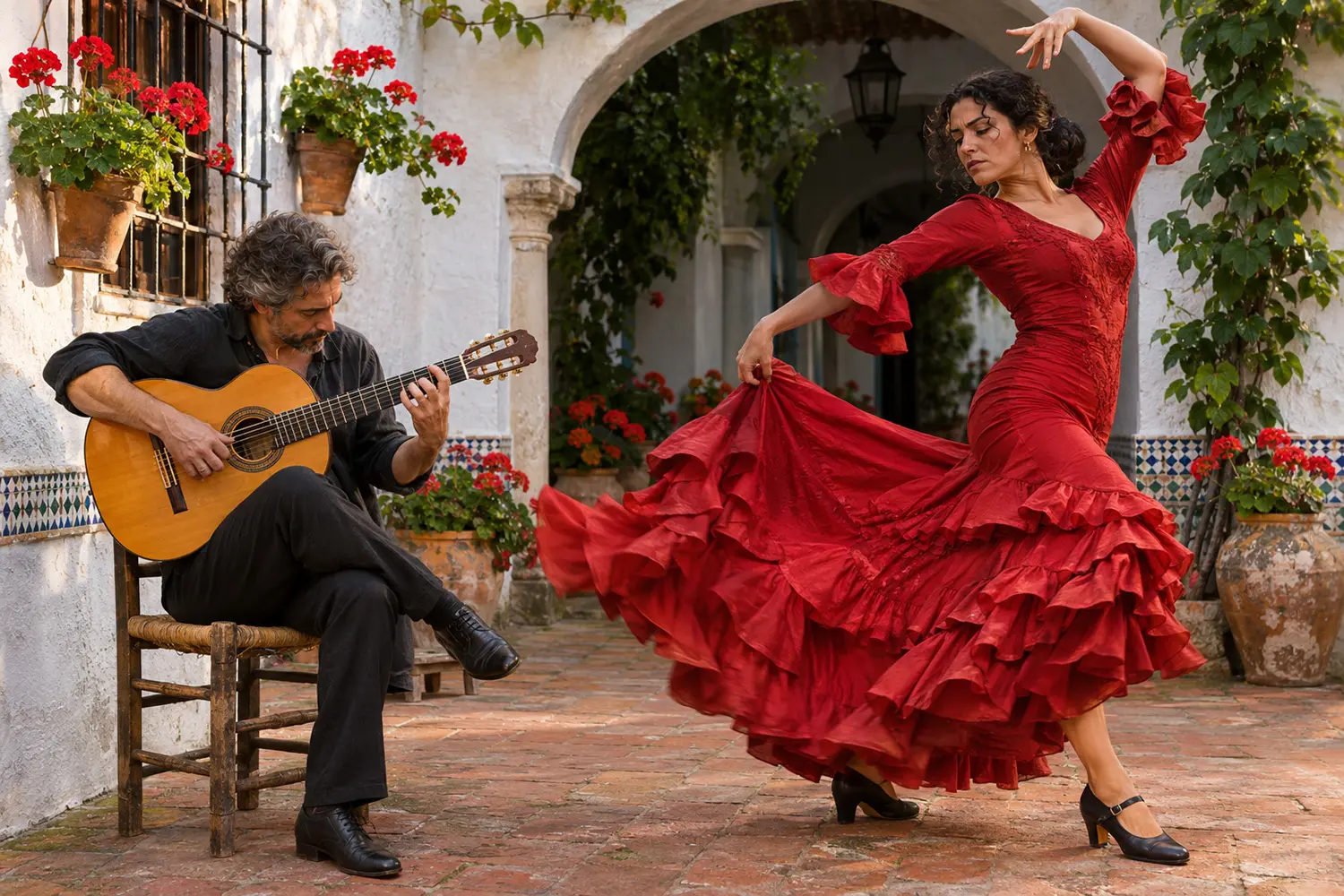
Spanish dances are a diverse group of dance styles that originated in Spain, many of which have deep roots in the country’s regional folk traditions. Dance is an important part of Spanish culture, bringing people together at festivals, religious celebrations and social gatherings. Some Spanish dances, most notably flamenco, have gained international popularity and are performed and taught around the world.
Among the most popular Spanish dances are flamenco, sevillanas, the jota and the pasodoble. Many regions of Spain also have their own distinctive dance traditions, from the sardana circle dances of Catalonia to the lively muiñeira of Galicia, danced to the sound of bagpipes.
In this guide, we’ll explore 28 Spanish dances, from internationally famous styles to lesser-known regional folk dances. Each entry includes an introduction to the dance and a video so you can experience its distinctive movements, music and character.
Popular Spanish Dances
From the fiery footwork of flamenco to the elegant movements of the bolero, Spain is home to some of the world’s most recognizable dance styles. These popular Spanish dances showcase the country’s rich musical heritage, expressive movements and passion for dance.
1. Flamenco: Song, Guitar and Expressive Dance
Flamenco is one of Spain’s most famous performing arts. It is closely associated with Andalusia, where Gitano (Spanish Romani) communities played an important role in its development. Flamenco combines cante (singing), toque (instrumental music, especially guitar) and baile (dance). UNESCO recognizes flamenco as part of the world’s intangible cultural heritage. [1]
Flamenco dancing is known for its grounded stance, expressive arm movements, twisting wrists and sharp rhythmic footwork called zapateado. Dancers may pause during a sung phrase before responding with a burst of foot percussion. Flamenco encompasses many different musical and dance forms, known as palos, including soleá, alegrías and bulerías, each with its own musical character and timing.
2. Sevillanas: A Four-Part Partner Dance
Sevillanas are a lively partner dance associated with Seville and the fairs and celebrations of Andalusia. Dancers typically face one another without maintaining a closed partner hold. A complete sevillanas set usually consists of four sections, called coplas, each with its own recognizable sequence of steps. [2]
Partners pass one another, turn and change places while tracing graceful shapes with their arms. Bright, repeating musical phrases guide the dancers from one figure to the next. Sevillanas have historical roots in the seguidillas family of Spanish music and dance.
3. Jota Aragonesa: Quick Feet and Castanets
The jota is a traditional dance found throughout several regions of Spain, with one of its best-known forms coming from Aragón in the northeast. The jota aragonesa often brings together singers, dancers and a rondalla, an ensemble featuring plucked-string instruments such as the guitar, bandurria and lute. Castanets often add a bright, rhythmic accompaniment. [3]
The dance combines raised arms and an upright posture with brisk heel-and-toe footwork, turns and small jumps. Partners face one another, separate and come back together in repeated patterns. The jota’s lively music and intricate footwork give the dance its energetic character, while the upper body remains poised and controlled.
4. Fandango: A Dance Family With Many Local Forms
The fandango is a family of traditional Spanish music and dances with forms found across the country. It is particularly associated with Andalusia, where it also forms part of the flamenco tradition. The Spanish government has recognized the fandango as an important part of the country’s cultural heritage. [4]
Many fandangos are danced to a lively rhythm grouped in threes, with rhythmic footwork, turns and changes of position. Regional folk versions often feature couples and group figures, while flamenco interpretations may emphasize expressive arm movements and percussive footwork. The fandangos de Huelva featured in the video are a regional tradition from Andalusia.
5. Pasodoble: A March-Like Partner Dance
Pasodoble, meaning ‘double step,’ is a partner dance closely associated with Spanish march music. Its strong, steady walking rhythm makes it a popular social dance at festivities. The music is also famously associated with the Spanish bullring, an influence reflected in some performances of the dance. [5]
Social pasodoble is danced with compact forward and backward steps, turns and changes of direction. The competitive ballroom version, known as Paso Doble, is a more theatrical interpretation of the dance, featuring dramatic poses, extended arm and body lines, and sharp movements.
6. Sardana: Catalonia’s Community Circle Dance
The sardana is a traditional circle dance of Catalonia and an important expression of community and regional culture. Participants join hands to form a circle, often dancing in public spaces. The dance is traditionally accompanied by a cobla, a musical ensemble known for its distinctive wind instruments. [6]
The dancers take small, measured steps to the side, alternating between short and long step patterns and changing the position of their joined hands. Although the individual movements are relatively simple, the dancers must stay in time with the music and one another to keep the circle moving together.
7. Muiñeira: Galicia’s Lively Bagpipe Dance
The muiñeira (also spelled muñeira in Spanish) is a lively traditional dance from Galicia in northwestern Spain. Its music often features the gaita, or Galician bagpipe, accompanied by percussion. The dance’s rolling 6/8 rhythm lends itself to quick hops and rhythmic step patterns known as puntos. [7]
Dancers form lines or circles, moving into smaller formations with fast, springy footwork. Partners turn and exchange places, often with their arms raised. The upbeat music and bouncing steps give the muiñeira its distinctive sense of energy.
8. Chotis Madrileño: A Tiny Turn Around the Floor
The chotis is one of Madrid’s signature dances and a familiar sight during the city’s San Isidro celebrations. Dancers often wear traditional chulapo and chulapa outfits, and the music is closely associated with the organillo, a street barrel organ. Although its origins extend beyond Madrid, the chotis has become an emblem of the city. [8]
The chotis is famous for how little space it requires. In a traditional figure, one partner pivots almost in place while the other circles around with small, controlled steps. This compact movement has given rise to the popular saying that the chotis can be danced on a single floor tile.
9. Spanish Bolero and Escuela Bolera: Elegant Footwork and Castanets
The Spanish bolero is a historical dance closely associated with escuela bolera, or the Spanish bolero school. This elegant theatrical dance tradition combines refined arm and upper-body positions with fast footwork, turns, jumps and the rhythmic sound of castanets. Escuela bolera is one of the major styles of Spanish stage dance performed by the Ballet Nacional de España. [9]
The dance is characterized by the contrast between its light, intricate footwork and its graceful, controlled poses. The Spanish bolero has a different musical and dance history from the romantic Cuban bolero, which developed in Cuba and spread throughout Latin America. [10]
10. Seguidillas Manchegas: Brisk Steps From La Mancha
Seguidillas are a traditional Spanish family of song and dance, and the seguidillas manchegas are particularly associated with the region of Castilla-La Mancha. Recognized as part of the region’s cultural heritage, they are commonly danced in pairs to brisk music featuring string instruments and sometimes castanets. [11]
Partners face one another, performing small, fast steps, turns and changes of place. The footwork follows the repeated musical phrases, with many of the movements taking place in a relatively small area. Local versions include the Albacete style demonstrated in the video.
Regional Dances of Andalusia and Catalonia
Andalusia and Catalonia are home to some of Spain’s richest dance traditions. The two regions have developed a wide range of styles, from the lively fandangos of Málaga and the flamenco traditions of Granada to the rhythmic stick dances and festive group dances of Catalonia.
11. Verdiales: Málaga’s Fandango Tradition
Verdiales are a traditional form of fandango music and dance from the Málaga area of Andalusia. Groups of performers known as pandas de verdiales play instruments such as the violin, guitar and pandero, a large frame tambourine. The distinctive sound of these ensembles is central to the tradition. [12]
Dancers perform quick, buoyant steps and turns, often in pairs, to the driving rhythm of the percussion. At celebrations such as Málaga’s annual fair, musicians and spectators gather around the dancers, creating a lively, communal atmosphere.
12. Zambra del Sacromonte: Granada’s Gitano Dance Tradition
The zambra is a musical and dance tradition associated with the Gitano communities of Granada’s Sacromonte neighborhood. It has close ties to family celebrations, including weddings, and is also performed today in local venues, where it has become a distinctive part of Granada’s cultural life. [13]
Zambra performances feature expressive upper-body movements, flamenco-related hand gestures and a close connection between dancers, singers and musicians. Singing and rhythmic handclaps accompany the dancers as they take turns performing.
13. Rumba Catalana: Guitar-Driven Party Music and Dance
Rumba catalana developed within Catalonia’s Gitano communities, particularly in Barcelona. It is a lively style of popular music and dance distinguished by the ventilador, a guitar technique that combines rhythmic strumming and percussive taps on the instrument. Singing and handclaps contribute to its infectious rhythm. [14]
Dancing to rumba catalana is typically informal, with relaxed steps, turns and playful gestures that follow the groove of the music. The style reached a worldwide audience during the closing ceremony of the 1992 Barcelona Olympics, when Peret and Los Amaya performed Gitana Hechicera.
14. Ball de Bastons: Catalan Stick Dancing
Ball de bastons means ‘stick dance’ in Catalan and is a popular feature of local festivals. Groups of dancers strike wooden sticks together in rhythm, creating a distinctive clicking sound that accompanies the music of traditional ensembles. Many towns have their own arrangements and dance figures. [15]
The dancers move through changing formations, turning and striking sticks with different partners in carefully timed patterns. The sound of the sticks becomes part of the music itself, and the precision of the dance depends on the coordination of the entire group.
15. Ball de Gitanes: Catalan Group Figures
Ball de gitanes is the name given to several local dance traditions in Catalonia. In the Vallès area, the dance features couples and groups performing coordinated figures. In Reus, the name refers to a festival dance in which the performers weave ribbons around a pole. [16]
The Vallès style, as performed by the Esbart Dansaire de Rubí in the video, is characterized by energetic partner exchanges and shifting group formations. The individual movements of each couple form part of a larger choreographic pattern.
Regional Dances of the Basque Country and Asturias
In the Basque Country and Asturias, dance plays a central role in community life. Traditional performances range from formal dances of honor and elaborate festival ceremonies to circle dances that bring neighbors together through music and song.
16. Aurresku: A Basque Dance of Honor
The aurresku is a traditional Basque dance of honor, often performed as a solo at weddings, civic ceremonies and other important occasions. The solo performance developed from the soka-dantza, a Basque chain-dance tradition in which the name aurresku refers to the first dancer. [17]
The dancer performs precise heel-and-toe steps, rapid changes of weight, high leg lifts and poised pauses. The music may be played on the txistu, a traditional three-hole flute, accompanied by a small drum. The combination of intricate footwork and controlled movements gives the aurresku its dignified character.
17. Ezpata-dantza: Basque Sword Dance
Ezpata-dantza means ‘sword dance’ in Basque and refers to a group of traditional dances performed by several communities. Swords serve as ceremonial and choreographic props, linking dancers into chains or creating arches as the group moves through different formations. [18]
One well-known example is the sword dance of Zumarraga, associated with the chapel of La Antigua. Precise footwork and carefully coordinated group patterns are central to the performance, with featured dancers taking their places within the larger formation.
18. Kaxarranka: Dancing Above the Crowd in Lekeitio
Watch Kaxarranka in Lekeitio on EITB
Kaxarranka is a striking ceremonial dance from Lekeitio, a fishing town in the Basque Country. Performed around the feast of San Pedro, the dance features a soloist standing on a chest held high above the ground by a group of carriers. The tradition has close ties to the town’s fishing community. [19]
The dancer performs intricate steps and changes of position on the small raised platform while the carriers keep it steady below. The performance combines balance and precise footwork with traditional Basque dance rhythms, including zortziko, fandango and arin-arin.
19. Danza Prima: Asturias’s Sung Circle Dance
Danza prima is a traditional circle or chain dance from Asturias, performed at community celebrations such as those in Llanes. The dancers sing as they move, with their shared voices providing the rhythm for the dance. [20]
Participants join hands, sometimes linking their little fingers, and move together in small, gentle side steps. The simplicity of the movement places the emphasis on the shared song and the unity of the group. The archival video shows a danza prima gathering in Llanes in 1973.
20. Pericote de Llanes: A Three-Person Asturian Dance
The pericote is a traditional dance closely associated with Llanes in Asturias, where it forms part of local festivities. One of its most recognizable features is its unusual trio formation, traditionally consisting of two women and one man. [20]
The three dancers weave around one another with light hops, small turns and changing formations. Their movements alternate between individual steps and coordinated group figures. Traditional costumes are also a distinctive feature of festival performances in Llanes.
Traditional Dances of the Balearic Islands
The Balearic Islands are home to a rich variety of traditional dances. Ibiza and Formentera are known for their energetic ball pagès, while Mallorca has its own lively social dances and colorful ceremonial performances. Local dance groups help keep these island traditions alive.
21. Ball Pagès: Ibiza’s Traditional Rural Dance
Ball pagès, meaning ‘peasant dance,’ is a traditional dance family from Ibiza and Formentera. Its distinctive musical accompaniment can include the flaüta (a small flute), a drum, the espasí (a metal percussion instrument) and large castanets known as castanyoles. [21]
A striking feature of ball pagès is the contrast between the two dancers’ movements. In a traditional pair, one glides across the ground with small, measured steps while the other circles around with energetic jumps, turns and rhythmic accents from the castanets. Traditional island costumes add to the visual character of the dance.
22. Ball de Bot: Mallorca’s Social Dance Family
Ball de bot is the collective name for several traditional social dances from Mallorca, including local jotas, fandangos, boleros, mateixes and copeos. Together, these styles form an important part of the island’s participatory folk dance culture. [22]
Couples often dance facing each other, following a shared rhythm while incorporating individual step variations called punts. Changes in footwork create a playful exchange between partners, while turns and traveling steps bring the dance floor to life.
23. Ball dels Cossiers: Mallorca’s Festival Figures
Ball dels cossiers is a traditional Mallorcan festival dance featuring a group of costumed performers. In Algaida and several other towns, dancers known as cossiers perform around a central figure called the Dama. Some local versions also feature a character known as the dimoni, or devil. [23]
The dancers perform coordinated circles, crossings and small jumps, incorporating handkerchiefs and other costume elements into their gestures. The choreography centers on the interaction between the characters and the patterns they create as a group. The performance in the video comes from Algaida.
Traditional Dances of the Canary Islands
The Canary Islands have a distinctive musical and dance heritage, often accompanied by the bright sound of the timple, a small plucked-string instrument. The islands’ traditional dances range from the joyful group figures of the isa to the graceful folías and drum-driven tajaraste.
24. Isa Canaria: A Joyful Group Dance
The isa is one of the Canary Islands’ liveliest traditional dances. Related to the Spanish jota, it has developed its own distinct Canarian character. Its festive music often features guitars, the timple and other traditional folk instruments. [24]
Couples perform springy steps and turns, joining together in lines, circles and other group formations. The dancers exchange places as they follow the rhythm of the music, giving the isa an energetic and social character.
25. Folías Canarias: Graceful Partner Figures
Canarian folías are a traditional style of song and dance with a slower, more graceful character than the isa. The music often features a measured three-beat feel, giving the singers room to express the melody. [25]
Partners dance with delicate steps, graceful turns and controlled changes of position, often maintaining some space between them. Their poised movements reflect the gentle pace and lyrical qualities of the music.
26. Tajaraste: Drum-Led Dance of the Canaries
Tajaraste is a traditional Canarian music and dance form with different local styles on Tenerife and La Gomera. Drums and, in some versions, large hand-held clappers known as chácaras provide its distinctive rhythmic accompaniment. [26]
The dancers perform repeated small hops and shifting steps in time with the percussion. In the La Gomera tradition featured in the video, the drum plays a central role, with the dancers’ movements following the powerful rhythm of the music and song.
Other Remarkable Regional Dance Traditions
Some of Spain’s most spectacular dance traditions are performed during local ceremonies and festivals. From spinning downhill on stilts to dancing by torchlight in elaborate costumes, these performances combine choreography with remarkable feats of skill and community tradition.
27. Danza de los Zancos: Spinning on Stilts in La Rioja
The danza de los zancos, or stilt dance, is a famous ceremonial performance from Anguiano in La Rioja. During local religious festivities, trained dancers wearing wooden stilts descend a steep cobblestone street while turning to the rhythm of castanets. The dramatic performance draws crowds of spectators. [27]
The dancers spin as they travel downhill, balancing on tall, narrow supports. The combination of continuous turns, the steep slope and the height of the stilts makes the danza de los zancos a remarkable display of balance and coordination.
28. Contradanza de Cetina: A Torchlit Festival Dance
Cetina, a town in Aragón, is known for its dramatic torchlit contradanza, performed during local festivities. Eight dancers wear striking black-and-white, skeleton-like costumes, while a ninth performer dressed in red represents the diablo, or devil. [28]
The dancers hop, exchange places and form intricate geometric patterns as the central character moves among them. The combination of torchlight, unusual costumes and carefully arranged formations gives the performance a theatrical character, distinct from the social contra dances popular in North America.
Frequently Asked Questions About Spanish Dances
What is the most famous Spanish dance?
Flamenco is Spain’s most internationally recognizable dance tradition, famous for its dramatic footwork, expressive arm movements, guitar music and singing. It encompasses many different styles known as palos. Sevillanas, jota and pasodoble are also among Spain’s best-known traditional dances.
Which Spanish dances can beginners learn?
Sevillanas, social pasodoble and chotis are good starting points for beginners interested in Spanish dancing. Sevillanas follow a repeatable four-part sequence, while social pasodoble and chotis feature relatively simple basic partner steps. The sardana is also a good introduction to Spanish group dances, particularly with guidance from experienced dancers.
Are salsa, bachata and tango Spanish dances?
Salsa, bachata and tango are Latin dances that are popular in Spain but originated elsewhere. Salsa developed from Afro-Caribbean music and dance traditions, with strong ties to Cuba, Puerto Rico and New York. Bachata originated in the Dominican Republic, while tango developed in the Río de la Plata region of Argentina and Uruguay. These styles are also featured in our guide to social dances.
Is Spanish bolero the same as Cuban bolero?
No. The Spanish bolero is a historical dance associated with escuela bolera, featuring elegant poses, intricate footwork and castanets. The Cuban bolero is a romantic song and dance tradition that developed in Cuba and spread throughout Latin America.
Do all traditional Spanish dances use castanets?
No. Castanets are particularly common in the jota, escuela bolera and various regional folk dances. Other Spanish dances feature different musical instruments, such as the cobla ensemble in the Catalan sardana, bagpipes in the Galician muiñeira and drums and chácaras in some Canarian dances.
Where can you see traditional Spanish dancing in Spain?
Traditional Spanish dances can be seen at local fairs, patron-saint festivals, romerías (community pilgrimages and celebrations), cultural events and folk dance performances. Seville’s fairs are famous for sevillanas, while towns such as Lekeitio and Cetina host distinctive ceremonial dances during local festivities. Festival schedules vary throughout the year. If you’re interested in exploring dance traditions from around the world, check out our guides to ballroom dances and social dances.
Sources and Further Reading
- UNESCO: Flamenco, Intangible Cultural Heritage.
- Instituto Andaluz del Flamenco: Sevillanas.
- Zaragoza Turismo: Jota Aragonesa.
- Boletín Oficial del Estado: Cultural heritage declaration concerning the fandango (PDF).
- Centros Municipales de Mayores de Chamartín: Pasodoble in social ballroom dancing.
- Government of Catalonia: The Sardana.
- Xunta de Galicia educational resources: A muiñeira.
- Comunidad de Madrid: San Isidro festivities and traditional dances (PDF).
- Ballet Nacional de España: Escuela bolera (PDF).
- UNESCO: Bolero, identity, emotion and poetry turned into song.
- Castilla-La Mancha: Seguidilla Manchega cultural heritage.
- Junta de Andalucía: Los Verdiales cultural heritage declaration.
- Junta de Andalucía: Zambra del Sacromonte cultural heritage documentation.
- Patrimoni Cultural de Catalunya: La rumba catalana.
- Ajuntament de Castelldefels: Ball de bastons.
- Coordinadora de Danses Tradicionals de Reus: Ball de Gitanes; see also Catalan heritage documentation for Sant Celoni (PDF).
- Basque Cultural Institute: Basque dance questions and answers.
- Basque Cultural Institute: Sword dances.
- Basque Country Tourism: Traditional Basque music and dance; Basque Government: Lekeitio’s 2026 Kaxarranka event.
- Turismo Asturias: Fiesta de Santa María Magdalena, Llanes.
- Spanish Ministry of Culture: Ball Pagès.
- Consell de Mallorca: Ball de bot.
- Balearic Islands Tourism: Ball dels Cossiers.
- Canary Islands Tourism: Island heritage and culture.
- Canary Islands educational resource: Folía.
- Canary Islands educational resource: Tajaraste.
- La Rioja Turismo: Danzadores de Anguiano.
- Turismo de Aragón: Cetina and its Contradanza.