
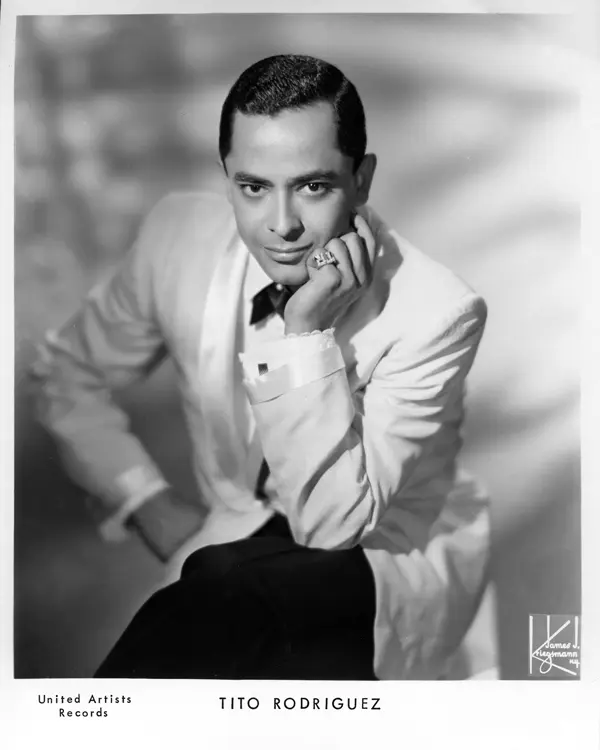
Tito Rodríguez was one of the three great bandleaders who defined New York’s mambo era, alongside Machito and Tito Puente. Their orchestras made the legendary Palladium Ballroom the center of Latin dance music in the 1950s. Rodríguez stood apart as both a brilliant bandleader and an elegant singer, equally celebrated for his exciting dance music and romantic ballads. Known as “El Inolvidable” (The Unforgettable One), he became one of the most beloved voices in Latin music.
Born in Santurce, Puerto Rico, Rodríguez began singing at an early age before moving to New York. He performed with established musicians including Xavier Cugat and Noro Morales before forming his own orchestra in the late 1940s. During the mambo craze, his band became one of the biggest attractions at the Palladium, thrilling dancers with recordings such as “Mama Güela,” “El Cayuco,” and “Avísale a Mi Contrario.” His repertoire also embraced cha-cha-chá, while his orchestra was a training ground for talented musicians, including Eddie Palmieri and Mario Rivera.
Rodríguez’s musical talents extended well beyond the dance floor. He worked with leading jazz musicians, including Clark Terry and Zoot Sims, on his 1963 album Live at Birdland. That same year, he achieved enormous success with From Tito Rodríguez with Love, an album of romantic boleros featuring his unforgettable interpretation of “Inolvidable,” written by Cuban composer Julio Gutiérrez. His ability to move between powerful mambo arrangements and intimate romantic songs made him one of Latin music’s most versatile performers.
In 1966, Rodríguez returned to Puerto Rico, where he hosted his own television program, El Show de Tito Rodríguez. He also founded TR Records and continued recording until his death in 1973, just as salsa was reaching a new generation of listeners.
Rodríguez’s influence lived on through the salsa musicians who followed him, especially singers such as Gilberto Santa Rosa, who has repeatedly honored his music. His legacy bridges the golden age of mambo and the rise of modern salsa, combining the energy of a world-class dance orchestra with one of Latin music’s most memorable singing voices.