
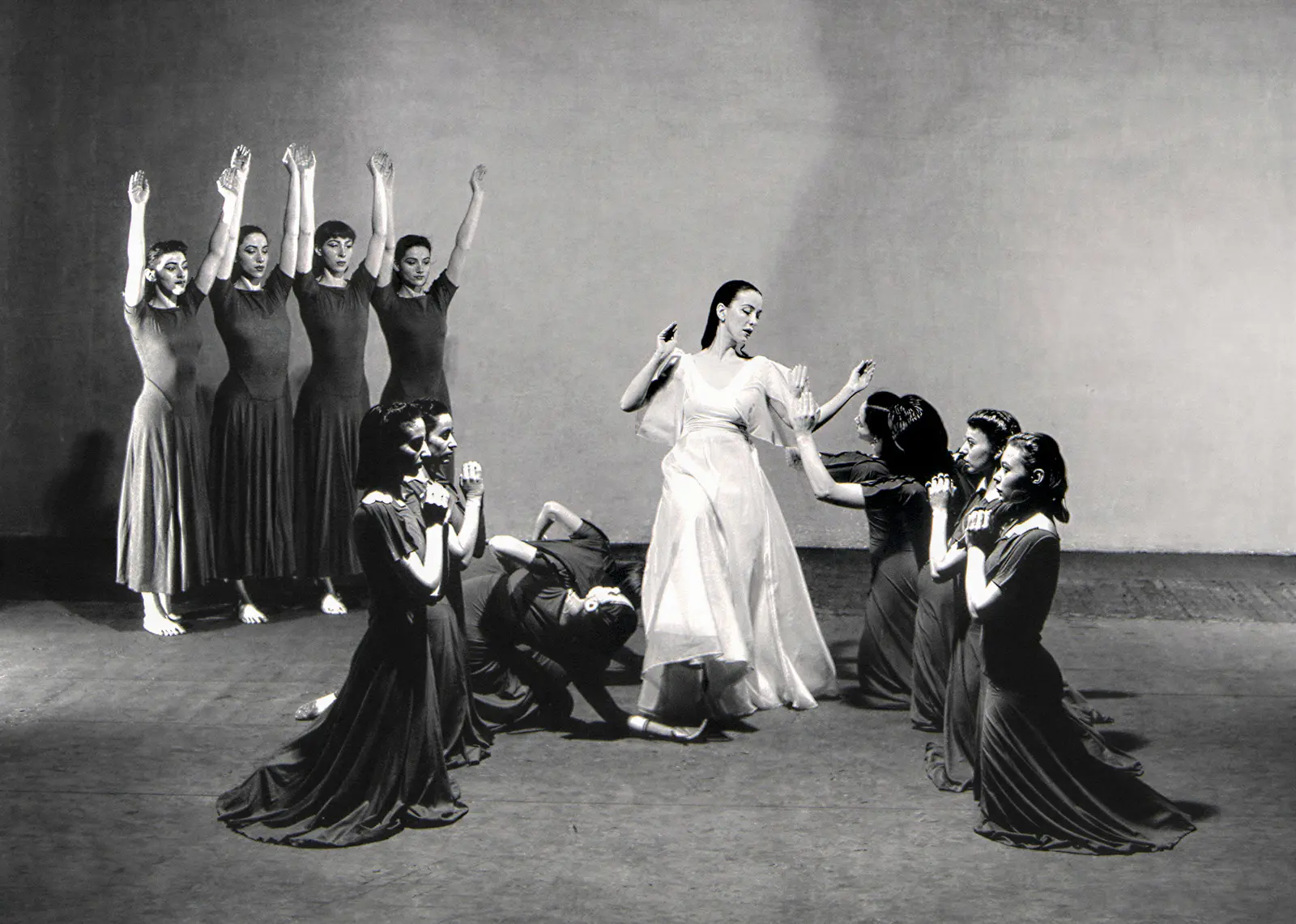
Summary. Modern dance is a broad tradition of concert dance, meaning dance created for performance before an audience. It took shape in the early 20th century, with major roots in the United States and Germany, as artists challenged ballet conventions and developed their own approaches to movement.[1][2] Modern dance has no single founder or universal technique. Its defining contribution was to make the possibilities of dance something artists could explore for themselves.[1]
Quick facts
| Origin/Region | Late 19th-century experiments developed into modern dance in the early 20th century, especially in the United States and Germany.[1][2] |
| Music | No fixed genre. Works may use classical music or draw on blues and African American religious music. Some are performed without musical accompaniment.[5][6][7] |
| Movement quality | Varies by technique. Dancers may explore the body’s weight and breath or work with precise shapes and complex coordination.[8][9] |
| Typical context | Stage performances and dance classes, along with workshops where artists develop and present new work.[10] |
| Related traditions | Closely connected to ballet and contemporary dance. Postmodern dance emerged later, questioning modern dance’s own conventions.[1] |
| Technique | Several distinct training methods, including Graham and Limón, as well as Horton and Cunningham. There is no universal sequence of basic steps.[1][11] |
| Costume | Varies with the production, from simple practice clothing to costumes that shape the choreography. Bare feet are common in some traditions and classes.[5][12][13] |
A useful comparison is modern art: “modern” describes a break with inherited artistic conventions, not simply something made recently. The connection also goes beyond the name. Graham drew inspiration from modern painting and worked with sculptor Isamu Noguchi to create distinctive stage environments. Dance was part of a wider conversation about what art could look like and how it could express human experience.[3]
The difference is a little like writing free verse rather than a sonnet. Both require craft, but free verse allows the poet to choose a different structure. Modern dancers likewise sought the freedom to develop their own movement language, rather than work only within an established one.
Origins & history
The ballet tradition modern dancers challenged
Ballet grew from entertainments in Italian Renaissance courts in the 15th century and developed further under French royal patronage. Over time, it became a professional stage art with formal schools and a shared vocabulary of movement. Classical ballet emphasizes turnout, the outward rotation of the legs from the hips, and carefully defined positions. During the 19th century, dancing on the tips of the toes in pointe shoes helped create the otherworldly quality of ballets about spirits and supernatural beings.[14]
Within Western theatrical dance, this tradition offered an influential model of what trained stage dancing should look like. Modern dance pioneers began asking what lay beyond it. Could a dancer develop movement from personal feeling rather than a prescribed vocabulary? Could a tense or awkward gesture be as expressive as a graceful one? Their answers did not produce a single replacement for ballet. They opened the door to different ways of making dance.[1][3][2]
New bodies and new possibilities onstage
Some of these experiments began before the 20th century. In 1892, Loie Fuller presented dances in which swirling fabric and colored light transformed her stage appearance. The visual effect mattered as much as recognizable steps.[15] Isadora Duncan offered a different kind of freedom, dancing barefoot in loose tunics inspired by ancient Greek clothing.[5] Both helped loosen the connection between theatrical dance and the expected image of a ballerina.
In Germany, Mary Wigman became a leading figure in Ausdruckstanz, or German expressionist dance. This approach placed inner feeling at the center of performance, including emotions that might appear disturbing rather than beautiful. Wigman worked with dance innovator Rudolf von Laban from 1913 to 1919 and used improvisation, creating movement in the moment, to discover expressive possibilities. Her school opened in Dresden, in eastern Germany, in 1920. Its dancers helped spread this approach through performances across Europe.[2]
In New York City, Martha Graham founded her company and school in 1926. She developed a movement language in which the torso could visibly register emotional tension.[3] A new teaching center opened in 1934 at the Bennington School of the Dance in Vermont. Graham and Hanya Holm worked there alongside Doris Humphrey and Charles Weidman, bringing technique classes together with the creation and performance of new work. Experimentation was becoming something dancers could study as well as watch.[10]
Whose experiences could dance represent?
Modern dance also expanded the lives and cultural experiences represented onstage. In the 1930s, Katherine Dunham researched dance in the Caribbean, including Haiti and Jamaica. Her work connected theatrical performance with traditions of the African diaspora, communities of African descent living outside Africa. These traditions contributed movement ideas and cultural knowledge, not simply subjects for choreography.[16]
Alvin Ailey brought African American experience to the center of his work. In 1958, he led a group of young Black modern dancers in the New York City performance that launched Alvin Ailey American Dance Theater.[6] His later Revelations would turn memories of church life into one of modern dance’s most enduring works.[17]
This history reaches beyond a handful of individual pioneers. Immigrants and artists living in exile helped shape American modern dance, as did Black and Indigenous artists whose contributions were often left out of familiar accounts. Their work widened both the movement available to choreographers and the stories that could occupy the stage.[18]
By the 1960s, a new generation was questioning the established techniques and theatrical expectations of modern dance itself. Their experiments helped shape postmodern dance. The question was no longer only how to create a new dance language, but whether a performance needed recognizable dance steps at all.[1]
Basic steps & movement
Modern dance has no universal basic step. Its techniques offer different ways to organize movement, and their differences are often more revealing than a single description of the style. A Graham dancer’s forceful contraction can look very different from a flowing Limón phrase or Cunningham’s precisely coordinated changes of direction.[19][8][9]
Weight, balance and the expressive torso
Working with gravity is one important part of modern dance, but “grounded” does not mean staying low. In Limón technique, a dancer may yield to a fall and then recover, allowing one movement to carry into the next. Suspension creates a brief sense of hanging between rising and falling. The interest lies in the changing relationship with balance, not simply in reaching a stable position.[8]
The torso can also become an active source of movement rather than remain upright above the legs. Graham training develops spirals, twisting movements through the torso, while Cunningham training explores how the torso and legs can move in different directions. These approaches open up ways of redirecting the body beyond a single upright line.[19][9]
Turning can also move beyond the familiar image of an upright pirouette, a turn performed on one leg. In Graham training, for example, a sideways tilt of the torso can be carried into a turn. This creates an off-axis shape, with the body inclined rather than stacked along a vertical line. Rotation becomes an opportunity to explore a different body shape, not simply to spin in place.[20]
Graham technique
Graham technique centers on contraction and release, movements that connect breathing with the closing and opening of the torso. Training includes floorwork, exercises performed on or close to the floor, as well as standing and traveling sequences. Dancers practice spirals and falls while learning how movement through the torso can propel a weight shift or carry the body from the floor to standing.[19]
Limón technique
José Limón’s technique uses breath and the body’s weight to create movement that flows through moments of fall and recovery. Rather than conceal every response to gravity, dancers work with it. A movement can gather momentum, reach a suspended moment and continue into a new direction. This gives the technique a dynamic sense of yielding and returning, rather than holding the body in one fixed shape.[8]
Horton technique
Lester Horton’s technique develops strength and coordination throughout the body. Exercises include flat backs, in which the dancer hinges forward with an elongated back, and stretches that extend the torso sideways. Its training combines detailed placement with a broad range of movement. Horton was Ailey’s mentor, and the technique became an important foundation for Ailey’s dancers and choreography.[11]
Cunningham technique
Cunningham technique develops coordination between the torso and legs, including movements in which they work in opposition. Dancers practice precise timing while changing direction. Any side of the room can become the front, challenging the expectation that the body should always be presented toward one audience viewpoint. The technique combines physical clarity with an unusually flexible approach to space.[9]
Choreography and improvisation
Creative freedom does not mean that every performance is improvised. Wigman used improvisation to discover movement, while Cunningham developed carefully organized procedures for composing dances through chance.[2][21] An experiment can become exact choreography that dancers rehearse repeatedly. What is open to invention is the process and its possibilities, not necessarily the steps during a performance.
Music & sound
Modern dance did not simply exchange classical music for a different soundtrack. Duncan danced to composers such as Chopin and Liszt, while Ailey drew on blues and jazz as well as African American religious music.[5][6] What changed was the range of choices available to a choreographer, including the possibility of questioning whether dance needed music at all.
Doris Humphrey’s Water Study (1928) was performed without musical accompaniment. The dancers’ breathing and shared movement created the rhythm as an ensemble evoked the changing motion of water. Without a score supplying the pulse, the audience’s attention shifted toward the timing generated by the bodies themselves.[7]
Cunningham and composer John Cage explored another possibility: music and dance could share a performance without being designed to match each other. The dancers did not have to illustrate a melody or land every movement on a musical accent.[4] In Suite by Chance, Cunningham paired his choreography with Christian Wolff’s For Magnetic Tape, extending the sound world beyond a conventional instrumental score.[21]
These approaches made accompaniment a creative question rather than a requirement. A choreographer could build movement closely around a song, let dance and sound unfold independently, or work without music. Each choice changes what an audience notices about time and movement.[6][4][7]
Notable works & radical experiments
The range becomes clearest in individual performances. Some artists found new ways to communicate emotion. Others challenged the need for a story or questioned what an audience should recognize as dancing. The final two examples below belong to postmodern dance, which pushed these questions in another direction.
Mary Wigman’s Hexentanz: a different image of the dancer
In the 1926 version of Hexentanz, or Witch Dance, Wigman used forceful gestures and wide-legged positions that challenged familiar ideals of feminine grace. The figure onstage was strange and confrontational rather than conventionally elegant. Its importance lay partly in that refusal: a dancer could command attention through an unsettling presence, not only through beauty or virtuosity.[22]
Martha Graham’s Lamentation (1930): grief made visible
Graham performed this solo almost entirely seated, enclosed in a tube of purple stretch fabric. As she pressed against the material, the costume changed shape with her body. Instead of telling a story about a particular loss, the work gave grief a physical presence through tension and restriction. A bench and a length of fabric were enough to create an intensely expressive stage world.[13]
Merce Cunningham’s Suite by Chance (1953): choreography beyond habit
Cunningham created charts of possible movements, their durations and their directions in space. Chance procedures helped determine the sequence and the dancers’ entrances and exits. This was not an invitation to make up anything onstage. It was a way to compose a structured dance without allowing personal preference or a planned storyline to control every decision. The method could produce combinations the choreographer might never have chosen deliberately.[21]
Alvin Ailey’s Revelations (1960): personal memory becomes shared experience
Drawing on his childhood experience of church in Texas, Ailey created a work that moves through sorrow and baptism toward communal joy. Its spirituals, traditional African American religious songs, are central to that journey. Revelations shows that expanding dance was not only about abstraction or unusual experiments. It could also mean bringing a community’s emotional and cultural life to the stage with extraordinary force.[17]
Yvonne Rainer’s Trio A (1966): removing the big moment
This postmodern work unfolds as a continuous sequence without the familiar build toward a dramatic climax. Ordinary-looking actions appear alongside movements that demand careful coordination, and the performer avoids direct eye contact with the audience. The apparent casualness is deceptive: the choreography is exact and difficult to learn. Rainer challenged the expectation that a dancer must continually impress or emotionally engage the viewer.[23]
Trisha Brown’s Man Walking Down the Side of a Building (1970): changing the stage itself
Brown turned an ordinary action into something startling by changing its setting. Supported by a harness and cables, a performer walked down the exterior of a building, treating the vertical wall as a floor.[24] The work used street clothing and ambient sound rather than a conventional theatrical setting. This postmodern experiment asked where dance could happen and how a familiar movement could become unfamiliar simply by changing its relationship to space and gravity.[25]
Costume & staging
Costume and stage design can be part of the choreography rather than decoration around it. Fuller’s swirling fabric and colored lighting transformed the outline of her body.[15] Graham’s stretch-fabric costume in Lamentation made each gesture visible as a changing shape.[13] These works depend on the relationship between dancer and material, not just the steps performed inside a costume.
Other productions use design to support an emotional journey. In Revelations, earth tones frame the opening section. White and pale blue accompany baptism, a Christian ritual involving water, while yellow and black help establish the atmosphere of the closing church scene.[17]
Class clothing is usually simpler. Mark Morris Dance Group recommends comfortable clothing and bare feet for its modern dance classes. Follow the school’s guidance, since footwear and clothing requirements vary.[12]
Related dance traditions
Modern dance’s relationship with ballet gradually became an exchange as well as a reaction. Ballet was also changing: the Ballets Russes brought together choreographers and composers with major visual artists to create innovative productions in the early 20th century.[26] Graham later worked with prominent ballet dancers, and her company became a training ground for choreographers who developed their own approaches.[3]
Modern dance also developed through encounters with other movement traditions. Dunham’s work drew on African American and Caribbean dance, placing those traditions within a broader theatrical practice.[16] Ailey brought his own choreographic ideas together with the technical foundation he had learned from Horton.[11][17]
Postmodern dance carried the questioning further by making everyday actions part of performance and reconsidering the need for theatrical display. Rainer’s Trio A is one important example.[23] The broader term contemporary dance often describes work that draws across these histories rather than belonging to a single established technique.[1]
Modern dance’s lasting significance is therefore larger than a preference for bare feet or grounded movement. It helped establish that the form of a dance, and the rules used to create it, could themselves become the subject of artistic exploration.
Where to experience it now
Modern dance continues through active companies and schools. In the United States, the American Dance Festival offers training and professional performances in Durham, North Carolina.[10] In New York City, the Martha Graham School teaches Graham technique, while the Martha Graham Dance Company and Graham 2 perform her work.[3]
The José Limón Dance Foundation offers training and performance opportunities that bring technique together with repertoire, meaning works dancers learn to perform.[27] The Merce Cunningham Trust teaches his technique and supports the transmission of his choreography through workshops and educational licensing.[9][28]
Before choosing a class, check its level and which technique it teaches. A class labeled modern may follow one method or draw from several approaches.[12] When watching a performance, the choreographer’s name and the work’s date can also help place it within this wide-ranging tradition.
Frequently asked questions
Is modern dance one technique?
No. Modern dance includes several established techniques and a continuing tradition of experimentation. Graham and Limón classes, for example, approach movement differently even though both belong to modern dance.[19][8]
Is all modern dance improvised?
No. Improvisation can be a way to discover movement, but many modern works have carefully set choreography. Even an experimental method such as Cunningham’s use of chance can produce a sequence that dancers learn and rehearse.[2][21]
Is modern dance the same as contemporary dance?
The terms overlap. Modern dance usually refers to the historical tradition discussed here and its established techniques. Contemporary dance is often a broader label for work that draws on modern dance alongside other approaches. A class or company’s own description is usually more informative than the label alone.[1]
Is modern dance the same as ISTD Modern Theatre?
No. The Imperial Society of Teachers of Dancing (ISTD) uses Modern Theatre for a style and training syllabus rooted in musical theatre, with jazz among its influences. That is different from modern dance as a historical concert dance tradition.[29]
Do I need a particular costume for class?
Wear clothing that allows you to move freely and follow the teacher’s footwear guidance. Some classes ask for bare feet, as Mark Morris Dance Group does, but requirements vary by school.[12]
References
- University of Georgia. 2. Brief History – Ch.1 – Contemporary Modern Dance. https://open.online.uga.edu/contemporarymoderndance/chapter/briefhistory/
- University of Washington. Mary Wigman. https://dance.washington.edu/people/mary-wigman
- Martha Graham Dance Company. History. https://marthagraham.org/history/
- Merce Cunningham Trust. Merce Cunningham. https://www.mercecunningham.org/about/merce-cunningham/
- Smithsonian American Art Museum. Isadora Duncan. https://americanart.si.edu/blog/eye-level/2009/04/1013/isadora-duncan
- Alvin Ailey Dance Foundation. Alvin Ailey, Founder. https://pressroom.alvinailey.org/alvin-ailey-american-dance-theater/directors/alvin-ailey
- Numeridanse. Water Study. https://numeridanse.com/en/publication/water-study/
- Alvin Ailey. Limón. https://ailey.org/classes/techniques/limon
- Merce Cunningham Trust. Cunningham Technique. https://www.mercecunningham.org/the-work/cunningham-technique/
- American Dance Festival. About ADF. https://americandancefestival.org/about/
- Alvin Ailey. Horton. https://ailey.org/classes/techniques/horton
- Mark Morris Dance Group. Modern Dance. https://markmorrisdancegroup.org/dance-center/adult-classes/modern-dance/
- Martha Graham Dance Company. Lamentation (1930). https://marthagraham.org/portfolio-items/lamentation-1930/
- Pittsburgh Ballet Theatre. A Brief History of Ballet. https://pbt.org/community/resources-audience-members/ballet-101/brief-history-ballet/
- The New York Public Library for the Performing Arts. Costume worn by Loie Fuller. https://www.nypl.org/events/exhibitions/galleries/performance/item/5456
- Library of Congress. Katherine Dunham: A Life in Dance. https://www.loc.gov/collections/katherine-dunham/articles-and-essays/katherine-dunham-a-life-in-dance/
- Alvin Ailey Dance Foundation. Revelations. https://pressroom.alvinailey.org/alvin-ailey-american-dance-theater/repertory/revelations
- The New York Public Library. Border Crossings: Exile and American Modern Dance, 1900–1955. https://www.nypl.org/press/new-york-public-library-performing-arts-presents-border-crossings-exile-and-american-modern
- Martha Graham School. Summer Teacher Workshop. https://marthagraham.edu/summer-teacher-workshop/
- Patrice Moniz, M-Intensive. The Graham Technique in 21 Movements. https://www.m-intensive.co.uk/asafeplacetobe/grahamtechniquemovement
- Merce Cunningham Trust. Suite by Chance. https://www.mercecunningham.org/the-work/choreography/suite-by-chance/
- TANZFONDS ERBE. The Witch Dance Project. https://tanzfonds.de/en/project/documentation-12-2015/the-witch-dance-project/
- The Museum of Modern Art. Yvonne Rainer. Trio A. 1978. https://www.moma.org/collection/works/119867
- Art Institute of Chicago. Joseph Schlichter Performing “Man Walking Down the Side of a Building” by Trisha Brown, 80 Wooster St.. https://www.artic.edu/artworks/239457/joseph-schlichter-performing-man-walking-down-the-side-of-a-building-by-trisha-brown-80-wooster-st
- Trisha Brown Dance Company. Man Walking Down the Side of a Building. https://trishabrowncompany.org/repertory/man-walking-down-the-side-of-a-building.html
- Victoria and Albert Museum. Diaghilev and the Ballets Russes. https://www.vam.ac.uk/articles/diaghilev-and-the-ballets-russes
- José Limón Dance Foundation. Training Programs | Pro & Launch. https://www.limon.nyc/pro-launch
- Merce Cunningham Trust. Educational Licensing. https://www.mercecunningham.org/licensing/educational-licensing/
- Imperial Society of Teachers of Dancing. Modern Theatre. https://www.istd.org/dance/dance-genres/modern-theatre/