
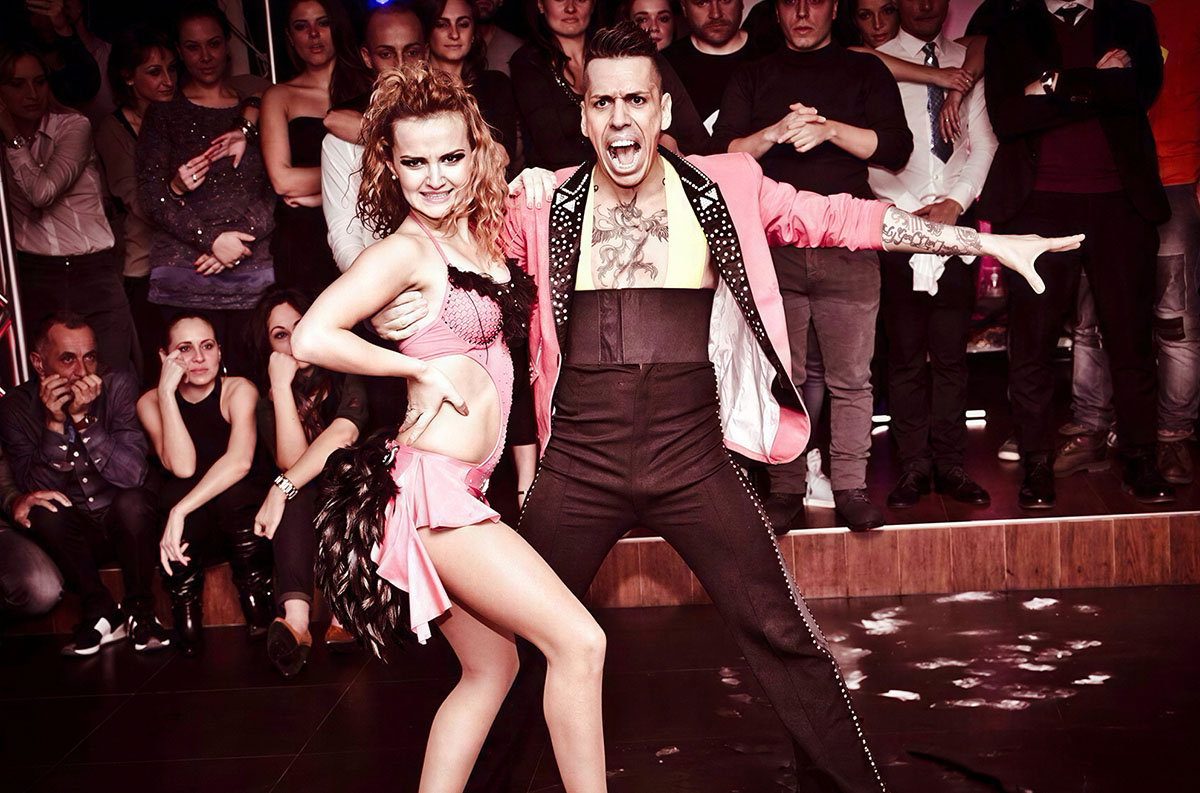
What is LA-Style Salsa?
LA-style salsa is a linear style of salsa dancing popularized in Los Angeles. Partners dance along an imaginary line, known as a slot, rather than continually circling one another. The style is known for its clear cross-body leads, fast turns, sharp musical accents, and, in its more theatrical form, dramatic dips and tricks.
Originally, LA-style salsa had a reputation for being showy, with flashy moves and large tricks. The Vazquez brothers, Luis, Francisco, and Johnny Vazquez, were central pioneers of this approach during the 1990s, alongside other dancers, teachers, teams, and promoters in the Los Angeles salsa scene.
Modern social LA-style salsa is usually less extreme than the performance style that made it famous. Dips, lifts, drops, and acrobatics are not required for social dancing. They should only be attempted with proper training, enough space, and a willing partner.
Basic Steps and Style Hallmarks
The defining spatial feature of LA-style salsa is the slot. This is an imaginary line along which the partners move back and forth. One partner travels through the slot while the other opens a path, redirects the movement, and returns to the line.
The cross-body lead is one of its most important movements. The leader opens the slot and guides the follower forward past them. By the end of the pattern, the partners have exchanged places and are facing one another from opposite ends of the line.
Other common movements include right and left turns, inside and outside turns, changes of place, and shines. Shines are short solo footwork sequences performed when the partners separate before reconnecting.
The historical LA look adds a sharper and more expansive quality to these fundamentals. Dancers may respond to musical accents with sudden stops, spins, body rolls, dips, or changes in direction. In performance routines, these movements can be extended into lifts, drops, and acrobatics.
How LA-Style Salsa Developed
LA-style salsa did not appear from nothing during the 1990s. Mambo had already reached Los Angeles during the mambo craze of the 1950s. Los Angeles dancers were also exposed to the theatrical mambo seen in Mexican films such as Al Son del Mambo and La Reina del Mambo. Their large movements and dramatic presentation offered a different model from purely social nightclub dancing.
During the 1990s, the Vazquez brothers helped turn these influences into the style most dancers recognize today. Their dancing combined fast footwork, spins, hand patterns, dips, theatrical presentation, and acrobatics.
The brothers were important pioneers, but LA style was created by a wider dance scene. Teachers, choreographers, partners, dance teams, and promoters all contributed to its development. Groups such as Los Rumberos and Salsa Brava helped establish its performance identity.
Promoter Albert Torres also helped introduce LA dancers to an international audience through salsa congresses. Instructors and dance teams then spread the style through workshops, festivals, performance tours, videos, and eventually online teaching.
Is LA-Style Salsa the Same as Salsa On1?
LA style and Salsa On1 are often used as if they mean exactly the same thing, but there is a useful distinction.
On1 describes the timing. Salsa music is commonly counted in an eight-count phrase. On1 dancers normally step on counts 1-2-3, take no full step on count 4, then step on 5-6-7 and take no full step on count 8.
A break step is the step where a dancer changes direction. In a common On1 basic, the dancers change direction on count 1 and again on count 5.
LA style describes the dance’s linear structure and historical Los Angeles styling. Cuban and Colombian dancers may also dance On1 without dancing LA style. Likewise, a dancer could use LA-influenced turns or styling while dancing to a different timing.
Many beginners find On1 easier to hear because the first beat often marks a clear start to the musical phrase. However, On1 is not simply the beginner version of salsa, and On2 is not automatically more advanced. Both timings can be danced socially at a very high level.
Because linear On1 dancing is now taught in many places, dancers often use “LA style” as a convenient name for almost any linear salsa danced On1, even when it does not include the dramatic styling associated with the original Los Angeles performance style.
LA-Style Salsa vs New York-Style Salsa
LA-style and New York-style salsa are both linear dances. Both use a slot, cross-body leads, turns, and patterns in which the partners exchange places.
The clearest difference is timing. LA style is usually danced On1, with the break steps occurring on counts 1 and 5. New York style is usually danced On2, with its break steps occurring on counts 2 and 6.
Their historical styling also tends to differ. Classic LA style is often sharper, larger, and more theatrical, with strong responses to musical accents and more space for dramatic tricks. New York style is often smoother and more compact, with intricate turn patterns and a close historical relationship to mambo.
These are tendencies rather than strict rules. Modern dancers frequently borrow movements and styling from both traditions, and a dancer’s timing cannot always be identified simply by looking at their styling.
Neither timing is better. The best choice depends on what the dancers hear in the music, what they have learned, and what feels comfortable with their partner.
LA-Style Salsa vs Cuban Salsa
LA-style salsa and Cuban salsa, more precisely called Casino, can both be danced On1. However, they organize the partnership and use the dance floor differently.
LA-style partners move back and forth along a slot, repeatedly exchanging places through cross-body leads and related movements. Casino is more rotational, with the partners walking and turning around one another.
The group form of Casino is called Rueda de Casino. Several couples dance in a circle while a caller announces the next pattern. Some figures include partner changes as part of the group movement.
Modern dancers borrow movements across styles, so one hand pattern or body movement does not always identify the style. The overall pathway remains the clearest clue: LA style travels along a line, while Casino moves through circular or rotational patterns.
Frequently Asked Questions
Is LA-style salsa always danced On1?
LA style is strongly associated with On1, and that is what most dancers mean when they use the term. However, timing and style are separate ideas. A dancer can use LA-influenced movements while dancing On2, and someone dancing On1 may not use the traditional LA aesthetic.
Is Salsa On1 easier than Salsa On2?
Many beginners find On1 easier to hear at first because beat 1 often provides a clear starting point. The movements are not automatically easier, though, and advanced On1 dancing can be extremely technical. The two timings simply organize the musical phrase differently.
Do I need to learn dips and tricks?
No. Dips, drops, lifts, and acrobatics are part of the performance history of LA style, not a requirement for social dancing. Good timing, comfortable connection, safe turns, and control of the slot are much more important.
What are salsa shines?
Shines are solo footwork sequences. The partners separate briefly, dance individual steps and styling, and then reconnect.
We hope this helped increase your knowledge about LA-style salsa! Learn more about the other different styles of salsa dancing.
References
- Melissa Hurtado. “Los Angeles Salsa.” U.S. National Park Service. 2023. https://www.nps.gov/articles/000/los-angeles-salsa.htm
- Juliet McMains. Spinning Mambo into Salsa: Caribbean Dance in Global Commerce. Oxford University Press. 2015. https://academic.oup.com/book/9865
- Francisco Vazquez. “About Francisco Vazquez.” Los Rumberos Dance Company. https://www.franciscovazquez.org/blank-1
- “Sweeping the World Off Its Feet.” Los Angeles Times. 2000. https://www.latimes.com/archives/la-xpm-2000-nov-15-cl-51864-story.html