
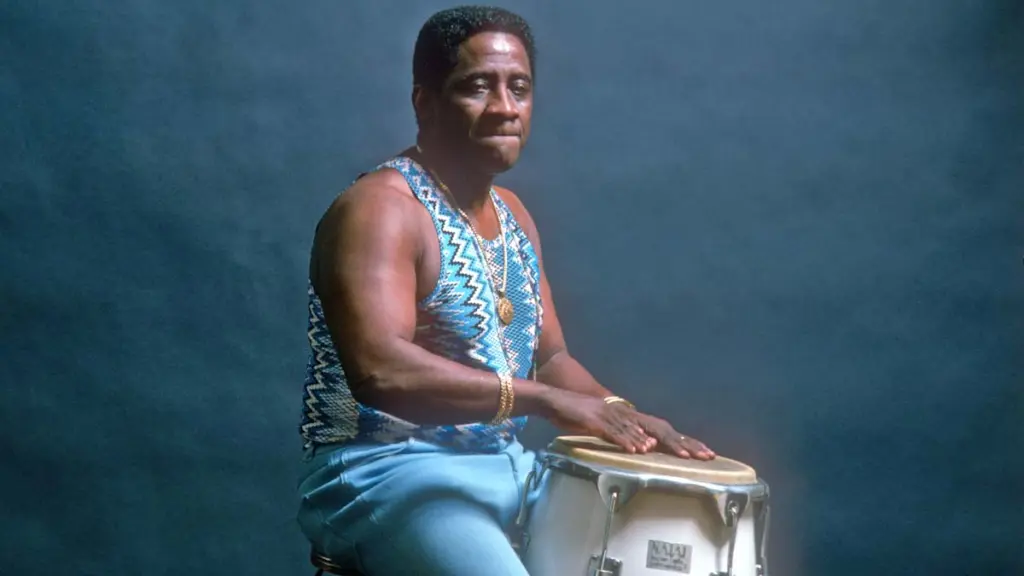
Mongo Santamaría was one of the great ambassadors of Afro-Cuban percussion, a conga player and bandleader who connected Cuban musical traditions with jazz, soul, and popular dance music. His composition “Afro Blue” became a jazz standard, while his hit version of Herbie Hancock’s “Watermelon Man” introduced his rhythmic approach to a much wider audience. His career helps explain the musical crossroads surrounding salsa’s development.
Born in Havana, Santamaría built his experience in Cuban music before working in Mexico and the United States. He played with Tito Puente and became an important member of vibraphonist Cal Tjader’s group, contributing to the development of West Coast Latin jazz. At the same time, his own recordings preserved a strong connection to Afro-Cuban drumming and song.
The late-1950s album Mongo introduced “Afro Blue,” later interpreted by musicians including John Coltrane. “Watermelon Man” brought another kind of breakthrough in 1963: a compact, infectious recording that crossed into the pop charts. Subsequent albums explored soul and rhythm and blues alongside Latin jazz, often with arrangements by trumpeter Marty Sheller.
During the 1970s, recordings for Vaya included Sofrito, an album that balanced contemporary sounds with Santamaría’s deep rhythmic roots. His later work continued to explore Latin jazz rather than settling into a single successful formula.
Santamaría died in 2003. Although much of his catalog belongs to Latin jazz rather than salsa proper, he is essential to understanding the broader music that dancers encounter. His legacy is the conga drum as a leading voice: rooted in Cuban tradition, yet capable of opening conversations across musical genres.