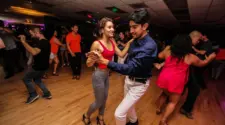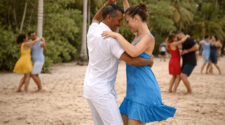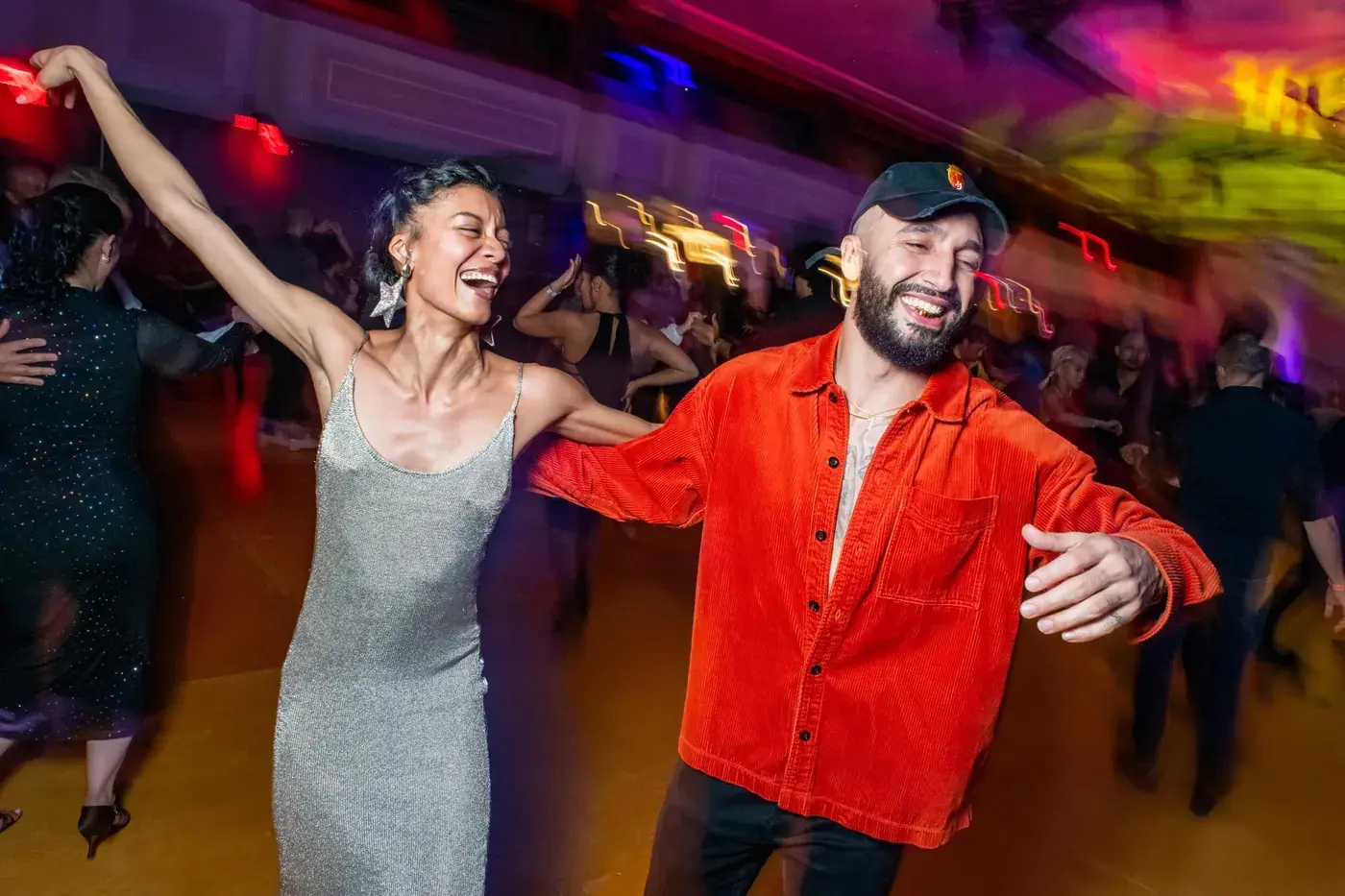
Social partner dances are dances shared by two people primarily for enjoyment, connection, and participation rather than for an audience. From salsa and bachata to swing, tango, and waltz, they span many musical traditions but share the experience of partners moving together to the music.
Unlike a choreographed performance, social partner dancing is usually improvised in the moment. Dancers use familiar steps and patterns to respond to the music, their partner, and the space around them, creating a different dance each time.
Below, we have put together a list of 24 popular partnered social dances, from Latin and swing styles to country and ballroom favorites. It is not an exhaustive list or a strict popularity ranking, since the dances people enjoy vary widely between countries and communities. Instead, it is a starting point for discovering the styles that appeal to you.
Salsa
Salsa is one of the world’s most popular social partner dances, with communities across Latin America, North America, Europe, Asia, and beyond. It draws heavily on Cuban dance and music, with Puerto Rican musicians and dancers also playing an important role in its development, particularly in New York City.
Salsa is known for lively turn patterns, expressive body movement, and playful interaction between partners. Couples can also separate for solo footwork called shines. There are several styles of salsa, including linear New York and LA styles and the more circular patterns of Cuban salsa.
Bachata
Bachata is a partner dance from the Dominican Republic that has developed a large international social dance community. Its music is known for its distinctive guitar sound, while the dancing can feel playful, romantic, or sensual depending on the song and style.
Beginners often start with three steps followed by a tap. Traditional Dominican bachata emphasizes rhythmic footwork and musical play, while modern and sensual styles use more turns and body movement. Bachata is often danced at the same events as salsa; see our guide to the differences between salsa and bachata for a closer comparison.
Brazilian Zouk
Brazilian zouk developed from lambada in Brazil during the 1990s as dancers adapted their movement to Caribbean zouk music. It later expanded to pop, R&B, and other music while developing its own international social dance community.
The dance is known for flowing movement, turns, body waves, and connections that shift between close and expansive. More advanced dancing can include characteristic head movements and off-axis positions, but these build on a foundation of balance, connection, and controlled movement.
Kizomba
Kizomba is a partner dance from Angola with roots in semba, an older Angolan music and dance tradition. Although kizomba is often included at Latin dance events, its origins are African rather than Latin American.
It is known for close connection, grounded walking steps, and subtle changes of direction, with much of the dance built around how the partners move together with the music. The related style urban kiz developed internationally and uses different movement and musical conventions, so the two names are not interchangeable.
Cha Cha
Cha cha, also called cha-cha-chá, developed in Cuba in the 1950s. It is both a Latin social dance and a ballroom dance, with different approaches to styling and technique in each setting.
Its signature feature is the quick triple step that gives the dance its familiar cha-cha-cha rhythm. Cha cha sometimes appears alongside salsa at Latin socials, and salsa dancers may recognize some of its turn patterns, although cha cha has its own timing and musical character.
Cumbia
Cumbia originated in Colombia and spread throughout Latin America, developing distinctive regional forms along the way. It is an important part of social dancing in Mexico and many other Latin American communities, especially at parties, weddings, and live music events.
The partner dancing seen at a Mexican cumbia party can look quite different from traditional Colombian folkloric cumbia. Depending on the local style, couples use relaxed rocking steps, turns, and changes between moving together and apart. Cumbia is often learned socially through friends and family as well as in dance classes.
Merengue
Merengue is a lively Dominican partner dance and a familiar part of Latin parties and celebrations. Its steady pulse gives dancers a clear rhythm to follow, while the music can range from relaxed to highly energetic.
The basic movement involves shifting weight from one foot to the other, almost like walking in place. Hip movement develops naturally from these weight changes, while partners can add turns, travel, and changing handholds without abandoning the underlying step.
Argentine Tango
Argentine tango developed in the Río de la Plata region, particularly Buenos Aires in Argentina and Montevideo in Uruguay. Despite its dramatic image in films and stage shows, social tango is often an intimate conversation built around walking, pauses, musical interpretation, and connection.
Partners generally improvise rather than follow a fixed routine, using an embrace that can be close or more open. Tango socials are called milongas and have their own traditions for sharing the floor and inviting partners to dance. Ballroom tango is related but has different technique and conventions.
West Coast Swing
West Coast Swing is an American swing dance known for smooth movement and an elastic connection between partners. It developed from earlier swing dancing but has a different look and musical range from Lindy Hop and East Coast Swing.
Partners generally dance along a narrow line called a slot, moving toward and away from each other while both dancers interpret the rhythm. West Coast Swing is now danced to blues, R&B, pop, and many other contemporary styles of music.
East Coast Swing
East Coast Swing is a lively American partner dance commonly taught in social dance and ballroom settings. It developed from the broader swing tradition and shares some of its basic movement with Lindy Hop.
Many classes teach a six-count foundation using two triple steps and a rock step, although a simpler single-step version is also common. Partners move between open and closed positions, adding underarm turns and other playful patterns to swing, rock and roll, and other suitable music.
Lindy Hop
Lindy Hop grew out of African American dance communities in Harlem, New York, during the late 1920s and 1930s. Closely associated with the Savoy Ballroom and swing jazz, it remains a central part of the international swing dance community.
The dance is known for rhythmic creativity and the swingout, a figure that sends partners from a closer position into an open connection. Dancers mix six-count and eight-count patterns and often incorporate Charleston movements. Aerials may appear in performances, but are not required for social Lindy Hop.
Charleston
Charleston is an African American dance that became internationally famous during the 1920s. Although it is often shown as a solo dance, it also has partnered forms that fit naturally into social swing dancing.
Its recognizable movements include swinging legs, kicks, and rhythmic weight changes. Partners can dance facing each other, side by side, or in tandem. In many swing communities, partnered Charleston is mixed with Lindy Hop, especially when dancing to faster swing music.
Blues Dance
Blues dance is a family of African American social dances that developed alongside blues music. It includes solo and partnered traditions, with partnered forms emphasizing rhythm, individual expression, and communication between dancers.
The movement often has a grounded, relaxed quality, but blues dancing is more than simply slow dancing in a close embrace. Depending on the music and tradition, it can be playful, driving, subtle, or expansive, with partners using both open and close positions and responding closely to the music.
Hustle
Hustle, also called Latin hustle, developed in New York during the 1970s, with Puerto Rican young people playing an important role in its early development. It became closely associated with disco and still has an active social dance community.
The dance is known for smooth turns, quick changes of place, and continuously flowing partner patterns. Hustle can be danced to disco, funk, and suitable contemporary music, offering a different musical setting for dancers who enjoy turn-based partner dancing.
Forró
Forró is a Brazilian social dance tradition with roots in the northeast of the country. The word can refer to the dancing, the music, or the gathering itself. Traditional forró music often features accordion, triangle, and a large drum called a zabumba.
Partners often dance in a close embrace using compact steps, turns, and changes of direction. Depending on the style and music, forró can feel relaxed and swaying or quick and rhythmically intricate. It remains an important social tradition in Brazil and has growing communities around the world.
Samba de Gafieira
Samba includes several Brazilian music and dance traditions, but the partner form highlighted here is samba de gafieira. Associated with the social dance halls of Rio de Janeiro, it is distinct from the solo samba commonly seen in Carnival performances.
Samba de gafieira combines close partnership with rhythmic footwork, turns, and playful changes of direction. It is also different from competitive ballroom samba. The two share Brazilian musical roots but developed distinct movement traditions and social settings.
Country Swing
Country swing is a broad label for partner dancing commonly seen in country bars and dance halls. There is no single approach used everywhere, but many versions emphasize underarm turns, wrapped positions, and combinations that flow from one movement into the next.
Unlike country two-step, country swing is generally danced in a smaller area instead of continuously traveling around the room. Dramatic dips and lifts sometimes appear in performances and online videos, but ordinary social dancing can be built around simple turns and partner connection.
Country Two-Step
Country two-step is a traveling partner dance associated with American country music and country-western dance halls. Couples move around the floor together, generally following a counterclockwise direction rather than staying in one small area.
A common basic rhythm is quick-quick-slow-slow. Walking steps provide the foundation while turns and changing partner positions add variety. Despite the similar names, it is different from nightclub two-step, which is usually danced to slower music, and country swing, which tends to stay in a smaller area.
Nightclub Two-Step
Nightclub two-step is a smooth partner dance developed by American dancer Buddy Schwimmer in the 1960s. It was designed for slower popular music, making it well suited to ballads that do not naturally fit faster social dances.
The dance uses side steps and rock steps to create a relaxed, flowing movement, with turns and changes of position added between partners. Despite its name, it is different from country two-step, which generally travels more continuously around the floor.
Banda Dancing
Banda dancing is a broad term for partner dancing to Mexican banda music, known for its prominent brass and percussion. It is a familiar part of parties, weddings, and live music events in Mexican and Mexican American communities rather than one standardized dance style.
Couples may use compact steps, turns, and bouncing or traveling movements depending on the song and local tradition. Because banda groups perform several rhythms, the dancing can overlap with styles such as cumbia and waltz. More acrobatic forms such as quebradita may also appear.
Waltz
Waltz is one of the most recognizable partner dances, known for its turning movement and three-beat rhythm: one-two-three, one-two-three. It became a major European social dance during the nineteenth century and remains part of ballroom dancing, weddings, and community dance events.
Waltz is actually a family of dances. Slow waltz has a flowing, measured quality, while Viennese waltz turns much faster around the floor. Country waltz and cross-step waltz offer other approaches to the same three-beat musical structure.
Foxtrot
Foxtrot is an American partner dance that became popular in the 1910s. It is associated with smooth traveling movement and the sound of jazz, big bands, and classic popular singers.
The dance combines slow and quick walking steps with turns and changes of direction. Social versions can be danced without the more demanding technique of competitive slow foxtrot. Compared with waltz, foxtrot uses a four-beat musical structure and has a more walking-based feel.
Rumba
Rumba, sometimes spelled rhumba, can refer to several different dance traditions. For this list, we are focusing on social ballroom rumba, which developed internationally from Cuban musical and dance influences.
Ballroom rumba is a slow, expressive partner dance built around controlled weight changes, hip movement, and connection. American and International styles use different basic structures and timing. Both are distinct from the Afro-Cuban rumba traditions of guaguancó, yambú, and columbia.
Polka
Polka is a lively partner dance that originated in Bohemia, now part of the Czech Republic, during the nineteenth century. It spread widely across Europe and the Americas and remains part of many community celebrations and dance traditions.
The basic movement has a skipping or springing quality, with couples often turning as they travel around the floor. Regional versions vary, and polka can still be encountered at folk events, weddings, cultural festivals, and some country-western dances.
Social Dance FAQ
What is social dancing?
Social partner dancing is dancing with another person primarily for enjoyment, connection, and participation rather than for an audience or competition. Partners usually improvise using familiar steps and patterns while responding to each other and the music. Salsa, bachata, swing, tango, and waltz are all examples of social partner dances.
What is the most popular social dance?
Salsa is the most popular partnered social dance in the world, with established communities across Latin America, North America, Europe, Asia, and beyond. Other widely popular social dances include bachata, cumbia, swing, and tango.
What is the easiest social dance for beginners?
Merengue is a good starting point because its basic step follows a steady walking rhythm. Basic bachata, beginner swing, and simple social foxtrot can also be approachable. The best choice is usually a dance whose music you enjoy and that you have opportunities to practice socially.
Do you need a partner to learn social dancing?
Not necessarily. Many beginner partner dance classes welcome individuals and rotate partners, although policies vary. You can also practice rhythm, balance, and basic steps on your own. Check whether a particular class requires you to register with a partner before attending.
What is the difference between social dancing and performance dancing?
Social dancing is primarily participatory: people dance with one another for enjoyment, connection, and the music, usually improvising rather than following a fixed routine. Performance dancing is created primarily for an audience and is often rehearsed or choreographed in advance. The same dance can exist in both settings; salsa, tango, swing, and many other social dances can also be performed on stage.
And that is our list of 24 popular social dances! Whether you prefer the energy of salsa and swing, the close connection of tango and kizomba, or the flowing movement of waltz and foxtrot, there are many ways to enjoy dancing with a partner. Explore Dancepedia to discover more dance styles, and let us know in the comments which social dances you enjoy most!