
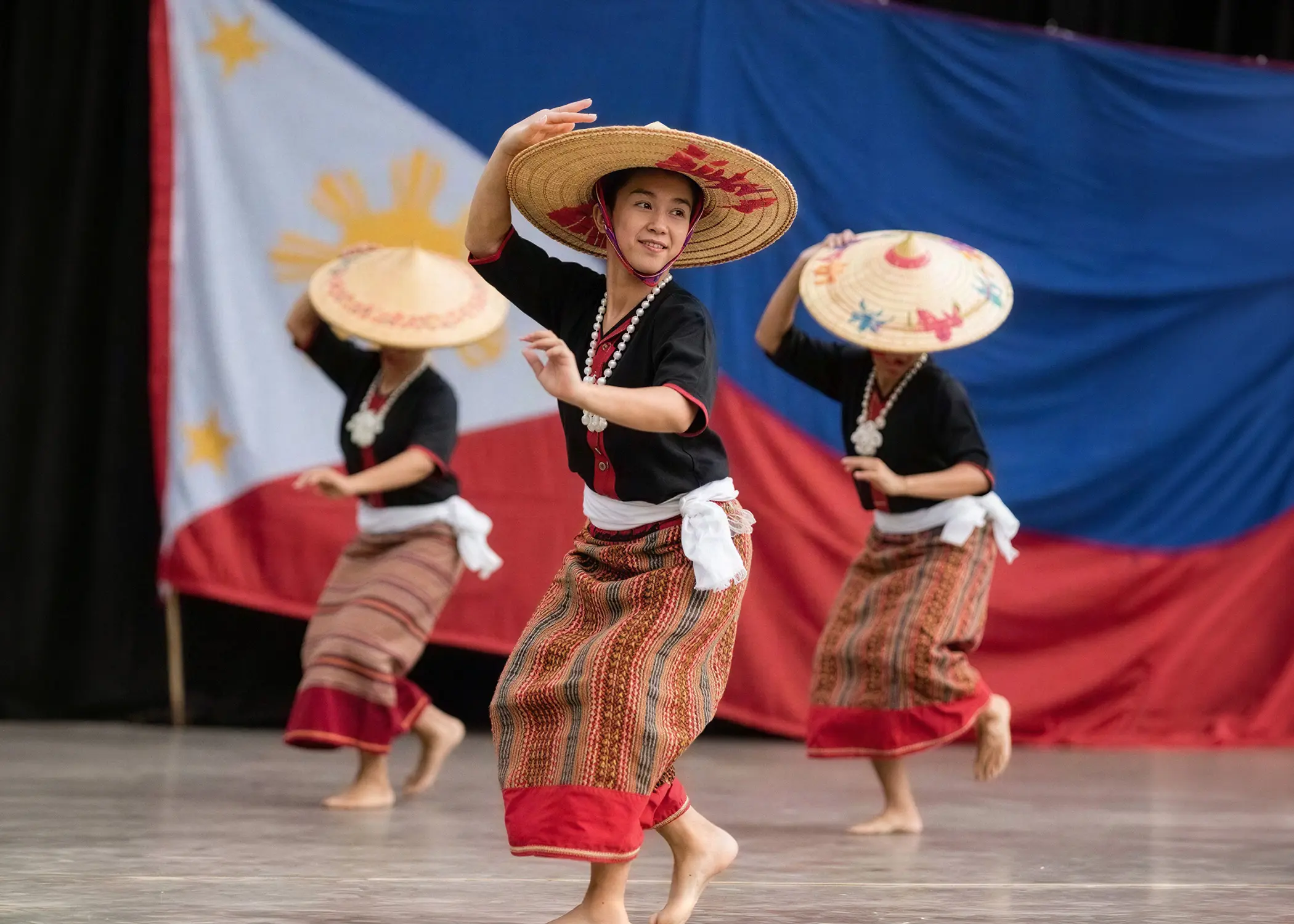
The Philippines is home to many distinct communities, and its dances reflect that diversity. Indigenous traditions sit alongside forms shaped by wider Southeast Asian connections and European influences. Some dances belong to weddings, harvest celebrations, or religious observances, while others are especially familiar through schools and the stage.
This guide explores 40 Filipino folk dances and dance traditions, grouped by region and cultural background, with videos to help you see each one in action. Some names cover a family of local versions rather than one fixed routine. You’ll find the origins, recognizable movements, and cultural setting of each dance, offering a starting point for exploring the country’s varied dance traditions.
Village, Celebration, and Devotional Dances
This group includes some of the most visually distinctive Philippine folk dances, from bamboo-pole footwork and balancing dances to traditions inspired by animals, agriculture, and religious devotion.
1. Tinikling
Tinikling is one of the most recognizable Philippine folk dances. Associated especially with Leyte in the Visayas, it features dancers stepping and hopping between bamboo poles that are tapped against the ground and snapped together in rhythm.
The movement evokes the nimble tikling bird as dancers weave through the opening, change direction, and turn without getting caught between the poles. The people handling the bamboo are equally important, since their timing creates both the rhythm and the challenge.
2. Pandanggo sa Ilaw
Pandanggo sa Ilaw is a lamp-balancing dance associated with Lubang, Mindoro. Its name means “fandango with lights,” and it belongs to the Philippine pandanggo family, which developed from Spanish-influenced dance traditions.
Dancers traditionally balance three lights, one on the head and one on each hand, while stepping and turning. Unlike Pandanggo Oasiwas, where lamps swing through the air, the visual focus is on keeping the lights steady while moving with control.
3. Itik-Itik
Itik-Itik is a playful dance associated with Surigao in northeastern Mindanao. Its name refers to ducks, and the choreography imitates their short steps, pecking motions, splashing, and fluttering wings.
A popular origin story credits a young dancer named Kanang with improvising ducklike movements during a celebration, although this is better understood as local folklore than a documented moment of invention. Today, Itik-Itik is widely taught and performed in school and cultural programs.
4. Maglalatik
Maglalatik is a lively dance associated with Biñan, Laguna, in which coconut-shell halves are attached to the dancers’ bodies and held in their hands. Performers strike the shells in coordinated patterns while moving through stylized mock-combat figures.
The dance’s familiar story concerns a dispute over latik, a coconut-based food product, followed by reconciliation. Maglalatik is also connected with Biñan celebrations honoring San Isidro Labrador, the patron saint of farmers.
5. Binasuan
Binasuan is a balancing dance from Bayambang, Pangasinan. The performer carries three drinking glasses containing liquid, with one balanced on the head and the others on the palms.
The glasses remain in place as the dancer turns and moves the arms through changing positions, sometimes lowering toward the floor or rolling. Binasuan is associated with festive occasions such as weddings and town celebrations.
6. Sayaw sa Bangko
Sayaw sa Bangko means “dance on a bench.” Associated with Pangasinan, it places a pair of dancers on a narrow raised surface rather than giving them an open dance floor.
The partners step, turn, and exchange positions while maintaining their balance and leaving space for one another. The narrow bench turns otherwise familiar movements into an immediate test of coordination.
7. Sayaw sa Salakot
The hat takes center stage in Sayaw sa Salakot. A salakot is a traditional wide-brimmed hat, often woven from rattan or reeds, that farmers wear for protection while working outdoors. In this dance, that everyday hat becomes the main prop.
Watch how the decorated hats accent the dancers’ graceful movements. They’re part of the choreography as well as the costume, giving this countryside dance its familiar look. It’s a simple idea: take something from daily life and turn it into a celebration.
8. Pandanggo Oasiwas
Pandanggo Oasiwas, also spelled Oasioas, is associated with Lingayen, Pangasinan. Its name refers to swinging, and the dance is traditionally linked to fishermen celebrating a good catch.
Dancers swing lights suspended in cloth, creating arcs through the air. This distinguishes it from Pandanggo sa Ilaw, where the lights are balanced on the dancer’s body.
9. Sakuting
Sakuting is a stick dance associated with Abra in northern Luzon. Dancers strike their sticks together in coordinated patterns, combining rhythmic footwork with a stylized mock fight.
It has traditionally been performed during Christmas celebrations, including visits to homes where spectators may offer gifts or refreshments. The sticks suggest combat while also providing the sharp percussion that drives the dance.
10. Tinolabong
Tinolabong comes from Capiz, particularly Panitan and Loctugan. It imitates the tolabong, a long-necked, long-winged bird commonly described as a heron.
The bird’s posture and broad wings shape the dance’s gestures. Like Itik-Itik, it draws inspiration from birds, but the two dances imitate very different forms of movement.
11. Gaway-Gaway
Gaway-Gaway is associated with Jaro, Leyte, and the harvesting of the gaway root crop. Its movement includes gestures suggesting stalks being pulled from the ground.
Another recognizable feature is siko-siko, or elbow-bumping action. Together, the harvesting gestures and playful elbow movements keep the dance visibly connected to agricultural work.
12. Bulaklakan
You’ll recognize Bulaklakan by its colorful flower arches and garlands. Dancers carry these decorations as they move together, framing their steps with blooms and leaves. The name refers to flowers, and the dance captures the festive spirit of May celebrations.
The flowers also connect the dance with seasonal abundance and community offerings during town fiestas. You may see Bulaklakan at school programs, cultural shows, and folk-dance competitions, where the group’s coordinated movements bring the floral display to life.
13. Tiklos
Tiklos comes from Leyte and celebrates the idea of neighbors helping neighbors. The name refers to a group who share jobs such as clearing land, preparing fields, or building a house. When it’s time for a break, music and dancing give everyone a chance to enjoy being together.
In the commonly taught version, dancers wear working clothes and begin facing their partners. The music is tied to the group’s midday rest and is also used to gather people before work. Knowing that background makes Tiklos easy to appreciate: it’s a dance about the friendships that grow out of pitching in.
14. Sayaw sa Obando
In Obando, Bulacan, dancing is a way to pray. During the town’s May 17–19 festivities, people join Sayaw sa Obando to ask for a child or a spouse, or to give thanks for blessings they’ve received. The celebration honors San Pascual Baylon, Santa Clara, and Nuestra Señora de Salambao.
Farmers and fishermen also join the street dancing to pray for a good harvest. For the people taking part, the steps carry personal hopes and gratitude. That shared sense of faith is at the heart of the tradition.
15. Subli
Subli is a devotional dance and song tradition from Batangas, particularly associated with communities such as Bauan and Alitagtag. It honors the Holy Cross, known locally as the Mahal na Poong Santa Cruz.
Prayer, singing, percussion, and movement belong together in Subli. Men’s bent postures, wooden clappers, bows, and other gestures are recognizable features. Although it also appears in school and cultural performances, its religious and community setting remains central to understanding the tradition.
Courtship and European-Influenced Social Dances
European dance forms were adapted as they entered Philippine social life. The dances below include courtship traditions, regional versions of imported forms, and formal group dances that developed distinct local identities.
16. Cariñosa
Cariñosa is a Philippine courtship dance whose name suggests affection or fondness. It is associated with Spanish-influenced social dancing and has several regional versions.
The dance is especially recognizable for its use of a fan or handkerchief. Partners hide their faces, peek at one another, approach, and retreat, turning small gestures into a playful courtship conversation.
17. Kuratsa
Kuratsa is especially associated with Waray communities in Samar and Leyte. It is a social and courtship dance with an important place in weddings and other community celebrations.
A couple takes the floor while the gathering becomes part of the occasion. In wedding settings, guests may give money as the pair dances, making Kuratsa as much a community tradition as a partner performance.
18. Pantomina
Pantomina is a courtship dance associated with the Bicol region. Often described as a dance of doves, it uses the interaction between partners to suggest attraction, pursuit, and response.
The dance appears at weddings and community celebrations. In Sorsogon, Pantomina sa Tinampo brings the tradition into the streets as part of the Kasanggayahan celebration.
19. Philippine Jota
The Philippine jota is a family of regional dances adapted from the Spanish jota. Different communities developed their own versions, so the name describes more than one choreography.
La Jota Moncadeña, from Moncada, Tarlac, combines Spanish-influenced and Ilocano elements, with bamboo castanets adding rhythmic accents. Other Philippine jotas are associated with places including Manila, Cavite, and Palawan.
20. Habanera Botoleña
Habanera Botoleña is a regional partner dance associated with Botolan, Zambales. It belongs to the European-influenced Philippine social repertoire and is performed at occasions such as weddings.
Its focus is the couple and their social interaction, offering a contrast to the prop-based and more theatrical dances found elsewhere in Philippine folk repertoire.
21. Surtido
Surtido means “assortment,” an apt name for a dance built from a mixture of figures and formations. Philippine versions bring couples together in an organized group rather than focusing on a single pair.
Its changing floor patterns recall European quadrilles, with dancers moving through coordinated formations as relationships within the group shift.
22. Polkabal
Polkabal is a Philippine social dance combining elements of the polka and balse, or waltz. A documented version comes from Atimonan, Quezon, while other regional versions also exist.
Its name reflects that mixed inheritance. Rather than preserving an imported form unchanged, local dancers combined established European-derived steps into a distinctly Philippine dance.
23. Rigodon de Honor
Rigodon de Honor is a formal group dance associated with grand social gatherings and balls in the Philippines. Couples participate in an arranged sequence rather than dancing independently.
Formal dress, orderly formations, and ceremonial presentation are central to its character. One documented setting is the annual El Círculo Fernandino reception in San Fernando, Pampanga.
24. Mazurka Boholana
Mazurka Boholana is a regional Philippine adaptation of the mazurka associated with Bohol. It belongs to the European-influenced social repertoire while incorporating its own local combination of steps.
The dance brings together mazurka, redoba, and sangig movements. Like Polkabal, it shows how European-derived dance forms were reshaped through regional Philippine traditions.
Cordillera and Northern Highland Dances
The Cordillera is home to distinct communities with their own dance traditions. These examples from Kalinga and Benguet include pot balancing, communal circles, courtship, gong accompaniment, and bird-inspired movement.
25. Banga
Banga is a Kalinga-inspired pot-balancing dance named for the earthenware vessels carried by the performers. Its imagery draws on women transporting water in pots balanced on their heads.
In familiar staged versions, dancers step and change position while maintaining steady posture beneath the pots. Some choreographies stack several vessels, expanding everyday water-carrying imagery into a demanding folk performance.
26. Ragragsakan
The baskets are the first thing you’ll notice in Ragragsakan. Women balance woven labba baskets on their heads, echoing the way supplies are carried along narrow rice-terrace paths. The dance is associated with Lubuagan, Kalinga, and takes its name from an Ilocano word for merrymaking.
Woven blankets and short saldumay songs also form part of the performance, adding to its celebratory feel. Like Banga, Ragragsakan turns everyday balancing skills into dance. Here, the baskets and the women moving together offer a glimpse of the work and togetherness behind a community celebration.
27. Bendian
Bendian, also written Bendayan, is a group dance associated with Benguet, particularly Ibaloi communities. Large circles of dancers move together, making collective participation one of its most recognizable features.
Historically associated with community rites and celebrations, Bendian also appears in contemporary cultural gatherings. Coordinated steps and arm positions emphasize the relationship between the individual dancer and the wider group.
28. Salidsid
Salidsid (also known as Salip) is a Kalinga courtship dance commonly performed by a pair. The man’s movements are associated with a rooster approaching a hen, represented by the woman.
The dancers’ exchanges suggest attention, attraction, and response, using bird imagery to give the courtship a recognizable dramatic shape.
29. Tachok / Lumagen
Tachok, also presented as Lumagen in folk-dance repertoire, is a Kalinga celebratory dance associated with gong accompaniment. Its outstretched arms evoke birds in flight.
The dance is linked with joyful community occasions, including weddings and other important gatherings, combining measured footwork and open arm positions with the sound of gongs.
30. Tarektek
Tarektek is a bird-inspired courtship dance from Benguet, associated with Ibaloi and Kankanaey communities. The name refers to a woodpecker, and the dance turns competing displays of attraction into a small drama.
In a version documented by the Ramon Obusan Folkloric Group, two male birds attract attention in different ways: one sounds a brass gong while the other displays a colorful blanket like feathers. The props make the courtship story easy to follow without spoken dialogue.
Maranao, Maguindanaon, Tausug, and Sama Dances
Across Mindanao and the Sulu and Tawi-Tawi archipelagos, distinct communities have developed a wide range of dance traditions. The examples below include Maranao bamboo-pole and fan choreography, Tausug and Sama hand movements, and the forceful warrior imagery of Sagayan.
31. Singkil
Singkil is a Maranao dance associated with the Lake Lanao region. In its familiar theatrical form, a principal dancer moves through opening and closing bamboo poles while maintaining a poised upper body and manipulating fans.
The widely known prince-and-princess presentation developed through theatrical adaptations, notably by Bayanihan, drawing on the Darangen epic. Singkil shares bamboo poles with Tinikling, but the dances have different cultural settings, movement traditions, and stage histories.
32. Pangalay
Pangalay is associated especially with Tausug communities in the Sulu Archipelago. It is recognizable for sustained arm movements, articulated wrists, and expressive hands and fingers.
Long metal fingernail extensions called janggay are sometimes worn to extend the hand gestures, although they do not define the tradition. Pangalay is danced at weddings and community celebrations as well as in contemporary teaching and performance.
33. Igal
Igal is a dance tradition of Sama communities, including those in Tawi-Tawi. It is related to Pangalay, but has its own terminology, movement practices, and community identity.
Documented movements include limbai, an undulating arm action associated with swaying palm fronds, and ingsud-ingsud, a sideward shuffling action of the feet. Igal is best understood as a living tradition with local variation rather than one fixed choreography.
34. Sagayan
Sagayan is a vigorous dance associated with Maguindanaon and Maranao traditions. A performer carrying a shield and sword creates the image of a warrior through forceful gestures and dynamic changes of position.
Its martial appearance is only part of its meaning. In Maguindanaon ritual contexts, Sagayan can serve a protective role connected with confronting harmful spirits, giving the movement significance beyond a staged battle.
35. Kapa Malong-Malong
Kapa Malong-Malong, also spelled Kappa Malong-Malong, is a dance from Mindanao folk repertoire built around the malong, a tubular cloth garment.
Dancers demonstrate different ways of wearing and using the fabric, turning the malong from a costume into the central subject of the choreography.
36. Asik
Asik, also encountered as Mag-asik, is associated with Maguindanaon dance traditions. In staged folk repertoire, it is often presented as a solo featuring small, stylized, doll-like movements.
Controlled gestures and changes of pose create the character rather than large traveling patterns. Stage programs sometimes frame the performer as an entertainer dancing before a person of rank.
37. Pagapir
Pagapir, also called Kapagapir, is a Maranao fan dance associated with the Lake Lanao area. It combines controlled handling of the apir, or fan, with small steps known as kini-kini.
The fans extend the shape of the dancer’s arms while measured footwork supports a composed presentation. Fans also appear in theatrical versions of Singkil, but Pagapir places the fan gestures and manner of walking at the center of the dance.
Indigenous Traditions of Panay and Upland Mindanao
Our final group includes Panay Bukidnon, Talaandig, and T’boli traditions. Bird imagery, agriculture, community life, and relationships with the spiritual world give these dances their distinct meanings.
38. Binanog
Binanog is a bird-inspired dance tradition associated with the Panay Bukidnon people of Panay. The version featured here draws on the movement of a bird of prey, often described as a hawk or eagle.
Extended arms suggest wings while pulsating movements of the hands and feet create the impression of flight. Compared with the playful duck imagery of Itik-Itik, Binanog uses a different posture and quality of movement to draw from the natural world.
39. Dugso
Dugso is a sacred dance tradition associated with Indigenous communities in Bukidnon. In the Talaandig tradition featured here, rhythmic stamping forms part of a relationship with spirits understood to care for the surrounding environment.
The footfalls have a ritual purpose, awakening or inviting those caretaker spirits. Dugso also appears in folk-dance presentations, but its community and spiritual context remain important to understanding the movement.
40. Kadal Tahaw
Kadal Tahaw is a T’boli dance associated with the tahaw bird. In the cultural account presented by Parangal with T’boli culture bearers, the bird is connected with the planting and harvesting seasons.
The bird marks changes in the agricultural year, connecting the dance with the rhythms of planting, harvesting, and the community’s relationship with the land.
Philippine Folk Dance FAQ
What are Philippine folk dances?
Philippine folk dances are dance traditions associated with the country’s communities, regions, and social life. The term covers courtship, celebration, devotional, and other community dances, as well as staged adaptations of those traditions.
What are some well-known Filipino dances?
Tinikling, Cariñosa, Singkil, Itik-Itik, Maglalatik, and Pandanggo sa Ilaw are familiar examples in Philippine folk-dance teaching and performance. They range from bamboo-pole footwork and courtship gestures to balancing lights and rhythmic coconut-shell percussion.
What is the difference between Tinikling and Singkil?
Tinikling is associated especially with Leyte and uses nimble, bird-inspired footwork between bamboo poles. Singkil is a Maranao dance whose familiar theatrical versions combine bamboo-pole crossings with poised upper-body movement, fans, and a courtly presentation. They share a prop, but not the same cultural background or performance style.
Which Philippine folk dances use props?
Tinikling and Singkil use bamboo poles; Binasuan uses drinking glasses; Pandanggo sa Ilaw and Pandanggo Oasiwas use lights; Maglalatik uses coconut shells; Banga uses earthenware pots; and Sayaw sa Bangko is performed on a bench.
Which Philippine dances are courtship dances?
Examples include Cariñosa, Kuratsa, Pantomina, Salidsid, and Tarektek. They express attraction through forms such as playful concealment, partner exchanges, and bird-inspired displays.
Are all Philippine folk dances Spanish-influenced?
No. Dances such as the Philippine jota, Polkabal, and Mazurka Boholana show European influence, but the country also has distinct Indigenous and wider Southeast Asian dance traditions. Each dance has its own origin and cultural setting.
Are the dances seen on stage the same as those performed in communities?
Not always. Stage versions may shorten a tradition, rearrange its movements, or add new characters. Singkil is a notable example. Community practice and staged folk dance can be related without being identical.
And that’s our roundup of 40 Filipino folk dances! From bamboo-pole footwork and balancing dances to courtship, community celebrations, and sacred traditions, Philippine dance reflects a remarkable range of regional cultures. You can find even more dances in Dancepedia. Let us know what your favorite dance is or if we missed any in the comments!
Leave a comment